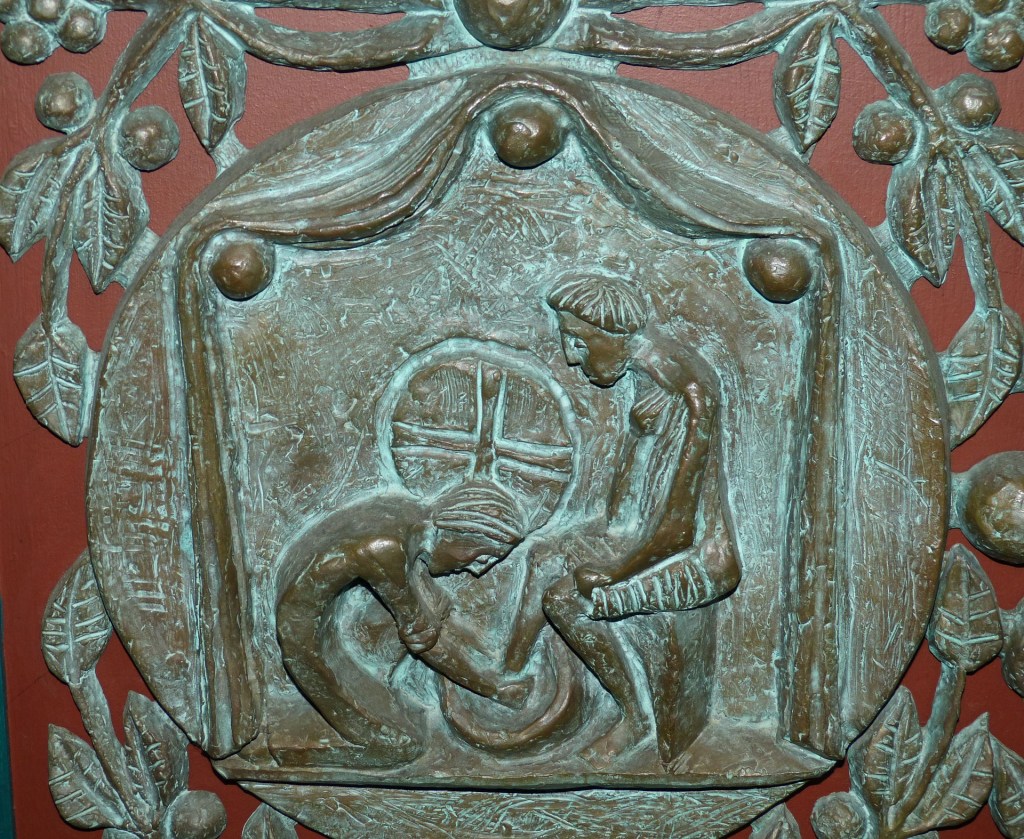
John 13: 1 – 17 Jesus washes his disciples’ feet

<a href="http://Image by <a href="https://pixabay.com/users/falco-81448/?utm_source=link-attribution&utm_medium=referral&utm_campaign=image&utm_content=2293084">falco</a&gt; from <a href="https://pixabay.com/?utm_source=link-attribution&utm_medium=referral&utm_campaign=image&utm_content=2293084">PixabayImage by falco from Pixabay

John 13: 1 – 17 Jesus washes his disciples’ feet

It was just before the Passover Festival. Jesus knew that the hour had come for him to leave this world and go to the Father. Having loved his own who were in the world, he loved them to the end.

The evening meal was in progress, and the devil had already prompted Judas, the son of Simon Iscariot, to betray Jesus. Jesus knew that the Father had put all things under his power, and that he had come from God and was returning to God; so he got up from the meal, took off his outer clothing, and wrapped a towel round his waist. After that, he poured water into a basin and began to wash his disciples’ feet, drying them with the towel that was wrapped round him.

He came to Simon Peter, who said to him, ‘Lord, are you going to wash my feet?’

Jesus replied, ‘You do not realise now what I am doing, but later you will understand.’

‘No,’ said Peter, ‘you shall never wash my feet.’

Jesus answered, ‘Unless I wash you, you have no part with me.’

‘Then, Lord,’ Simon Peter replied, ‘not just my feet but my hands and my head as well!’

Jesus answered, ‘Those who have had a bath need only to wash their feet; their whole body is clean. And you are clean, though not every one of you.’ For he knew who was going to betray him, and that was why he said not everyone was clean.

When he had finished washing their feet, he put on his clothes and returned to his place. ‘Do you understand what I have done for you?’ he asked them. ‘You call me “Teacher” and “Lord”, and rightly so, for that is what I am. Now that I, your Lord and Teacher, have washed your feet, you also should wash one another’s feet. I have set you an example that you should do as I have done for you. Very truly I tell you, no servant is greater than his master, nor is a messenger greater than the one who sent him. Now that you know these things, you will be blessed if you do them.

*       *       *

I wonder why this passage, like the raising of Lazarus, is only recorded in St John’s gospel? I don’t find any of the suggestions that I’ve read very convincing. If you want to read what the synoptic gospels say about the Last Supper, you can read it in Matthew 26: 17 – 30, Mark 14: 12 – 26 and Luke 22: 7 – 38.

However, that doesn’t seem the most important matter for my walk of faith at present. Out of this passage, three things really make an impact.

The first is the obvious one – the story of Jesus washing his disciples’ feet. Not merely does St John tell us what happened, he also tells us the explanation Jesus gave for his actions. Jesus washed the feet of his disciples just as a slave would have done, and he did so to show them what was meant by loving each other.

The second is Peter’s response. He had a deep emotional love for Jesus. The idea that this man he revered so much should act as his slave appalled him. He told Jesus that he wouldn’t allow him to perform so menial a task for him. Jesus rebukes him. There is no anger, merely a statement of fact: ‘Unless I wash you, you have no part with me.’ Peter, in his desire not to see Jesus abase himself has disobeyed him, and shows a fundamental lack of understanding of Jesus’ mission.

Peter realises what he has done, and wants to make amends; above everything, he wants to be a loyal follower of Jesus. ‘Then, Lord,’ Simon Peter replied, ‘not just my feet but my hands and my head as well!’

We have to be obedient to Jesus even when we don’t understand why he wants something; and even when what he is asking for doesn’t feel right. It’s important.

Thirdly, Jesus washes our feet – today! There will be occasions in our life when Jesus will do things for us: to teach us, or to encourage us, or simply out of love for us. He is always our King, our Lord, our Teacher, but he shows us, in practical ways what it means to serve. What a wonderful person to have as our King!

And this leads on directly to the cross. If Jesus taking the role of a slave washing our feet is too much for us to stomach, how can we accept Jesus dying a slave’s death on the cross? How can we say that he did it for us?

Lord Jesus, I am not worthy of such a sacrifice but I thank you and bless you that you made it for me. You are the Son of God.

Prayer

Heavenly Father

Thank you for Jesus’ life, his ministry, and his example. Thank you above all that he died for me. Help me to follow him and obey him. Your kingdom come, on earth as it is in heaven.

Amen

John 12: 37 – 50 Belief and unbelief among the Jews

John 12: 37 – 50 Belief and unbelief among the Jews

Even after Jesus had performed so many signs in their presence, they still would not believe in him. This was to fulfil the word of Isaiah the prophet:

‘Lord, who has believed our message

and to whom has the arm of the

Lord been revealed?’

For this reason they could not believe, because, as Isaiah says elsewhere:

‘He has blinded their eyes

and hardened their hearts,

so they can neither see with their eyes,

nor understand with their hearts,

nor turn – and I would heal them.’

Isaiah said this because he saw Jesus’ glory and spoke about him.

This is a difficult passage to understand. At first reading – and second and third readings, too, in my case – it reads as though God has blinded their eyes and hardened their hearts deliberately.

It has been pointed out that the Jews of Jesus’ day believed very literally that everything was in God’s plan, therefore God must have blinded the eyes and hardened the hearts. That didn’t help me understand this passage very much, so I looked back into Isaiah and read chapters 5 – 7. What I learned by doing that was that this is a prophecy that applies to more than one event.

In Isaiah’s day, the government of the Jewish nation had become corrupt. When God looked for justice, he saw bloodshed; he looked for righteousness, but he heard cries of distress. The rich were greedy and ungodly. This left the nation weak, and facing the potential of invasion from more than one neighbour. The prophecy is not saying that God will harden the heart of the people; it is a figure of speech saying that this is what will happen, indeed it has already happened through the sins of the people.

And it seems to me that exactly the same applies to the passage in St John’s gospel. The leaders of the nation are greedy and ungodly, and therefore their hearts are hardened and their eyes blinded. It was not God who made them so – but St John says that, just as with Isaiah’s prophecy, the Jewish leaders could not accept the prophet’s message because they were steeped in corruption.

Yet at the same time many even among the leaders believed in him. But because of the Pharisees they would not openly acknowledge their faith for fear they would be put out of the synagogue; for they loved human praise more than praise from God.

This paragraph shocks and horrifies me. Some of those leaders who believed would have been present in the Great Sanhedrin that condemned Jesus. The most important and significant event in history; the defining moment of God’s plan; and they were on the wrong side.

What an appalling position they put themselves in by loving human praise more than praise from God!

Then Jesus cried out, ‘Whoever believes in me does not believe in me only, but in the one who sent me. The one who looks at me is seeing the one who sent me. I have come into the world as a light, so that no one who believes in me should stay in darkness.

‘If anyone hears my words but does not keep them, I do not judge that person. For I did not come to judge the world, but to save the world. There is a judge for the one who rejects me and does not accept my words; the very words I have spoken will condemn them at the last day. For I did not speak on my own, but the Father who sent me commanded me to say all that I have spoken. I know that his command leads to eternal life. So whatever I say is just what the Father has told me to say.’

This is Jesus’ last public teaching (there was private teaching for the disciples, of course). It’s the same message we’ve been given throughout. We must believe in Jesus, and by doing so we also believe in the one who sent him, the Father. Jesus is the light of the world. Jesus came into the world to save it, not to judge it. Those who reject Jesus, reject the one who sent him, and they will stand condemned by the words he has spoken.

Prayer

Heavenly Father,

Please help me to follow Jesus more faithfully day by day, that I may do your will and fulfil your purpose for me. You want only the best for me, and I trust you.

In Jesus’ name, Amen

Post Script from yesterday

Yesterday I was confronted by some very challenging conclusions:

“Whoever serves me must follow me; and where I am, my servant also will be.

Where is Jesus?

Right where he was in Palestine in the first century AD. He’s with the poor; with the sick; with the lepers; on the cross.

So where do I need to be?

That’s right. With the poor; with the sick; with social outcasts; and, if it comes to it, ready to die for Jesus.

I fall a long way short of that.”

I have thought intensively about that, and prayed about it.

Yes, I’m called to have a passionate concern for the poor, the sick, and social outcasts. Yes, I must be ready to die for Jesus if necessary – not very likely in the UK, of course. But Jesus the King has all sorts of servants, from great spiritual warriors to the spiritual equivalent of cooks, cleaners – and scribes.

Jesus called me to this study because I asked him to draw me closer. When I asked to come closer, he said, “You’re a writer. Write a blog. Don’t worry about readers; you’re writing it for you and me.” Through this discipline, he’s made me confront the challenge of discipleship; he’s drawn me closer which is exactly what I asked for. Thank you, Lord!

So, for the present at least, I’m one of his scribes!

John 12: 20 – 36 Jesus predicts his death

John 12: 20 – 36 Jesus predicts his death

Now there were some Greeks among those who went up to worship at the festival. They came to Philip, who was from Bethsaida in Galilee, with a request. ‘Sir,’ they said, ‘we would like to see Jesus.’ Philip went to tell Andrew; Andrew and Philip in turn told Jesus.

Jesus replied, ‘The hour has come for the Son of Man to be glorified. Very truly I tell you, unless a grain of wheat falls to the ground and dies, it remains only a single seed. But if it dies, it produces many seeds. Anyone who loves their life will lose it, while anyone who hates their life in this world will keep it for eternal life. Whoever serves me must follow me; and where I am, my servant also will be. My Father will honour the one who serves me.

‘Now my soul is troubled, and what shall I say? “Father, save me from this hour”? No, it was for this very reason that I came to this hour. Father, glorify your name!’

Then a voice came from heaven, ‘I have glorified it, and will glorify it again.’ The crowd that was there and heard it said it had thundered; others said an angel had spoken to him.

Jesus said, ‘This voice was for your benefit, not mine. Now is the time for judgment on this world; now the prince of this world will be driven out. And I, when I am lifted up from the earth, will draw all people to myself.’ He said this to show the kind of death he was going to die.

The crowd spoke up, ‘We have heard from the Law that the Messiah will remain for ever, so how can you say, “The Son of Man must be lifted up”? Who is this “Son of Man”?’

Then Jesus told them, ‘You are going to have the light just a little while longer. Walk while you have the light, before darkness overtakes you. Whoever walks in the dark does not know where they are going. Believe in the light while you have the light, so that you may become children of light.’ When he had finished speaking, Jesus left and hid himself from them.

There are things that puzzle me about this story.

Some Greeks approach Philip because they want to see Jesus. Well, that makes sense. Don’t interrupt the rabbi; approach one of his disciples who will know when would be the best time for them to meet Jesus. That’s both sensible and polite. But Philip seems taken aback, and goes to see Andrew.

Perhaps Andrew was closer to Jesus than Philip; that would account for it. Andrew and Philip go together to Jesus. OK. Not extraordinary. But what puzzles me is why include such a trivial detail as the way the approach was made? At the time he completed his gospel, St John had been mulling over the spiritual significance of Jesus’ ministry for perhaps 60 years. What’s the significance of this? And while I’m in a mood to question, does St John really remember such a tiny detail?

Then, when Philip and Andrew go to Jesus to tell him about the request of the Greeks, Jesus responds with a prophecy of his death. Isn’t that a non-sequitur?

I’m sorry, but I have no answers for these questions today. Besides which, there are some very important truths to be confronted in this passage.

Jesus replied, ‘The hour has come for the Son of Man to be glorified. Very truly I tell you, unless a grain of wheat falls to the ground and dies, it remains only a single seed. But if it dies, it produces many seeds.

The primary meaning of this is that Jesus is going to die, and that his death will bring life to many. Will this metaphor of the seed dying extend further, I wonder? The seed dies in this world. The many seeds produced by its death live in this world. God’s plan (insofar as we can guess at it) includes this world. Is Jesus’ death and resurrection primarily to demonstrate that no matter how great the suffering and injustice, God’s plan is victorious even in this sinful world?

Anyone who loves their life will lose it, while anyone who hates their life in this world will keep it for eternal life.

This sounds odd. I mean what a lot of God-given gifts you would hate if you ‘hated your life in this world’. I understand that the Hebrews of Jesus’ day used a figure of speech to express a strong preference. In modern speech, maybe to ‘love your life’ means to neglect the spiritual life; to ‘hate your life in this world’ means to consistently act to strengthen the spiritual in preference to striving for human delights.

But actually, it’s stronger than that, because doing the right thing, following Jesus, will challenge us profoundly, as we see in the next sentence.

Whoever serves me must follow me; and where I am, my servant also will be.

Where is Jesus?

Right where he was in Palestine in the first century AD. He’s with the poor; with the sick; with the lepers; on the cross.

So where do I need to be?

That’s right. With the poor; with the sick; with social outcasts; and, if it comes to it, ready to die for Jesus.

I fall a long way short of that.

My Father will honour the one who serves me.

Prayer

Heavenly Father

I feel very challenged by today’s study. I know I fall far short of what is needed, and I am sorry for that. Please help me to do better.

In Jesus name, Amen

John 12: 12 – 19 Jesus comes to Jerusalem as king

John 12:12 – 19 Jesus comes to Jerusalem as king

The next day the great crowd that had come for the festival heard that Jesus was on his way to Jerusalem. They took palm branches and went out to meet him, shouting,

‘Hosanna!’

‘Blessed is he who comes in the name of the Lord!’

‘Blessed is the king of Israel!’

Jesus found a young donkey and sat upon it, as it is written:

‘Do not be afraid, Daughter Zion;

See, your king is coming

Seated on a donkey’s colt.’

At first his disciples did not understand all this. Only after Jesus was glorified did they realise that these things had been written about him and that these things had been done to him.

Now the crowd that was with him when he called Lazarus from the tomb and raised him from the dead continued to spread the word. Many people, because they had heard that he had performed this sign, went out to meet him. So the Pharisees said to one another, ‘See, this is getting us nowhere. Look how the whole world has gone after him!’

*       *       *

All four gospels include this story, and their descriptions are similar. You can find them at Matthew 21:1 – 11, Mark 11:1 – 11 and Luke 19:28 – 44. The gist of each story is that Jesus entered Jerusalem on a donkey or a colt, and was acclaimed as king of Israel by large crowds. St Matthew and St John record that the entry on a donkey was to fulfil the prophecy of Zechariah (Zechariah 9:9); ‘Do not be afraid, Daughter Zion; See, your king is coming, seated on a donkey’s colt.’

St John provides two other elements:  

  • He mentions that it was the testimony of the witnesses to the resurrection of Lazarus that brought the crowds; and
  • He records the response of the Pharisees to Jesus triumphal entry.

St John’s explanation for the malice of the Pharisees is that they feared a popular religious movement that would provoke Rome. A movement that identified its leader as the Messiah was doubly dangerous; the Messiah was to be king of Israel, and establish the throne of David once more.

They were under no illusions as to what would happen. The Romans would crush them mercilessly. (And they were right, as we know from the way the Romans subsequently dealt with various Jewish uprisings. Eventually Israel was destroyed as a nation state until the 20th century).

But Jesus was not a military leader; he was not someone seeking to overthrow rulers by violence. For his triumphal entry into Jerusalem he signalled as much by choosing to ride a donkey. If he had been a military leader, he would have ridden a horse.

And yet, he was (and is) a king, and he affirms as much.

In Matthew 21:15 – 16 we read: “But when the chief priests and teachers of the law saw the wonderful things he did and the children shouting in the temple courts ‘Hosanna to the Son of David’ they were indignant. ‘Do you hear what these children are saying?’ they asked him. ‘Yes,’ replied Jesus, ‘have you never read “From the lips of children and infants you, Lord, have called forth your praise”?’

In Luke 19:37 – 40 we read: “When he came near the place where the road goes down the Mount of Olives, the whole crowd of disciples began joyfully to praise God in loud voices for all the miracles they had seen: ‘Blessed is the king who comes in the name of the Lord!’ ‘Peace in heaven and glory in the highest!’ Some of the Pharisees in the crowd said to Jesus, ‘Teacher, rebuke your disciples!’ I tell you,’ he replied, ‘if they keep quiet, the stones will cry out.’

And that brings me to the heart of what I need to consider.

What does the kingship of Jesus mean to me?

However Jesus chooses to rule, the essence of kingship is that he rules and I obey. When I don’t obey, I deny him; I turn my face away from him; I step away from him.

I must be obedient to Jesus, because he is the king.

Prayer

Heavenly Father,

Thank you for opening my eyes to the kingship of Jesus. Please help me to be obedient to his will.

In Jesus’ name, Amen

John 12: 1 – 11 Jesus anointed at Bethany

John 12: 1 – 11 Jesus anointed at Bethany

Six days before the Passover, Jesus came to Bethany, where Lazarus lived, whom Jesus had raised from the dead. Here a dinner was given in Jesus’ honour. Martha served, while Lazarus was among those reclining at table with him. Then Mary took about half a litre of pure nard, an expensive perfume; she poured it on Jesus feet and wiped his feet with her hair. And the house was filled with the fragrance of the perfume.

But one of his disciples, Judas Iscariot, who was later to betray him, objected, ‘Why wasn’t this perfume sold and the money given to the poor? It was worth a year’s wages.’ He did not say this because he cared about the poor but because he was a thief; as keeper of the money bag, he used to help himself to what was put into it.

‘Leave her alone,’ Jesus replied. It was intended that she should save this perfume for the day of my burial. You will always have the poor among you, but you will not always have me.’

Meanwhile a large crowd of Jews found out that Jesus was there and came, not only because of him but also to see Lazarus, whom he had raised from the dead. So the chief priests made plans to kill Lazarus as well, for on account of him many of the Jews were going over to Jesus and believing in him.  

I find the story of Mary anointing Jesus’ feet very moving. It’s such a human gesture, arising out of a profound human love. It is an act of adoration; even an act of worship. It is an extravagant, emotional act.

When I was musing on it this morning, I was struck by the contrast between the emotion expressed here and the business-like approach of Judaism. God made a contract with Abraham, and through him with the Jewish people; you can read it in Genesis 17. The Old Testament is full of references to the numerous ways the Israelites broke the terms of the contract, and how, when they did, they were punished. But God always kept the original contract with Abraham, and, indeed, he still does today.

This contractual arrangement seems to me to make the main response to God one of fear. Keep these rules, or else.

Mary, though, responds to Jesus with love, not just with her head, not just with her heart, but with her whole being. I don’t know to what extent the disciples found this behaviour inappropriate; St John says that Judas Iscariot objected for dishonest reasons, but St Matthew says that all the disciples objected. ‘The perfume should have been sold and the money given to the poor,’ they said.

Jesus, however, defends her.

‘Leave her alone,’ Jesus replied. ‘It was intended that she should save this perfume for the day of my burial. You will always have the poor among you, but you will not always have me.’

In other words, it’s absolutely okay to worship like this. Jesus welcomes our adoration, and responds to it with love.

What a wonderful thought that is!

Prayer

Heavenly Father,

Thank you that you call us to worship you with every part of our being, body, mind and spirit. Please accept my worship despite its many imperfections.

In Jesus name, Amen

John 11: 45 – 57 The plot to kill Jesus

John 11: 45 – 57 The plot to kill Jesus

Therefore many of the Jews who had come to visit Mary, and had seen what Jesus did, believed in him. But some of them went to the Pharisees and told them what Jesus had done. Then the chief priests and Pharisees called a meeting of the Sanhedrin.

Why would you not be convinced by the raising of a dead man to life? I suppose there’s always ‘wiggle room’ for disbelief. If you hadn’t been present until after the committal you might think that perhaps Lazarus wasn’t actually dead when he was placed in the tomb. When something conflicts with our world-view, we seize on any details to shore up our position. It’s still commonplace now; look at the prevalence of ‘fake news’.

At all events, the Pharisees were told, and they called a meeting of the Sanhedrin. (In fact, as the Great Sanhedrin sat every day, it would probably be more accurate to say that they raised the subject at a meeting of the Sanhedrin)

‘What are we accomplishing?’ they asked. ‘Here is this man performing many signs. If we let him go on like this, everyone will believe in him, and then the Romans will come and take away both our temple and our nation.’

According to St John, most of the Sanhedrin didn’t know what to do. They knew what the risks were – ‘the Romans will come and take away both our temple and our nation,’ but they didn’t know what to do about it.

Then one of them, named Caiaphas, who was high priest that year, spoke up, ‘You know nothing at all! You do not realise that it is better for you that one man die for the people than that the whole nation perish.’

Those who had been involved in disputes with Jesus would have known of several occasions when attempts had been made to stone him to death. Caiaphas, though, puts it into words. One man must die for the people. If Jesus’ movement got out of hand and became a revolutionary organisation, the Romans would crush them and destroy the nation.

He did not say this on his own, but as high priest that year he prophesied that Jesus would die for the Jewish nation, and not only for that nation but also for the scattered children of God, to bring them together and make them one. So from that day on they plotted to take his life.

St John tells us that what Caiaphas said was prophecy. God was still speaking through his chosen people about his plan for the world. But as well as prophecy, it crystallised the will of the Sanhedrin that Jesus should die. “So from that day on they plotted to take his life.”

Therefore Jesus no longer moved about publicly among the people of Judea. Instead he withdrew to a region near the wilderness, to a village called Ephraim, where he stayed with his disciples.

Jesus’ time had nearly come. He withdraws to Ephraim, not to try to avoid death, but to ensure that the timing of his death is according to God’s plan.  

When it was almost time for the Jewish Passover, many went up from the country to Jerusalem for their ceremonial cleansing before the Passover. They kept looking for Jesus, and as they stood in the temple courts they asked one another, ‘What do you think? Isn’t he coming to the festival at all?’ But the chief priests and the Pharisees had given orders that anyone who found out where Jesus was should report it so that they might arrest him.

Everything is ready. When the time is right Jesus will enter Jerusalem and God’s plan of salvation will reach its climax.

Prayer

Heavenly Father

Thank you for Jesus’ obedience to your plan. Please help me to copy his obedience.

In Jesus name, Amen

John 11: 17 – 44 Jesus raises Lazarus from the dead

John 11: 17 – 44 Jesus raises Lazarus from the dead

On his arrival, Jesus found that Lazarus had already been in the tomb for four days. Now Bethany was less than two miles from Jerusalem, and many Jews had come to Martha and Mary to comfort them in the loss of their brother. When Martha heard that Jesus was coming, she went out to meet him, but Mary stayed at home.

Martha went to meet Jesus, but Mary stayed at home. Did she blame Jesus for not healing her brother? It would have been understandable.

‘Lord,’ Martha said to Jesus, ‘if you had been here, my brother would not have died. But I know that even now God will give you whatever you ask.’

Martha certainly blames Jesus, and says so. But she also feels a desperate hope and, even though Jesus has let her brother die, she feels a tiny trickle of faith.

Jesus said to her, ‘Your brother will rise again.’

This has been a central part of Jesus’ teaching (see, for example John 6: 40). Martha thinks about what Jesus has just said, and then answers in a way which shows that she has remembered his teaching.

Martha answered, ‘I know he will rise again in the resurrection at the last day.’

Jesus said to her, ‘I am the resurrection and the life. The one who believes in me will live, even though they die; and whoever lives by believing in me will never die. Do you believe this?’

Jesus amplifies the teaching, making it clear that belief in him is the way to eternal life. Then he asks Martha whether she truly believes it. This time, she answers not just with her intellectual understanding, but with heart and head and will. She confesses Jesus as Messiah.

‘Yes, Lord,’ she replied, ‘I believe you are the Messiah, the Son of God, who is to come into the world.’

Now she has genuine hope! The trickle of faith has become a stream. She goes home and persuades Mary to come to Jesus.

After she had said this, she went back and called her sister Mary aside. ‘The Teacher is here,’ she said, ‘and is asking for you.’ When Mary heard this, she got up quickly and went to him. Now Jesus had not yet entered the village, but was still at the place where Martha had met him. When the Jews who had been with Mary in the house, comforting her, noticed how quickly she got up and went out, they followed her, supposing she was going to the tomb to mourn there.

When Mary reached the place where Jesus was and saw him, she fell at his feet and said, ‘Lord, if you had been here, my brother would not have died.’

Mary blames Jesus, but her faith in him is unshaken.

When Jesus saw her weeping, and the Jews who had come along with her also weeping, he was deeply moved in spirit and troubled. ‘Where have you laid him?’ he asked.

‘Come and see, Lord,’ they replied.

Jesus wept.

Then the Jews said, ‘See how he loved him!’

Jesus mourned with Mary. He stood alongside her in her grief and wept. He knew there was no need to grieve for Lazarus; he knew what he was going to do; but out of sheer fellow-feeling he weeps with Mary and the mourners. In this, he shows that the Son of Man is fully human, as well as being the Son of God. He experiences our emotions.

But some of them said, ‘Could not he who opened the eyes of the blind man have kept this man from dying?’

Yes, he could, but that was not what God had planned. God’s plan was that the miracle of Lazarus being raised to life should strengthen the faith of the witnesses, especially the twelve disciples who were closest to Jesus and who would need to bear witness to Jesus’ own resurrection.

Jesus, once more deeply moved, came to the tomb. It was a cave with a stone laid across the entrance. ‘Take away the stone,’ he said.

‘But, Lord,’ said Martha, the sister of the dead man, ‘by this time there is a bad odour, for he has been there four days.’

Martha doesn’t know what’s going to happen. She has faith in Jesus, but she also trusts what her senses and her experience tell her. Lazarus has been in the tomb four days. The corpse will be rotting. She makes a very human objection.

Then Jesus said, ‘Did I not tell you that if you believe, you will see the glory of God?’

What authority Jesus must have shown to cause them to open the tomb with no further argument!

So they took away the stone. Then Jesus looked up and said, ‘Father, I thank you that you have heard me. I knew that you always hear me, but I said this for the benefit of the people standing here, that they may believe that you sent me.’

Now Jesus explains to the onlookers why he didn’t heal Lazarus, but let him die. It was so that this great miracle could inspire the witnesses. But as we shall hear tomorrow, it goes further than being a sign to bring people to faith; it’s a cause of division between Jesus and the chief priests and Pharisees, and it is the catalyst that makes Jesus’ death inevitable.

When he had said this, Jesus called in a loud voice, ‘Lazarus, come out!’ The dead man came out, his hands and feet wrapped with strips of linen, and a cloth round his face.

Jesus said to them, ‘Take off the grave clothes and let him go.’

What did Martha and Mary feel, I wonder? Horror? Awe? Terror? Joy? How do we feel when God answers prayer?

*       *       *

This narrative can be looked at as a model of intercessory prayer. When Mary and Martha send a message to Jesus, (John 11: 3) they are praying. They believe that Jesus can heal their brother, and the request that Jesus should heal him is implicit. They are praying in faith, because they have seen Jesus heal people. Despite praying in faith, their prayer doesn’t seem to be answered; Lazarus dies.

But Jesus goes to them, arriving four days after Lazarus has died. “Why didn’t you heal my brother, Lord?”

Jesus teaches Martha by saying, ‘Your brother will rise again.’ And Martha says, “Yes, okay, at the resurrection, at the last day.” She doesn’t say so, but you can imagine her anguished thought, “But that doesn’t give me back my brother.” So Jesus makes it personal. He reminds her of what he has taught many times, that those who believe in him will live, and then asks her if she believes this. And she says, ‘I believe you are the Messiah, the Son of God, who is to come into the world.’

This exchange is emphatically not Jesus testing Martha’s faith. He knows the state of Martha’s faith better than she does. By prompting Martha to confess her faith in him as Messiah, Jesus draws her closer to himself. She knows him better, and she understands the relationship between them better.

She can still make mistakes, though. Her very human response to Jesus’ instruction to take away the stone from the tomb shows that her understanding is still far from perfect. But Jesus is in control now, and, after spelling out his motivation for doing the miracle – that the witnesses may believe that God has sent him – he raises Lazarus from the dead.

I draw three lessons from this account. The first is that God does miracles for his own reasons; we need to align ourselves with his plan if we are to see miracles happen in response to our intercessions. Secondly, an intercession should be a two way process – not just us asking, but us listening to what God has to say to us about our request. Thirdly, provided we approach prayer with a clear understanding that we are to do God’s will rather than that he is to answer what we want, there is no barrier to what Jesus can accomplish.

Prayer

Heavenly Father

Thank you for the love you show in teaching me through prayer. Please help me to put your will first in everything I do.

In Jesus’ name, Amen

John 11: 1 – 16 The death of Lazarus

John 11: 1 – 16 The death of Lazarus

Now a man named Lazarus was ill. He was from Bethany, the village of Mary and her sister Martha. (This Mary, whose brother Lazarus now lay ill, was the same one who poured perfume on the Lord and wiped his feet with her hair.)

So the sisters sent word to Jesus, ‘Lord, the one you love is ill.’

St John makes sure we know who he is talking about. It’s Lazarus, from Bethany, the brother of Martha and Mary. Oh, and that’s the Mary who anointed Jesus with expensive perfume. This is his way of saying, ‘Look, you can check this. This is something that happened to real people, in a real place, and there were witnesses.’

When he heard this, Jesus said, ‘This illness will not end in death. No, it is for God’s glory so that God’s Son may be glorified through it.’

With his crucifixion fast approaching, Jesus is closer to the Father than he’s ever been. He knows what’s going to happen, he knows how it will happen, and he knows why it will happen.

Now Jesus loved Martha and her sister and Lazarus. So when he heard that Lazarus was ill, he stayed where he was two more days, and then he said to his disciples, ‘Let us go back to Judea.’

‘But Rabbi,’ they said, ‘a short while ago the Jews there tried to stone you, and yet you are going back?’

By human wisdom, going back to Judea sounds like a really bad idea. The chief priests and Pharisees have repeatedly tried to stone Jesus; surely he can’t keep on escaping them? And aren’t there other ways Jesus can heal Lazarus?

And, of course, there are. For example, he could heal Lazarus at a distance, as he did the court official’s son. He didn’t do this though. Why not? Because he knew it wasn’t God’s plan. He knew God’s plan was to achieve more than merely preserving Lazarus’ mortal life.

There’s a big lesson here for me. Faced with a decision, I might have a really good plan. It may look very much like the sort of thing Jesus would do. But if it’s my plan and not God’s plan, it’s not going to do God’s work. It seems more and more important for me to listen to Jesus.

A lot of our intercessory prayer is prayed without first seeking God’s will in the situation. It’s a human cry for help. Absolutely nothing wrong with that; it’s what Martha and Mary do. “So the sisters sent word to Jesus, ‘Lord, the one you love is ill.’” But it’s only the start; we have to discover God’s plan for resolving our need; and there’ll be more about that tomorrow

Jesus answered, ‘Are there not twelve hours of daylight? Anyone who walks in the day-time will not stumble, for they see by this world’s light. It is when a person walks at night that they stumble, for they have no light.’

There is a time and place for everything. The light – Jesus – is still in the world, and God’s work must still be done.

After he had said this, he went on to tell them, ‘Our friend Lazarus has fallen asleep; but I am going there to wake him up.’

His disciples replied, ‘Lord, if he sleeps, he will get better.’ Jesus had been speaking of his death, but his disciples thought he meant natural sleep.

So then he told them plainly, ‘Lazarus is dead, and for your sake I am glad I was not there, so that you may believe. But let us go to him.’

Jesus, through his closeness to the Father, knows that God’s plan doesn’t just involve healing Lazarus, or even raising him from the dead – dramatic though those signs are. No, it’s more comprehensive, more caring, than that. And there will be more about that, too, tomorrow!

Then Thomas (also known as Didymus) said to the rest of the disciples, ‘Let us all go, that we may die with him.’

Probably all the disciples were expressing similar sentiments, but St John singles out Thomas. I wonder why?

Prayer

Heavenly Father

Thank you that I can come to you and ask for help. Please teach me how to listen to your reply, and know what I need to do to align myself with your will. Let your will be done.

In Jesus name, Amen.

John 10: 22 – 42 Further conflict over Jesus claims

John 10: 22 – 42 Further conflict over Jesus’ claims

Then came the Festival of Dedication at Jerusalem. It was winter, and Jesus was in the temple courts walking in Solomon’s Colonnade. The Jews who were there gathered round him, saying, ‘How long will you keep us in suspense? If you are the Messiah, tell us plainly.’

Jesus answered, ‘I did tell you, but you did not believe. The works I do in my Father’s name testify about me, but you do not believe because you are not my sheep. My sheep listen to my voice; I know them, and they follow me. I give them eternal life, and they shall never perish; no one will snatch them out of my hand. My Father, who has given them to me, is greater than all; no one can snatch them out of my Father’s hand. I and the Father are one.’

Again his Jewish opponents picked up stones to stone him, but Jesus said to them, ‘I have shown you many good works from the Father. For which of these do you stone me?’

‘We are not stoning you for any good work,’ they replied, ‘but for blasphemy, because you, a mere man, claim to be God.’

Jesus answered them, ‘Is it not written in your Law, “I have said you are ‘gods’”? If he called them “gods” to whom the word of God came – and scripture cannot be set aside – what about the one whom the Father set apart as his very own and sent into the world? Why then do you accuse me of blasphemy because I said “I am God’s Son”? Do not believe me unless I do the works of my Father. But if I do them, even though you do not believe me, believe the works, that you may know and understand that the Father is in me, and I in the Father.’ Again they tried to seize him, but he escaped their grasp.

Then Jesus went back across the Jordan to the place where John had been baptising in the early days. There he stayed, and many people came to him. They said, ‘Though John never performed a sign, all that John said about this man was true.’ And in that place many believed in Jesus.

The Festival of Dedication is more usually known as Hannukah. It celebrates the restoration of temple worship after a period when Antiochus IV had defiled the temple and banned worship there. Jewish military action recaptured Jerusalem and restored temple worship. It is in the context of military action regaining Zion and the temple for the Jews that St John wants us to understand this passage.

‘How long will you keep us in suspense? If you are the Messiah, tell us plainly.’

Hannukah celebrated the rededication of the temple. The Jews of Jesus’ day longed for Israel to be free from Roman rule. Their question means, ‘Tell us whether you’re going to drive out the Romans.’

Jesus has already told them that he is the Son of God, the Messiah, (John 8: 58) and so he answers ‘I did tell you, but you did not believe… I and the Father are one.’  He points out once again, ‘I have shown you many good works from the Father.’

The listeners pick up stones to stone himto stone him for blasphemy. We are not stoning you for any good work,’ they replied, ‘but for blasphemy, because you, a mere man, claim to be God.’

They’re not prepared to listen at all, because Jesus doesn’t match their expectations of the Messiah. If he had been the military ruler they anticipated, his supporters could expect to share in his triumph and his power. The more devout among them could bask in the glow of renewed holiness for Zion, and vindication of their belief in themselves as God’s chosen people.

Jesus, though, is not making any effort to lead an armed insurrection against the Romans, and, perhaps worse that that, he’s making claims that strike right at the source of the authority of the chief priests and Pharisees. He’s claiming to have privileged communication with God.

They misunderstood Jesus’ mission and message, and refused to accept them, despite repeated teaching by Jesus, and despite the signs that Jesus did as proof that he did the will of the Father.

And what were these signs? So far in his gospel St John has listed these:

  • Changed water into wine at the wedding in Cana
  • Prophesied to a Samaritan woman about her history
  • Prophesied his own death and resurrection
  • Healed the son of a royal official
  • Healed a man disabled for 38 years
  • Fed 5000 people on 5 loaves and 2 fish
  • Walked on water
  • Healed a man born blind

I am frequently tempted to choose my actions based on how I perceive my self-interest. I am frequently tempted to want to believe the theology that appeals to me. These are the sins of the chief priests and the Pharisees.

There are two things I must do when faced with these temptations; I must look at the signs Jesus did, and I must seek with all my heart to follow him. I must be ready to be obedient.

Prayer

Heavenly Father

Thank you for Jesus, and thank you for the record of his life in St John’s gospel. Please help me to follow him more closely every day.

In Jesus name, Amen

John 10: 1 – 21 The good shepherd and his sheep

John 10: 1 – 21 The good shepherd and his sheep

‘Very truly I tell you Pharisees, anyone who does not enter the sheepfold by the gate, but climbs in by some other way, is a thief and a robber. The one who enters by the gate is the shepherd of the sheep. The gatekeeper opens the gate for him, and the sheep listen to his voice. He calls his own sheep by name and leads them out. When he has brought out all his own, he goes on ahead of them, and his sheep follow him because they know his voice. But they will never follow a stranger; in fact, they will run away from him because they do not recognise a stranger’s voice.’ Jesus used this figure of speech, but the Pharisees did not understand what he was telling them.

Therefore Jesus said again, ‘Very truly I tell you, I am the gate for the sheep. All who have come before me are thieves and robbers, but the sheep have not listened to them. I am the gate; whoever enters through me will be saved.

It is only through belief in Jesus that we can be saved.

I need to remember that my human wisdom is no better than the wisdom of the Pharisees. Nevertheless, I query that word ‘Saved’. Saved from what? Saved for what? I feel these are important questions, but I also feel that sheep who wander off tend to get lost! I need to be open to hearing what God wants to tell me about these questions, in his time, because he will know when I am capable of understanding what he has to say.

They will come in and go out, and find pasture. The thief comes only to steal and kill and destroy; I have come that they may have life, and have it to the full.

I HAVE COME THAT THEY MAY HAVE LIFE, AND HAVE IT TO THE FULL

This is a promise on which we can rely. All we need to do is listen for our shepherd’s voice and follow him and we will have life in all its fulness.

Personally, I need to listen with expectation. A full life means we can expect to experience the love of God, we can expect to experience joy, we can expect to experience peace. That doesn’t mean we can expect an easy life – far from it – we certainly shouldn’t expect life to be free of difficulties – but if we listen, God will always be there with us; if we turn to him, he will give us joy and peace and love.

‘I am the good shepherd. The good shepherd lays down his life for the sheep.

At the time St John says these words were spoken, the listeners would not have known that Jesus would be crucified. This is prophecy. Jesus laid down his life for us when he was crucified. He knew this terrible thing was coming to him, yet he went on regardless – because he is the good shepherd and we are his sheep.

The hired hand is not the shepherd and does not own the sheep. So when he sees the wolf coming, he abandons the sheep and runs away. Then the wolf attacks the flock and scatters it. The man runs away because he is a hired hand and cares nothing for the sheep.

‘I am the good shepherd; I know my sheep and my sheep know me – just as the Father knows me and I know the Father – and I lay down my life for the sheep.

I have other sheep that are not of this sheepfold. I must bring them also. They too will listen to my voice, and there shall be one flock and one shepherd.

To understand this statement, we need to remember that St John was writing well after Jesus’ death and resurrection, and he’s recounting a debate between Jesus and some Pharisees.

The Pharisees believed you had to be a Jew to be one of God’s chosen. If they understood anything from this statement it was probably that Jesus would unite the Jews of Israel with those of the diaspora (those living overseas, spread across the Roman empire).

St John, though, had seen the good news taken to the Gentiles, and had seen them accepted, not as second-class Jews, but as followers of The Way – Christians, in other words. In this passage, Jesus is prophesying that he was going to lay down his life for all who would accept him.

The reason my Father loves me is that I lay down my life – only to take it up again. No one takes it from me, but I lay it down of my own accord. I have authority to lay it down and authority to take it up again. This command I received from my Father.’

The Jews who heard these words were again divided. Many of them said, ‘He is demon-possessed and raving mad. Why listen to him?’

But others said, ‘These are not the sayings of a man possessed by a demon. Can a demon open the eyes of the blind?’

Again, St John records the division that Jesus’ words caused. Again, he cites the evidence of the healing of the man blind from birth. Jesus couldn’t carry out the healings that he did unless God was with him.

Prayer

Heavenly Father

Thank you that Jesus said “I have come that they may have life, and have it to the full.” Help me to trust in that promise, and to live my life in obedient anticipation of experiencing life in all its fulness.

In Jesus’ name, Amen