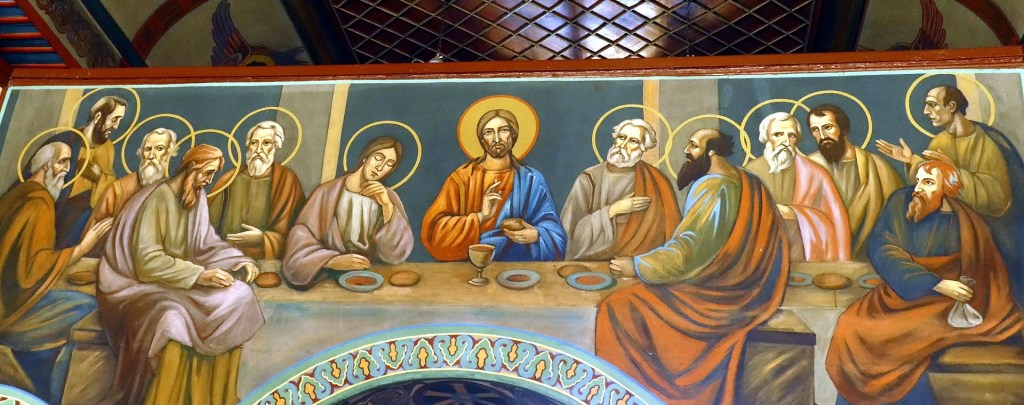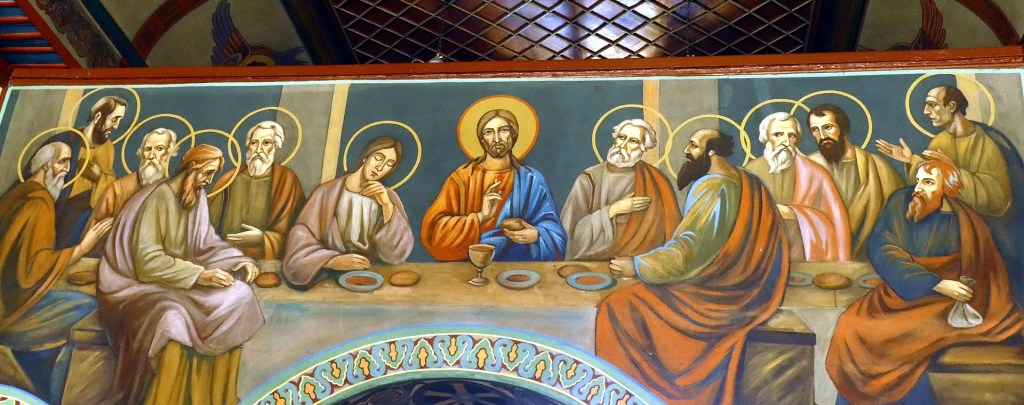
John 17: 6 – 19 Jesus prays for his disciples

John 17: 6 – 19 Jesus prays for his disciples

‘I have revealed you to those whom you gave me out of the world. They were yours; you gave them to me and they have obeyed your word. Now they know that everything you have given me comes from you. For I gave them the words you gave me and they accepted them. They knew with certainty that I came from you, and they believed that you sent me. I pray for them. I am not praying for the world, but for those you have given me, for they are yours. All I have is yours, and all you have is mine. And glory has come to me through them. I will remain in the world no longer, but they are still in the world, and I am coming to you. Holy Father, protect them by the power of your name, the name you gave me, so that they may be one as we are one. While I was with them, I protected them and kept them safe by that name you gave me. None has been lost except the one doomed to destruction so that Scripture would be fulfilled.

‘I am coming to you now, but I say these things while I am still in the world, so that they may have the full measure of my joy within them. I have given them your word and the world has hated them, for they are not of the world any more than I am of the world. My prayer is not that you take them out of the world but that you protect them from the evil one. They are not of the world, even as I am not of it. Sanctify them by the truth; your word is truth. As you sent me into the world, I have sent them into the world. For them I sanctify myself, that they too may be truly sanctified.

*       *       *

This passage is written in the form of a prayer to which the disciples would have listened. It’s perfectly possible that Jesus may have prayed these exact words. However, it’s also quite possible that St John is using a prayer format to express truths that Jesus had expressed and that we need to know. I say “We need to know,” because this passage is written for all subsequent Christians – for us, in other words.

By putting the words into Jesus’ mouth as a prayer to the Father, St John is saying, “This is teaching you can rely on.”

The passage is telling us that we can trust what the disciples tell us, because Jesus says:

  • ‘I have revealed you (the Father) to those whom you gave me out of the world.
  • They were yours; you gave them to me
  • They have obeyed your word.
  • They know that everything you have given me comes from you.
  • I gave them the words you gave me and they accepted them.
  • They knew with certainty that I came from you
  • They believed that you sent me.’

St John is saying that we can trust what the disciples say with as much confidence as we trust what Jesus says. I’m not altogether sure that I feel confident about that. It depends on the reliability of the written texts passed down to us. But, in a sense that doesn’t matter. What matters is that I have confidence that the risen Jesus is with me.

‘My prayer is not that you take them (the disciples) out of the world but that you protect them from the evil one.’

Jesus prays for his disciples, not that they should be taken out of the world, but that the Father will protect them from the evil one. That’s important, and teaches us two things.

The first is that our life in this world is important. God wants us in the world; one could say there’s work to be done here.

Secondly, it suggests that the disciples will continue to be subject to temptation, and will occasionally fail – as indeed we see in Peter’s betrayal. We, too, will remain prone to failure. We, too, need to pray that the Father will protect us from temptation.

Prayer

Heavenly Father

Thank you for the presence of Jesus in my life. Please help me to do your work in this world. Please help me to resist temptation.

In Jesus’ name, Amen
John 17: 1 – 5 Jesus prays to be glorified

John 17: 1 – 5 Jesus prays to be glorified

After Jesus said this, he looked towards heaven and prayed:

‘Father, the hour has come. Glorify your Son, that your Son may glorify you. For you granted him authority over all people that he might give eternal life to all those you have given him. Now this is eternal life: that they know you, the only true God, and Jesus Christ, whom you have sent. I have brought you glory on earth by finishing the work you gave me to do. And now, Father, glorify me in your presence with the glory I had with you before the world began.’

*       *       *

The first thing that strikes me about this passage is that it is different from the synoptic gospels. St Matthew and St Mark don’t mention it at all, while St Luke says, ‘You are those who have stood by me in my trials. And I confer on you a kingdom, just as my Father conferred one on me, so that you may eat and drink at my table in my kingdom and sit on thrones, judging the twelve tribes of Israel.’ (Luke 22: 28 – 30)

I don’t want to consider the detail of St Luke’s version until the next blog post on Monday, as it is more relevant to the next passage for study. However, it has relevance to today’s study in that St Luke and St John agree that at the last supper Jesus spoke about the nature of his kingdom and the place the disciples would hold in it.

‘Father, the hour has come.’

Jesus knows that the forces ruling the temporal world are now going to take their course, and he is going to be crucified, and raised from the dead. Up until this moment Jesus has always been active in the world, and avoided death on several occasions. Now, he is deliberately and formally relinquishing control of his earthly life.

‘Glorify your Son, that your Son may glorify you.’

The synoptic gospels describe Jesus as being deeply troubled in spirit but nevertheless submitting to the will of the Father. St John presents a different view in which Jesus sees beyond the ordeal he faces to the glory that is to come.

‘For you granted him authority over all people’

How gently he has exercised that authority! Think of the wedding at Cana, the way he spoke to the Samaritan woman, the patience he showed to Nicodemus, the way he washed his disciples’ feet. Such gentleness, such love can give us hope for our own lives.

‘Now this is eternal life: that they know you, the only true God, and Jesus Christ, whom you have sent.’

This is a great mystery; one might almost say, the great mystery. I certainly can’t explain it. My personal view of what St John means here is something like “We don’t know the exact nature of heaven, but that’s not really important. If we know the Father, and Jesus, we’re in safe hands. They want the very best for us.”

‘I have brought you glory on earth by finishing the work you gave me to do.’

We might suppose, on the basis of a human timeline, that Jesus’ work is not yet finished, but in one sense it is. Jesus has always surrendered all control of his life to the Father. Everything he has taught, everything he has done, has been in accordance with the will of the Father. And now, for the benefit of the disciples who were listening to the human Jesus, and for us as we read St John’s gospel, Jesus prays and emphasises his total obedience.

We, too, must make that commitment to follow Jesus without reservation – and there will be more about that in Tuesday’s blog.

Prayer

Heavenly Father

Thank you that you glorified Jesus. I give you my life to use as you will; please help me to keep that promise.

In Jesus name, Amen

John 16: 16 – 33 The disciples’ grief will turn to joy

John 16: 16 – 33 The disciples’ grief will turn to joy

Jesus went on to say, ‘In a little while you will see me no more, and then after a little while you will see me.’

At this, some of his disciples said to one another, ‘What does he mean by saying, “In a little while you will see me no more, and then after a little while you will see me,” and “Because I am going to the Father”?’ They kept asking, ‘What does he mean by “a little while”? We don’t understand what he is saying.’

Jesus saw that they wanted to ask him about this, so he said to them, ‘Are you asking one another what I meant when I said, “In a little while you will see me no more, and then after a little while you will see me”? Very truly I tell you, you will weep and mourn while the world rejoices. You will grieve but your grief will turn to joy. A woman giving birth to a child has pain because her time is come; but when her baby is born she forgets the anguish because of her joy that a child is born into the world. So with you; now is your time of grief, but I will see you again and you will rejoice, and no one will take away your joy. In that day you will no longer ask me anything. Very truly I tell you, my Father will give you whatever you ask in my name. Until now you have not asked for anything in my name. Ask and you will receive, and your joy will be complete.

‘Though I have been speaking figuratively, a time is coming when I will no longer use this kind of language but will tell you plainly about my Father. In that day you will ask in my name. I am not saying that I will ask the Father on your behalf. No, the Father himself loves you because you have loved me and have believed that I came from God. I came from the Father and entered the world; now I am leaving the world and going back to the Father.’

Then Jesus’ disciples said, ‘Now you are speaking clearly and without figures of speech. Now we can see that you know all things and that you do not even need to have anyone ask you questions. This makes us believe that you came from God.’

‘Do you now believe?’ Jesus replied. ‘A time is coming and in fact has come when you will be scattered, each to your own home. You will leave me all alone. Yet I am not alone, for my Father is with me.

‘I have told you these things, so that in me you may have peace. In this world you will have trouble. But take heart! I have overcome the world.’

*       *       *

I started this passage by asking myself why St John had included it. While it seems very relevant to Jesus’ disciples, how is it relevant to me?

St Luke tells us in Luke 22: 24 – 26 tells us that even at the last supper, the disciples had argued about who was going to be the greatest in the coming kingdom. They were thinking of an earthly kingdom. They were confused.

Here, as he teaches them about the Holy Spirit, Jesus tries to make it clearer. Or does he? He continues to speak figuratively and the disciples inevitably misunderstand. Jesus is speaking about a spiritual kingdom; the disciples are still thinking of an earthly one.

At this point, I was suddenly faced with a question.

Does the temporal world matter?

Well, yes it does.

It has been the witness of countless Christians in the temporal world that has drawn people to follow Jesus.

It has been the experience of the human love of my wife, in the temporal world, that has taught me that love was of primary importance.

But, at the same time, the temporal world doesn’t matter. Obedience to Jesus is likely to lead to persecution. If that ends in martyrdom, then the temporal world can be seen to matter not at all.

In the light of what we have seen over nearly 2,000 years of Christianity, we can see that disciples of every generation have needed to take action in the world, while simultaneously knowing that it is the spiritual world that is truly important.

Indeed, God is still working out his plan in the temporal world. It’s got to matter.

That is the message that this passage has brought me today. If I am to follow Jesus, I must be aware of the Holy Spirit’s presence. The Spirit will lead me into truth. I will know what I need to do in this world.

And there is a wonderful promise at the end

‘I have told you these things, so that in me you may have peace. In this world you will have trouble. But take heart! I have overcome the world.’

Prayer

Heavenly Father

Thank you for sending your Holy Spirit to guide us into the truth. Please help me to be obedient to his guidance.

In Jesus’ name, Amen

John 15:26 – 16:15 The work of the Holy Spirit

John 15:26 – 16:15 The work of the Holy Spirit

‘When the Advocate comes, whom I will send to you from the Father – the Spirit of truth who goes out from the Father – he will testify about me. And you also must testify, for you have been with me from the beginning.

‘All this I have told you so that you will not fall away. They will put you out of the synagogue; in fact, the time is coming when anyone who kills you will think they are offering a service to God. They will do such things because they have not known the Father or me. I have told you this, so that when their time comes you will remember that I warned you about them. I did not tell you this from the beginning because I was with you, but now I am going to him who sent me. None of you asks me, “Where are you going?” Rather, you are filled with grief because I have said these things. But very truly I tell you, it is for your good that I am going away. Unless I go away, the Advocate will not come to you; but if I go, I will send him to you. When he comes, he will prove the world to be in the wrong about sin and righteousness and judgment: about sin, because people do not believe in me; about righteousness, because I am going to the Father where you can see me no longer; and about judgment, because the prince of this world now stands condemned.

‘I have much more to say to you, more than you can now bear. But when he, the Spirit of truth, comes, he will guide you into all the truth. He will not speak on his own; he will speak only what he hears, and he will tell you what is yet to come. He will glorify me because it is from me that he will receive what he will make known to you. All that belongs to the Father is mine. That is why I said the Spirit will receive from me what he will make known to you.’

*       *       *

A word of caution to myself before I start. St John’s gospel was written well after the events of Pentecost (see Acts chapter 2), and well after St Paul’s first letter to the Corinthians which describes the gifts of the Spirit (1 Corinthians 12: 1 – 11). St John would have been an eye witness to the events of Pentecost, as well as to the events he’s describing here in his gospel. He would also, surely, be familiar with the way the Holy Spirit was manifested in the worship of the church.

Although the emphasis in John’s gospel is different from Acts and 1 Corinthians, it doesn’t contradict those accounts; it is more an explanation of the significance of the actions of the Spirit.

So, what will the Spirit do?

The Spirit will testify about Jesus (John 15: 26).

And here St John adds “And you also must testify, for you have been with me from the beginning.” (John 15: 27). This is very important. The disciples were eye witnesses of Jesus’ life, his teaching and the signs he worked. Throughout his gospel, St John has been pointing out the human witnesses to Jesus’ work and teaching.

The testimony of human experience is important today as well. Everyone who follows Jesus has a story to tell of their experience of him, and their testimony can change lives. I feel this passage is telling me strongly to be more open about my experience of Jesus.

Jesus then utters prophecy specifically for the disciples: ‘All this I have told you so that you will not fall away. They will put you out of the synagogue; in fact, the time is coming when anyone who kills you will think they are offering a service to God. They will do such things because they have not known the Father or me. I have told you this, so that when their time comes you will remember that I warned you about them. (John 16: 1 – 4)

Is that prophecy just for the disciples, or does it apply to the present day? While we feel safe enough in the West, there are many places in the world where being a Christian brings persecution and even death; North Korea, for example.

The verses that follow (John 16: 5 – 11) are words of consolation; or, perhaps words of explanation; it is easier to bear suffering if we understand why it’s happening. It’s some help even if all we can do is hold on to the knowledge that the suffering was meant to happen. The disciples are starting to understand that Jesus is about to be killed. They’re grieving, frightened and desperately confused. How can the Messiah die? Shouldn’t he be conquering his enemies?

Finally, Jesus explains how the Spirit of truth will work, and it’s in the same way that Jesus himself did during his earthly life. The Father will make the truth known to the Son, Jesus, who will make it known to the Holy Spirit. The Holy Spirit will guide Jesus’ disciples into all the truth.

Prayer

Heavenly Father,

Thank you for the gift of the Holy Spirit. Please open my heart to his guiding so that I may follow Jesus more closely.

In Jesus’ name, Amen

John 15: 18 – 25 The world hates the disciples

John 15: 18 – 25 The world hates the disciples

‘If the world hates you, keep in mind that it hated me first. If you belonged to the world, it would love you as its own. As it is, you do not belong to the world, but I have chosen you out of the world. That is why the world hates you. Remember what I told you: “A servant is not greater than his master.” If they persecuted me, they will persecute you also. If they obeyed my teaching, they will obey yours also. They will treat you this way because of my name, for they do not know the one who sent me. If I had not come and spoken to them, they would not be guilty of sin; but now they have no excuse for their sin. Whoever hates me, hates my Father as well. If I had not done among them the works no one else did, they would not be guilty of sin. As it is, they have seen, and yet they have hated both me and my Father. But this is to fulfil what is written in their Law: “They hated me without reason.”

*       *       *

Before getting into the meat of this passage, let me define the “world” as I think St John is using it here. The “world” is humanity without God. Until we allow God to have control of our lives we will be selfish; in big things, in small things, at the level of nations and at the level of families.

I feel uneasy on two counts as I read this passage from St John’s gospel.

How do some people who are not Christians lead lives which are much more ‘Godly’ than most Christians? I’m going to park this question for another time. I don’t have any answers, and it doesn’t detract from my second question.

Does the world hate me?

The honest answer is that I don’t think so. And yet St John’s gospel suggests that it should.

Why did the world hate Jesus?

St John’s gospel suggests that the reason the chief priests and Pharisees conspired to have Jesus put to death was because he was too popular and might attract the wrath of Rome (John 11: 45 – 53). They were particularly worried by the raising of Lazarus from the dead (John 11: 38 – 44), and Jesus’ triumphal entry into Jerusalem (John 12: 12 – 19).

Added to that, Jesus had driven out officially sanctioned traders from the temple (John 2: 13 – 17). He had deliberately broken the sabbath by healing the sick, and he’d encouraged one of those he’d healed to break it, too (John 5: 8).

He challenged the theology of the chief priests and Pharisees, firstly by breaking the Sabbath (which was a serious offence), and secondly by claiming to be the Son of God, which roused their anger so greatly that they tried to stone him (John 10: 22 – 31).

He challenged their economic system by driving out officially sanctioned traders from the temple.

He challenged their authority to subject him to their legal process.

Finally, he challenged the Romans (yes, even the Romans – why else would the chief priests and Pharisees have been so worried?), by raising a mob of disciples in Jerusalem in the days immediately before the Passover.

Jesus’ actions were a direct challenge to the power and authority of the leaders of his day in every way and on every level.

I think it’s important to realise that’s how the disciples would have seen it. That’s why, even as late as the last supper, we find them arguing about who will be the greatest in the new kingdom (Luke 22: 24). Of course they expected a military uprising!

Realising this also sharpens my own response to the study passage. Jesus was hated because he publicly and powerfully denounced the evils of the world.

Has the world changed?

There are some improvements, yes. Slavery is no longer legal (although it continues). Human rights are defined, even though in many cases they are ignored.

However, there is still a great deal of evil. Humans still fight (and compel others to fight wars) for power. Humans still exploit others. Humans still coerce or mislead others into having sex with them.

Today’s passage from the bible makes it clear that we can expect the world to hate us. It will hate us for the same reason that it hated Jesus; because we show it up for what it is. If the world doesn’t hate us, we should perhaps ask ourselves whether we’re being effective witnesses.

However – and it’s a big however – what is the command that Jesus gave his disciples?

‘This is my command: love each other.’ (John 15: 17)

Over and above everything, we are called to love. No one who came to Jesus with sincerity was ever too much trouble for him. He gave time and attention to the Samaritan woman; to Nicodemus; to Zacchaeus; to Matthew the tax collector; even to the thief crucified next to him.

We should love each other with sacrificial love, like Jesus.

Looking at the modern world with the radical eyes of Jesus’ teaching, that surely means supporting such things as:

  • nations showing compassion to refugees;
  • international trading rules that are fair to poorer nations
  • equality in the provision of healthcare and education

But while we need to be aware of such matters, have thought and prayed about them, and, if God has called us to do so, we’ve taken political action, ultimately the most important thing is to love each other.

Prayer

Heavenly Father

Thank you for the example and teaching of Jesus. Thank you for the Holy Spirit living in us and guiding us.

In Jesus’ name, Amen

John 15: 1 – 17 The vine and the branches

John 15: 1 – 17 The vine and the branches

‘I am the true vine, and my Father is the gardener. He cuts off every branch in me that bears no fruit, while every branch that does bear fruit he prunes so that it will be even more fruitful. You are already clean because of the word I have spoken to you. Remain in me, as I also remain in you. No branch can bear fruit by itself; it must remain in the vine. Neither can you bear fruit unless you remain in me.

‘I am the vine; you are the branches. If you remain in me and I in you, you will bear much fruit; apart from me you can do nothing. If you do not remain in me, you are like a branch that is thrown away and withers; such branches are picked up, thrown into the fire, and burned. If you remain in me and my words remain in you, ask whatever you wish, and it will be done for you. This is to my Father’s glory that you bear much fruit, showing yourselves to be my disciples.

‘As the Father has loved me, so I have loved you. Now remain in my love. If you keep my commands, you will remain in my love, just as I have kept my Father’s commands and remain in his love. I have told you this so that my joy may be in you and that your joy may be complete. My command is this: love each other as I have loved you. Greater love has no one than this: to lay down one’s life for one’s friends. You are my friends if you do what I command. I no longer call you servants, because a servant does not know his master’s business. Instead, I have called you friends, for everything that I learned from my Father I have made known to you. You did not choose me, but I chose you and appointed you so that you might go and bear fruit – fruit that will last – and so that whatever you ask in my name the Father will give you. This is my command: love each other.

*       *       *

What is this fruit that we should aspire to bear? St John doesn’t tell us here, but it’s in a passage emphasising Jesus’ command: love each other. It seems reasonable then to suppose that the fruit St John is writing about is the result of the love that the disciples will express in their lives through the power of the in-dwelling Holy Spirit.

St Paul wrote about this, too, in Galatians chapter 5.

In verse 14, he writes, “For the entire law is fulfilled in keeping this one command: ‘Love your neighbour as yourself.’ In verse 22, he writes, “But the fruit of the Spirit is love, joy, peace, forbearance, kindness, goodness, faithfulness, gentleness and self-control.”

I am wary of drawing an exact parallel between the two passages – we have two different writers who are writing to quite different readers (St John’s gospel is most likely focussed on Greeks, whereas Galatians is addressed to people who are being tempted to return to observance of the Jewish law). Nevertheless, I believe that St John is using the idea of fruit in much the same way as St Paul in the letter to the Ephesians.

St John tells us that Jesus warned that there would be people who came to him but who bore no fruit. They would be removed in the same way that a gardener would remove dead wood from a vine.

Jesus has a special word for the disciples: ‘You are already clean because of the word I have spoken to you.’ Jesus has taught the disciples everything his Father has shown him, and that teaching has pruned them; they are clean. (The Greek word used can mean either pruned or cleaned). Although this is addressed to the disciples, it also suggests how the pruning is carried out; it is by the teaching of Jesus.

Those of us who bear fruit can expect to be pruned so that we can be even more fruitful. The pruning will be done by the teaching of Jesus. If we look back a page, to John 14: 26 we read: ‘But the Advocate, the Holy Spirit, whom the Father will send in my name, will teach you all things and will remind you of everything I have said to you.’

I suggest that this means first and foremost that we need to know Jesus as he is revealed through the gospels. But I don’t think it’s sufficient to read the words of the bible; we need, as well, to be prayerfully open to the promptings of the Holy Spirit. And, in addition to that, we need to look for evidence of God’s work in our lives, and in the lives of the world around us; we need to be open to change. And the absolute key is love. Over and over again, Jesus says it. This is my command: love each other.

What I’m discovering as I study and blog is that God is changing me. He is pruning me, removing the sinful and inessential, and making me more aware of his presence. Thank you, Lord!

Prayer

Heavenly Father,

Thank you for caring enough to prune me, so that I may bear fruit for you. May your will be done on earth, as it is in heaven.

In Jesus name, Amen.

John 14: 15 – 31 Jesus promises the Holy Spirit

John 14: 15 – 31 Jesus promises the Holy Spirit

‘If you love me, keep my commands. And I will ask the Father, and he will give you another advocate to help you and be with you for ever – the Spirit of truth. The world cannot accept him, because it neither sees him nor knows him. But you know him, for he lives with you and will be in you. I will not leave you as orphans; I will come to you. Before long, the world will not see me any more, but you will see me. Because I live, you also will live. On that day you will realise that I am in my Father, and you are in me, and I am in you. Whoever has my commands and keeps them is the one who loves me. The one who loves me will be loved by my Father, and I too will love them and show myself to them.’

Then Judas (not Judas Iscariot) said, ‘But, Lord, why do you intend to show yourself to us and not to the world?’

Jesus replied, ‘Anyone who loves me will obey my teaching. My Father will love them, and we will come to them and make our home with them. Anyone who does not love me will not obey my teaching. These words you hear are not my own; they belong to the Father who sent me.

‘All this I have spoken while still with you. But the Advocate, the Holy Spirit, whom the Father will send in my name, will teach you all things and will remind you of everything I have said to you. Peace I leave with you; my peace I give you. I do not give to you as the world gives. Do not let your hearts be troubled and do not be afraid.

‘You heard me say, “I am going away and I am coming back to you.” If you loved me, you would be glad that I am going back to the Father, for the Father is greater than I. I have told you now before it happens, so that when it does happen you will believe. I will not say much more to you, for the prince of this world is coming. He has no hold over me, but he comes so that the world may learn that I love the Father and do exactly what my Father has commanded me.

‘Come now; let us leave.’

*       *       *

This passage is headed “Jesus promises the Holy Spirit”.

Firstly, what does it teach me about this?

  • In verse 16, we are told that Jesus will ask the Father and he will give us another advocate to help us and be with us for ever. The Greek word St John uses for advocate is parakleiton, which has overtones beyond being just a legal advocate; they can be an encourager, an expert you call in for advice, a strengthener.
  • This advocate will be the Spirit of truth.
  • Jesus says “But you know him, for he lives with you and will be in you.” “He lives with you,” implies that the Holy Spirit is, in some way, Jesus living within us. Jesus also says, “I am in my Father, and you are in me, and I am in you,” which is in some ways the same thing. Does it also imply that human souls somehow become part of God insofar as they follow Jesus?
  • Finally, Jesus says “But the Advocate, the Holy Spirit, whom the Father will send in my name, will teach you all things and will remind you of everything I have said to you.”

Secondly, Judas (not Judas Iscariot) asks Jesus, ‘But, Lord, why do you intend to show yourself to us and not to the world?’

Jesus seems to answer by repeating some of his teaching, that anyone who loves him will obey his teaching. But the context changes the emphasis of this teaching. As an answer to Judas’s question, it seems to say that it’s not God’s intention that the world shall not see him; it’s just the way things are.

Now that seems to me to divide humanity very starkly into two categories; those who follow Jesus and those who don’t. And if you’re a follower of Jesus, you’re where he is, with the poor, the sick and anyone who needs you. There are many Christians who don’t live like that consistently – I’m one of them – and there are many non-Christians whose lives show sacrificial love – I think in particular of those who work for Medecins sans Frontieres.

Thirdly, Jesus says “Peace I leave with you; my peace I give you. I do not give to you as the world gives. Do not let your hearts be troubled and do not be afraid.”

This is one of sentences that resonate, isn’t it? It’s very well-known and very encouraging.

But, hang on; what’s the context here? This is the Last Supper. Shortly, Jesus and the disciples will go to Gethsemane, and Jesus will be very troubled, and even afraid. Look at the following passages:

  • And being in anguish, he prayed more earnestly, and his sweat was like drops of blood falling to the ground. (Luke 22: 44);
  • He took Peter, James and John along with him, and he began to be deeply distressed and troubled. ‘My soul is overwhelmed with sorrow to the point of death,’ he said to them. ‘Stay here and keep watch. (Mark 14: 33 – 34);
  • Then Jesus went with his disciples to a place called Gethsemane, and he said to them ‘Sit here while I go over there and pray.’ He took Peter and the two sons of Zebedee along with him, and he began to be sorrowful and troubled. Then he said to them, ‘My soul is overwhelmed with sorrow to the point of death. Stay here and keep watch with me.’ (Matthew 26: 36 – 38).

And in St John’s gospel? Nothing. As soon as they reach Gethsemane, Jesus is arrested. The synoptic gospels appear to contradict St John’s gospel in the case of teaching specifically attributed to Jesus.

Conclusion

I have to admit that I find this passage difficult to understand, and very challenging. All I can do is put my trust in Jesus without knowing the answers to these doubts, and that feels like a cop-out.

Prayer

Heavenly Father

Thank you for calling me to become more aware of Jesus in my life. Please help me to understand these matters, insofar as I need to understand them to do your will.

In Jesus’ name, Amen

John 14: 1 – 14 Jesus comforts his disciples

John 14: 1 – 14 Jesus comforts his disciples

‘Do not let your hearts be troubled. You believe in God; believe also in me. My Father’s house had many rooms; if that were not so, would I have told you that I am going there to prepare a place for you? And if I go and prepare a place for you, I will come back and take you to be with me that you also may be where I am. You know the way to the place where I am going.’

Thomas said to him, ‘Lord, we don’t know where you are going, so how can we know the way?’

Jesus answered, ‘I am the way and the truth and the life. No one comes to the Father except through me. If you really know me, you will know my Father as well. From now on, you do know him and have seen him.’

Philip said, ‘Lord, show us the Father and that will be enough for us.’

Jesus answered: ‘Don’t you know me, Philip, even after I have been among you such a long time? Anyone who has seen me has seen the Father. How can you say, “Show us the Father”? Don’t you believe that I am in the Father, and that the Father is in me?” The words I say to you I do not speak on my own authority. Rather, it is the Father, living in me, who is doing this work. Believe me when I say that I am in the Father and the Father is in me; or at least believe on the evidence of the works themselves. Very truly I tell you, whoever believes in me will do the works I have been doing, and they will do even greater things than these, because I am going to the Father. And I will do whatever you ask in my name, so that the Father may be glorified in the Son. You may ask me for anything in my name, and I will do it.

*       *       *

What an amazing passage this is!

There is the wonderful consolation of verses 1 – 4, with its direct assurance that we will be with Jesus when we leave this mortal life.

There is the blunt question of Thomas, the sceptic, in verse 5, and Jesus’ transcendent response, ‘I am the way and the truth and the life,’ which tells us that reality is Jesus; and Jesus is reality.

There is Philip’s request, which must have taken some courage as Philip’s view of the Father would have been the God of Moses – awesome, appearing as a column of fire, or a pillar of smoke, and after being in whose presence Moses’ own face shone so that it had to be covered (Exodus 34: 29 – 35). And Jesus replies, ‘Don’t you know me, Philip, even after I have been among you such a long time? Anyone who has seen me has seen the Father.’

Then, finally, there is Jesus’ promise about what his disciples will do after he has been glorified: ‘Very truly I tell you, whoever believes in me will do the works I have been doing, and they will do even greater things than these, because I am going to the Father. And I will do whatever you ask in my name, so that the Father may be glorified in the Son. You may ask me for anything in my name, and I will do it.’

I’m going to look at this last promise, because it’s one with which I have struggled.

Between thirty and forty years ago, in the heat of the Pentecostal renewal, I was in a house group that prayed earnestly for many good things – and we saw healings and other signs that couldn’t readily be explained in human terms. Then one of our group was diagnosed with terminal cancer. We prayed. He worsened. We prayed a lot. He died. That was a body blow.

‘You may ask me for anything in my name, and I will do it.’

We knew this promise of Jesus. So what were we doing wrong?

We continued to pray in faith. We still saw healings occasionally. God answered prayer, but our expectations were lowered.

Now, this blog has been started in faith. I was praying to be closer to Jesus, and he said, “It’s easy. Just spend some time being with me. I’m always with you, but I can’t show you myself unless you look”. And then, as I hesitated, partly wondering whether this was real, and partly wondering just what Jesus meant, he said, “You’re a writer. Read St John’s gospel and blog about what you learn. Don’t worry about readers – it doesn’t matter if you have no readers – just write the blog and publish the posts.”

So that’s what I’ve done. Every day except Sunday, it’s been the first task of the day to read, pray and write. Sometimes it’s taken all day. Many times I have no readers, but it doesn’t matter. And I’m growing closer to Jesus – or, as he is always with me, I should say that I am slowly, slowly learning how to listen to him and how to know him better.

Which brings me back to Jesus’ promise, ‘You may ask me for anything in my name, and I will do it.’

Jesus is talking about requests made in his name, which is to say, in accordance with his will. Our intercessions need to be in line with God’s plan, just as Jesus’ intercessions are. While I was reading about this, I came across a sentence that summed it up very neatly: “The primary principle of intercession is simply to tell God what he tells us to tell him as the means of releasing his power.” If we learn how to understand God’s will in a situation, we know how to pray about it, and we will see his promise fulfilled.

Finally, here are two encouraging passages of scripture to help us understand God’s will.

“If any of you lacks wisdom, you should ask God, who gives generously to all without finding fault, and it will be given to you.” (James 1: 5)

“Do not conform to the pattern of this world but be transformed by the renewing of your mind. Then you will be able to test and approve what God’s will is – his good, pleasing and perfect will.” (Romans 12: 2)

Prayer

Heavenly Father,

Thank you for helping me be more aware of Jesus’ presence with me. Please help me to be a faithful disciple.

In Jesus name, Amen

John 13: 31 – 38 Jesus predicts Peter’s denial

John 13: 31 – 38 Jesus predicts Peter’s denial

When he (Judas) was gone, Jesus said, ‘Now the Son of Man is glorified and God is glorified in him. God will glorify the Son in himself, and will glorify him at once.

‘My children, I will be with you only a little longer. You will look for me, and just as I told the Jews, so I tell you now: where I am going, you cannot come.

‘A new command I give you: love one another. As I have loved you, so you must love one another. By this everyone will know that you are my disciples, if you love one another.’

Simon Peter asked him, ‘Lord, where are you going?’

Jesus replied, ‘Where I am going, you cannot follow now, but you will follow later.’

Peter asked, ‘Lord, why can’t I follow you now? I will lay down my life for you.’

Then Jesus answered, ‘Will you truly lay down your life for me? Very truly I tell you, before the cock crows, you will disown me three times!’

*       *       *

The Jesus who attracts me is the Jesus who preaches about love; who heals people; and who comes alongside them in their joys (the wedding in Cana) and sorrows (the death of Lazarus). The Jesus who spoke out against exploitation; who taught forgiveness; who preached non-violence in the face of aggression (turning the other cheek). If we all copied that love, I can see how the world could work without warfare and without poverty.

There is a lot of that Jesus in the gospels.

But there is also another Jesus.

A Jesus who says that his crucifixion is in obedience to the will of the Father, and that it is absolutely necessary. A Jesus who dreads what is going to happen to him, but who goes through with it anyway.

Is it really that God demands a sacrifice? What kind of God would that be?

I said above that I could see how the world could work without warfare and without poverty. But it doesn’t. The reason it doesn’t is human nature. It’s easy enough to point a finger at dictators who torture and murder; at politicians who lie and cheat for power; at a global trade system that makes poor communities poorer to enrich those who already have more than they need. It’s easy to blame.

But I’m a part of that. I have more than I need but I don’t give away the surplus. For all my efforts to be virtuous, I behave selfishly and sometimes with cruelty. I’m part of the problem.

It’s not God who demands a sacrifice, it’s mankind who needs a sacrifice. Jesus shows us that what’s needed to mend humanity is sacrificial love, and he is the supreme example.

That’s what Jesus is talking about when he says ‘A new command I give you: love one another. As I have loved you, so you must love one another.’

Prayer

Heavenly Father

Thank you for the teaching you’ve given me today. Please help me to be obedient. Your will be done, on earth as it is in heaven.

Amen

John 13: 18 – 30 Jesus predicts his betrayal

John 13: 18 – 30 Jesus predicts his betrayal

‘I am not referring to all of you; I know those I have chosen. But this is to fulfil this passage of scripture: “He who shared my bread has turned against me.”

I am telling you now before it happens, so that when it does happen you will believe Iam who I am. Very truly I tell you, whoever accepts anyone I send accepts me; and whoever accepts me accepts the one who sent me.’

After he had said this, Jesus was troubled in spirit and testified, ‘Very truly I tell you, one of you is going to betray me.’

His disciples stared at one another, at a loss to know which of them he meant. One of them, the disciple whom Jesus loved, was reclining next to him. Simon Peter motioned to this disciple and said, ‘Ask him which one he means.’

Leaning back against Jesus, he asked him, ‘Lord, who is it?’

Jesus answered, ‘It is the one to whom I will give this piece of bread when I have dipped it in the dish.’ Then, dipping the piece of bread, he gave it to Judas, the son of Simon Iscariot. As soon as Judas took the bread, Satan entered into him.

So Jesus told him, ‘What you are about to do, do quickly.” But no one at the meal understood why Jesus said this to him. Since Judas had charge of the money, some thought Jesus was telling him to buy what was needed for the festival, or to give something to the poor. As soon as Judas had taken the bread, he went out. And it was night.

*      *       *

This is the start of Jesus’ suffering.

Betrayal hurts. It turns your world upside down. Everything you had previously felt about someone becomes doubtful. If the betrayer does that now, when did he start to feel that way? If the betrayer can do that, what about these others I have trusted? Jesus was fully human. Despite his closeness to the Father, he must have felt these emotions.

As St John puts it, Jesus was troubled in spirit.

Nevertheless, Jesus knows what is to happen and what must be done. He tells his disciples what is to happen. He indicates the identity of his betrayer to two of them, by dipping a piece of bread in the food and giving it to Judas. He tells him to do what he must. God’s plan is coming to its climax.

And, as for Judas Iscariot, as soon as he had taken the bread, he went out.

And it was night.

Prayer

Heavenly Father

Thank you for sending Jesus to carry out your plan for us. Thank you for his obedience. Please help me to follow Jesus obediently.

In his name I pray, Amen