John 21: 1 – 14 Jesus and the miraculous catch of fish
Afterwards Jesus appeared again to his disciples, by the Sea of Galilee. It happened this way: Simon Peter, Thomas (also known as Didymus), Nathanael from Cana in Galilee, the sons of Zebedee, and two other disciples were together. ‘I’m going out to fish,’ Simon Peter told them, and they said, ‘We’ll go with you.’ So they went out and got into the boat, but that night they caught nothing.
Early in the morning, Jesus stood on the shore, but the disciples did not realise that it was Jesus.
He called out to them, ‘Friends, haven’t you any fish?’
‘No,’ they answered.
He said, ‘Throw your net on the right side of the boat and you will find some.’ When they did, they were unable to haul the net in because of the large number of fish.
Then the disciple whom Jesus loved said to Peter, ‘It is the Lord!’ As soon as Simon Peter heard him say, ‘It is the Lord,’ he wrapped his outer garment round him (for he had taken it off) and jumped into the water. The other disciples followed in the boat, towing the net full of fish, for they were not far from shore, about a hundred metres. When they landed, they saw a fire of burning coals there with fish on it, and some bread.
Jesus said to them, ‘Bring some of the fish you have just caught.’ So Simon Peter climbed back into the boat and dragged the net ashore. It was full of large fish, 153, but even with so many the net was not torn. Jesus said to them, ‘Come and have breakfast.’ None of the disciples dared ask him, ‘Who are you?’ They knew it was the Lord. Jesus came, took the bread and gave it to them, and did the same with the fish. This was now the third time Jesus appeared to his disciples after he was raised from the dead.
* * *
It was no ghost that the disciples saw, no vision conjured up by grief and shock. This was a person cooking fish over a fire on the beach, a man who served bread and fish to the disciples. They saw him, they heard him, they felt and tasted the food that he handed to them. He was real and they recognised him as their Lord.
This episode has lessons we can learn.
If we start an enterprise without Jesus, it’s not going to help accomplish God’s work. We need to know what he wants us to be doing.
We can work as hard as we like, but without Jesus’ directions we won’t accomplish God’s work. We need to know how Jesus wants us to be working.
Jesus’ voice is often soft. It can be hard to recognise. We need to practise listening, in prayer and in obedience. We need to allow what we think Jesus is saying to actually directly affect what we do. We have to trust him to show us whether it’s right or wrong.
If we faithfully listen, pray and act on what we are told, we can work miracles in doing God’s work.
Prayer
Heavenly Father
Thank you for the presence of the Holy Spirit to help us to hear and understand what Jesus is saying. Please help me to serve you diligently.
Although Jesus had been crucified and buried; although Peter and John had seen the empty tomb; although Mary Magdalene had told the disciples that she had seen Jesus; despite being terrified of the Jewish leaders; the disciples were still there, still together in Jerusalem. Somewhere, deep inside each of them, was a hope that things would somehow come right.
* * *
On the evening of that first day of the week, when the disciples were together, with the doors locked for fear of the Jewish leaders, Jesus came and stood among them and said, ‘Peace be with you!’ After he said this, he showed them his hands and side. The disciples were overjoyed when they saw the Lord.
Jesus showed the disciples his hands and his side without being asked. When they were convinced of the reality of his presence, they were overjoyed. It’s hard to imagine the scene. Someone you love, and have seen die, is suddenly there with you again. There must surely have been fear, at least at first. But once the disciples accepted the reality of their experience, they must have been aware of being in the presence of someone with supreme power.
Again Jesus said, ‘Peace be with you! As the Father has sent me, I am sending you.’ And with that he breathed on them and said, ‘Receive the Holy Spirit. If you forgive anyone’s sins, their sins are forgiven; if you do not forgive them, they are not forgiven.’
Now Thomas (also known as Didymus), one of the twelve, was not with the disciples when Jesus came. So the other disciples told him, ‘We have seen the Lord!’
But he said to them, ‘Unless I see the nail marks in his hands and put my finger where the nails were, and put my hand into his side, I will not believe.’
A week later his disciples were in the house again, and Thomas was with them. Though the doors were locked, Jesus came and stood among them and said, ‘Peace be with you!’ Then he said to Thomas, ‘Put your finger here; see my hands. Reach out your hand and put it into my side. Stop doubting and believe.’
Thomas said to him, ‘My Lord and my God!’
Why does St John include this story of Thomas? I think it’s because he’s a good story-teller. The details of Jesus showing his hands and side are described in verse 20. They are a graphic way of emphasising that the Jesus who appeared was real, and could be touched as well as seen and heard. But St John, natural story-teller that he was, thinks that if he tells us about Thomas’s doubts the details will be even more convincing. The other disciples might be mistaken, or hoodwinked, but not hard-headed Thomas.
Then Jesus told him, ‘Because you have seen me, you have believed; blessed are those who have not seen and yet have believed.’
* * *
We all fit into that second category, don’t we? We have not seen and yet have believed; and, yes, we are truly blessed.
So why do we believe?
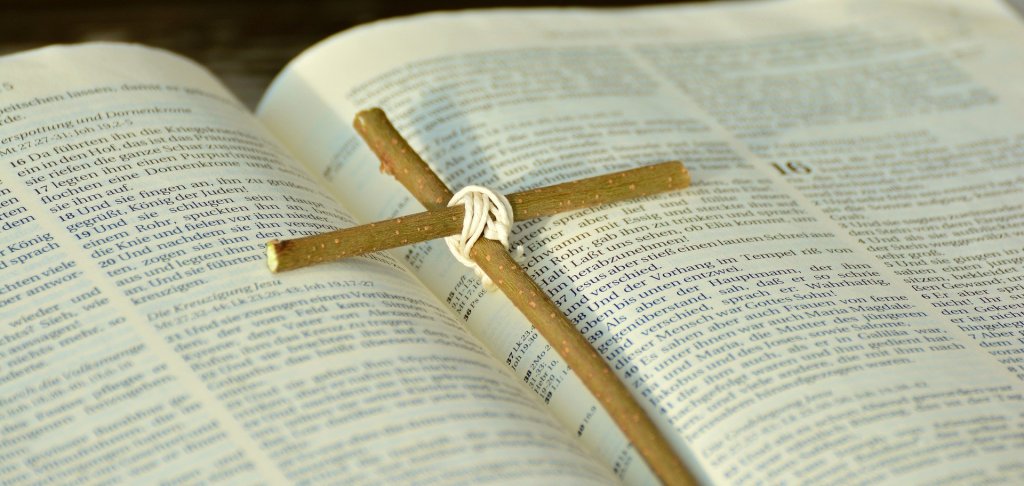
The witness of the apostles as recorded in the bible.
The testimony of people about what they have experienced of Jesus in their lives.
The experience of the actions of Jesus in our lives.
Thank God for all those who have witnessed to Jesus over the millennia so that we can know him!
Prayer
Thank you, Father, for all who have witnessed to your name over the centuries. Thank you that we can know Jesus by his Holy Spirit living in us. Thank you for the strength and warmth of your love.
John 20: 1 – 18 The empty tomb – Jesus appears to Mary Magdalene
The empty tomb
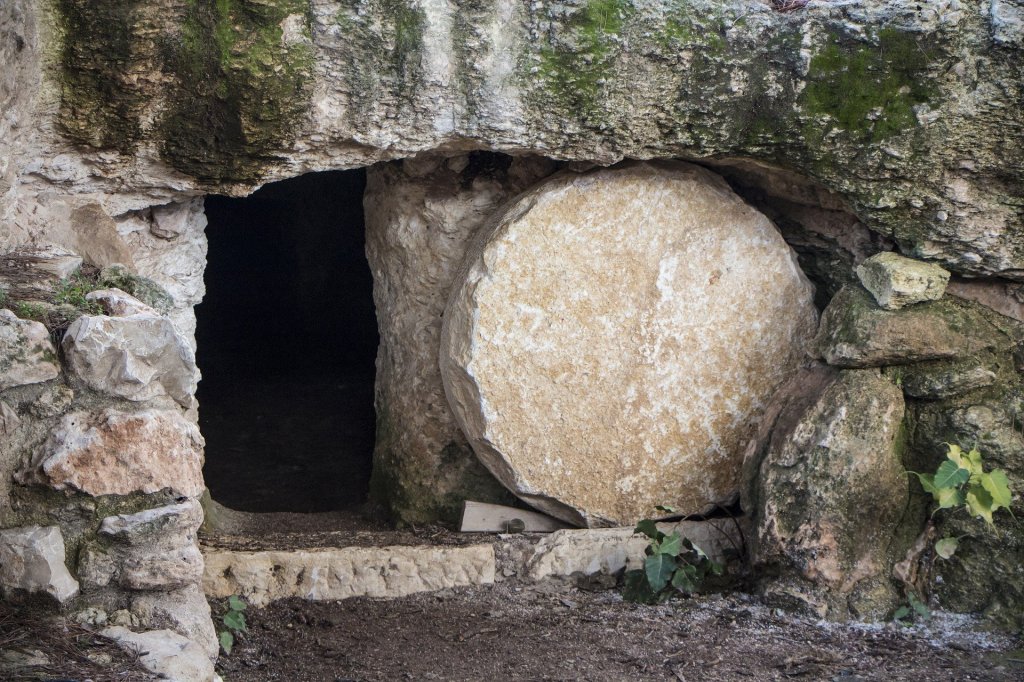
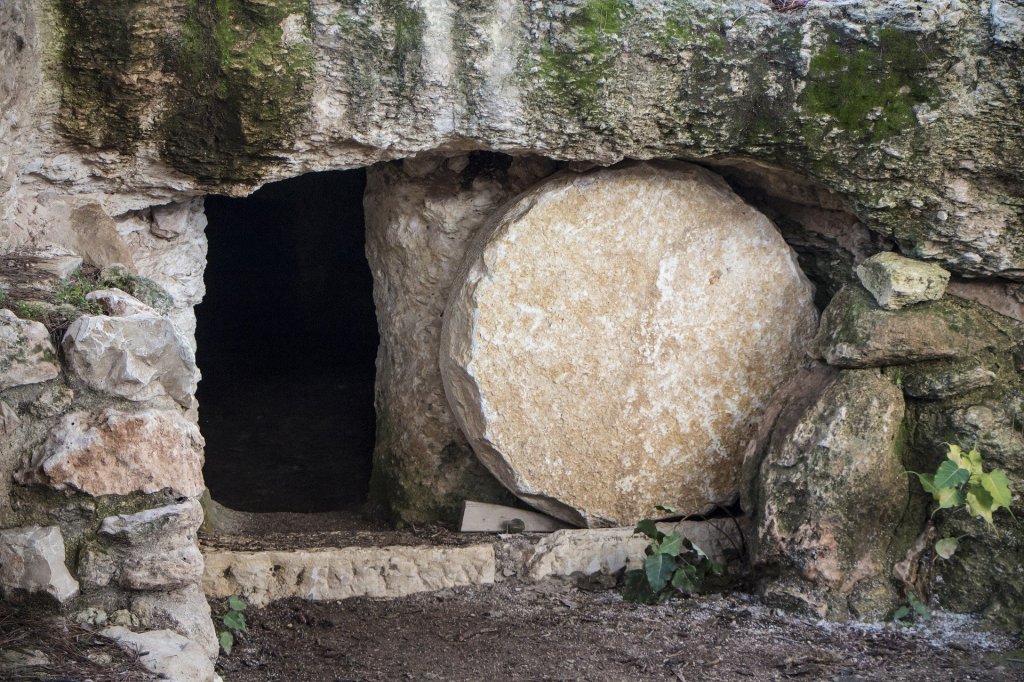
Early on the first day of the week, while it was still dark, Mary Magdalene went to the tomb and saw that the stone had been removed from the entrance. So she came running to Simon Peter and the other disciple, the one Jesus loved, and said, ‘They have taken the Lord out of the tomb, and we don’t know where they have put him!’
So Peter and the other disciple started for the tomb. Both were running, but the other disciple outran Peter and reached the tomb first. He bent over and looked at the strips of linen lying there but did not go in. Then Simon Peter came along behind him and went straight into the tomb. He saw the strips of linen lying there, as well as the cloth that had been wrapped round Jesus’ head. The cloth was still lying in its place, separate from the linen. Finally the other disciple, who had reached the tomb first, also went inside. He saw and believed. (They still did not understand from Scripture that Jesus had to rise from the dead.) Then the disciples went back to where they were staying.
Jesus appears to Mary Magdalene
Now Mary stood outside the tomb crying. As she wept, she bent over to look into the tomb and saw two angels in white, seated where Jesus’ body had been, one at the head and the other at the foot.
They asked her, ‘Woman, why are you crying?’
‘They have taken my Lord away,’ she said, ‘and I don’t know where they have put him.’ At this, she turned round and saw Jesus standing there, but she did not realise that it was Jesus.
He asked her, ‘Woman, why are you crying? Who is it you are looking for?’
Thinking he was the gardener, she said, ‘Sir, if you have carried him away, tell me where you have put him, and I will get him.’
Jesus said to her, ‘Mary.’
She turned towards him and cried out in Aramaic, ‘Rabboni!’ (which means ‘Teacher’).
Jesus said, ‘Do not hold on to me, for I have not yet ascended to the Father. Go instead to my brothers and tell them, “I am ascending to my Father and your Father, to my God and your God.”’
Mary Magdalene went to the disciples with the news: ‘I have seen the Lord!’ And she told them that he had said these things to her.
* * *
If you like to read every word of the bible as being literally true, a comparison of this passage with the same situation described in the synoptic gospels surely gives cause for thought.
All the gospels agree on the time. It was either just before or just after sunrise on the first day following the Sabbath.
They all agree that the empty tomb was witnessed, although they disagree on who witnessed it. In St Matthew’s and St Mark’s accounts, it was just the women. St Luke adds Peter to the roll call, and St John adds Peter and ‘the disciple whom Jesus loved’ (thought to be St John himself).
They disagree on who was in the first group to arrive at the tomb. St Matthew’s gospel says it was Mary Magdalene and the other Mary. St Mark says Mary Magdalene, Mary the mother of James, and Salome. St Luke says Mary Magdalene, Joanna, Mary the mother of James, and others. St John says that it was just Mary Magdalene.
Were there angels present? All the gospels agree that there were, but Matthew and Mark say one, while Luke and John say two.
There is a big divergence over the opening of the tomb. In Mark, Luke and John the tomb had been opened before anybody arrived. St Matthew, though, paints a dramatic picture:
“After the Sabbath, at dawn on the first day of the week, Mary Magdalene and the other Mary went to look at the tomb. There was a violent earthquake, for an angel of the Lord came down from heaven and, going to the tomb, rolled back the stone and sat on it. His appearance was like lightning, and his clothes were white as snow. The guards were so afraid of him that they shook and became like dead men.”
Then, too, what do the gospels say about Jesus speaking to Mary on this occasion? St Matthew writes this:
“So the women hurried away from the tomb, afraid yet filled with joy, and ran to tell his disciples. Suddenly Jesus met them. ‘Greetings,’ he said. They came to him, clasped his feet and worshipped him. Then Jesus said to them, ‘Do not be afraid. Go and tell my brothers to go to Galilee; there they will see me.’
St John gives us the tender scene of Mary weeping, and mistaking Jesus for the gardener.
St Mark and St Luke say nothing about an appearance.
Finally, there are the actions taken by the women after visiting the tomb. St Matthew doesn’t tell us, although he implies that they delivered the message that the disciples should go to Galilee. St Mark says: “Trembling and bewildered, the women went out and fled from the tomb. They said nothing to anyone because they were afraid.” St Luke says: “When they came back from the tomb, they told all these things to the eleven and to all the others…But they did not believe the women, because their words seemed to them like nonsense. Peter, however, got up and ran to the tomb. Bending over, he saw the strips of linen lying by themselves, and he went away, wondering to himself what had happened.”
There are a lot of discrepancies in the accounts. It’s hard to accept that every word of each of the accounts is literally true, because there is just too much of substance that differs between them.
As I don’t believe that every word of the bible is literally true, this doesn’t matter to me.
I am quite happy to read these accounts as testimony recalled years after the events, testimony of the most dramatic event in history. All the witnesses had been traumatised by what they had experienced. They didn’t know what was going to happen. They were terrified that the authorities would come for them next. They had lost the expectation that Jesus would overthrow the corrupt rule of the chief priests who were backed by the Romans. As a force, they were broken by the loss of their leader.
Of course there are differences in the gospel accounts of the resurrection! It would be astonishing and suspicious if there weren’t. And taken as a whole, the accounts add up to a testimony to its truth. Jesus was raised from the dead. God won. Jesus lives. We need fear nothing. Alleluia!
The account I’m studying today, from the gospel of St John, may not be literally true, but it contains a profound emotional truth. Mary Magdalene loved Jesus, and she loved his teaching. Her love was probably more intense and purer than anything experienced by the eleven apostles. She was there, on her own, first thing in the morning. When Peter and John had seen the empty tomb, they left. Mary didn’t. She remained, grieving.
As a result of her fidelity, and her love, Jesus was able to comfort her and use her as a messenger to the apostles.
When we love Jesus, when we love his words and his teaching, he can use us to do his will. Perhaps best of all, we can know and understand a little of the ardour with which he loves each one of us.
Isn’t that wonderful?
Prayer
Heavenly Father,
Thank you for the resurrection of Jesus, and for everything that means for us. Please increase my love for Jesus day by day, so that I may become a better and more faithful servant.
Later, Joseph of Arimathea asked Pilate for the body of Jesus. Now Joseph was a disciple of Jesus, but secretly because he feared the Jewish leaders. With Pilate’s permission he came and took the body away. He was accompanied by Nicodemus, the man who earlier had visited Jesus at night. Nicodemus brought a mixture of myrrh and aloes, about thirty-five kilograms. Taking Jesus’ body, the two of them wrapped it, with the spices, in strips of linen. This was in accordance with Jewish burial customs. At the place where Jesus was crucified, there was a garden, and in the garden a new tomb, in which no one had ever been laid. Because it was the Jewish day of Preparation and since the tomb was nearby, they laid Jesus there.
* * *
All four gospels describe Joseph of Arimathea going to Pilate and asking for Jesus’ body, and, when granted it, taking the body, wrapping it in linen, and laying it in a tomb hewn out from the rock. St Matthew’s gospel even identifies the tomb as being Joseph’s own, saying “Joseph took the body, wrapped it in a clean linen cloth, and placed it in his own new tomb that he had cut out of the rock.” (Matthew 27: 59 – 60)
Who was this man, Joseph?
He must have been influential as well as wealthy for Pilate to have entrusted him with the body of Jesus. He must, surely, have been a disciple, or else why should the inner circle of disciples have let him be the one to perform the last rites for Jesus?
St John tells us that he was a disciple “but secretly because he feared the Jewish leaders”. St Luke, though, says that Joseph was “a member of the Council, a good and upright man, who had not consented to their decision and action.” (Luke 23: 50 – 51) I must say I find St Luke’s version more compelling.
There are two other details that only appear in one gospel.
Mark says that when Joseph asked Pilate for Jesus’ body, Pilate sent for the centurion to have the death confirmed (Mark 15: 44 – 45)
Matthew says “The next day, the one after Preparation Day, the chief priests and the Pharisees went to Pilate. ‘Sir,’ they said, ‘we remember that while he was still alive, that deceiver said, “After three days I will rise again.” So give the order for the tomb to be made secure until the third day. Otherwise, his disciples may come and steal the body and tell the people he has been raised from the dead. This last deception will be worse than the first.’
‘Take a guard,’ Pilate answered. ‘Go, make the tomb as secure as you know how.’ So they went and made the tomb secure by putting a seal on the stone and posting the guard. (Matthew 27: 62 – 66)
These two details are probably intended to affirm the truth of the resurrection of Jesus. The first makes it plain that the centurion who had been in charge of the crucifixion was certain Jesus was dead. The second says that nobody could have stolen the body, because the entrance to the tomb was sealed and under manned guard on the orders of Pilate.
I have doubts about the literal truth of Matthew’s account. The day after preparation day was the Sabbath. Sealing the tomb and posting a guard would, I feel sure, have been regarded as breaking the Sabbath. I think also that if they had been concerned about a faked resurrection they would have taken charge of Jesus’ body themselves. Still, it’s very difficult to be sure one way or the other.
There is another discrepancy between St John’s gospel and the gospels of St Luke and St Mark. In St John’s account, Joseph of Arimathea is accompanied by Nicodemus, who brings a heavy load of myrrh and aloes and the two men anoint Jesus body for burial. In the other two accounts, it is the women who bring spices on the first day of the week, as soon as possible after the Sabbath.
Do these discrepancies matter? I don’t think so. The crucifixion and death of Jesus left his supporters confused and deeply distressed. Probably no single person saw all the actions relating to the burial take place. The accounts we read in the gospels are a collation of people’s memories of the events.
It does seem likely, though, that Joseph of Arimathea played a significant role, and there is a lesson there for us.
Joseph may have been a secret disciple for fear of the Jews. He was powerless to prevent the crucifixion. But when it mattered, he stepped forward and did what was necessary.
I am afraid of the vested interests of our society; I would be very wary of challenging some injustices too robustly. I am pretty much powerless to change things. But I can keep my heart open to the Lord and when he calls, I can play my part.
Prayer
Heavenly Father,
Thank you that even those of us who are timid and weak can serve you. Please help me to do so wholeheartedly.
John 19: 17 – 37 The crucifixion and death of Jesus
The crucifixion of Jesus
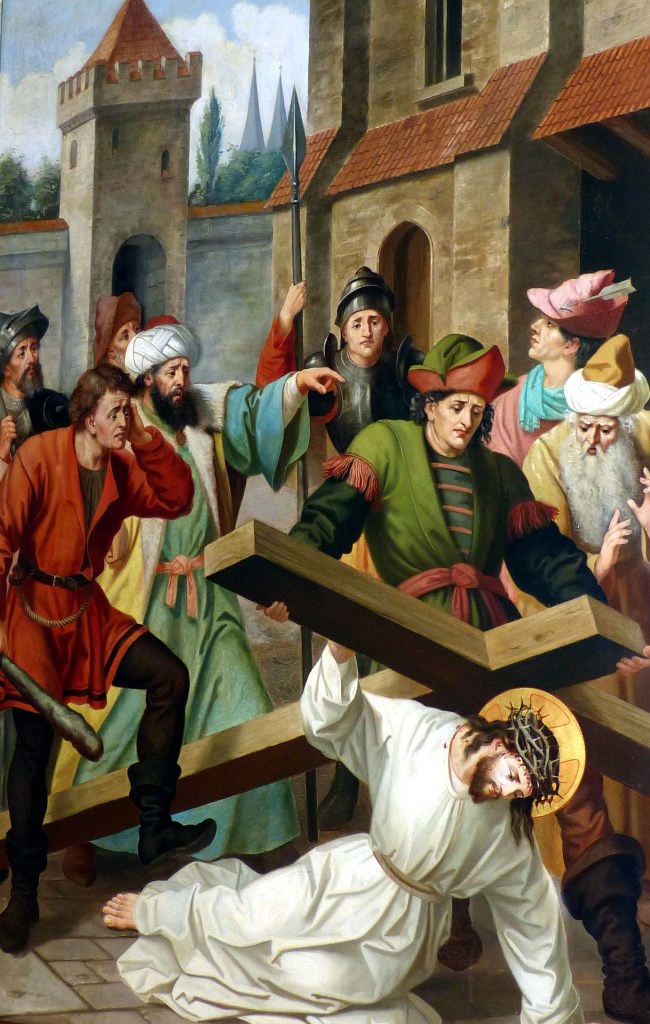
So the soldiers took charge of Jesus. Carrying his own cross, he went out to the place of the skull (which in Aramaic is called Golgotha). There they crucified him, and with him two others – one on each side and Jesus in the middle.
Pilate had a notice prepared and fastened to the cross. It read: JESUS OF NAZARETH, THE KING OF THE JEWS. Many of the Jews read this sign, for the place where Jesus was crucified was near the city, and the sign was written in Aramaic, Latin and Greek. The chief priests of the Jews protested to Pilate, ‘Do not write “The King of the Jews”, but that this man claimed to be king of the Jews.’
Pilate answered ‘What I have written, I have written.’
When the soldiers crucified Jesus, they took his clothes, dividing them into four shares, one for each of them, with the undergarment remaining. This garment was seamless, woven in one piece from top to bottom.
‘Let’s not tear it,’ they said to one another. ‘Let’s decide by lot who will get it.’
This happened that the scripture might be fulfilled that said.
‘They divided my clothes among them and cast lots for my garment.’
So this is what the soldiers did.
Near the cross of Jesus stood his mother, his mother’s sister, Mary the wife of Clopas, and Mary Magdalene. When Jesus saw his mother there, and the disciple whom he loved standing near by, he said to her, ‘Woman, here is your son,’ and to the discipke, ‘Here is your mother.’ From that time on, this disciple took her into his home.
The death of Jesus
Later, knowing that everything had now been finished, and so that Scripture would be fulfilled, Jesus said, ‘I am thirsty.’ A jar of wine vinegar was there, so they soaked a sponge in it, put the sponge on a stalk of the hyssop plant, and lifted it to Jesus’ lips. When he had received the drink, Jesus said, ‘It is finished.’ With that, he bowed his head and gave up his spirit.
Now it was the day of preparation, and the next day was to be a special Sabbath. Because the Jewish leaders didn’t want the bodies left on the crosses during the Sabbath, they asked Pilate to have the legs broken and the bodies taken down. The soldiers therefore came and broke the legs of the first man who had been crucified with Jesus, and then those of the other. But when they came to Jesus and found that he was already dead, they did not break his legs. Instead, one of the soldiers pierced Jesus’ side with a spear, bringing a sudden flow of blood and water. The man who saw it has given testimony, and his testimony is true. He knows that he tells the truth, and he testifies that you also may believe. These things happened so that the scripture would be fulfilled: ‘Not one of his bones will be broken,’ and, as another scripture says, ‘They will look on the one they have pierced.’
* * *
St John describes the crucifixion very briefly.
So the soldiers took charge of Jesus. Carrying his own cross, he went out to the place of the skull (which in Aramaic is called Golgotha). There they crucified him, and with him two others – one on each side and Jesus in the middle.
He doesn’t go into detail; he didn’t need to; his readers would all have been familiar with the practice. In our time, we aren’t familiar with it – thank God! – so we have no real idea of the horror. Suffice it to say, it was a procedure designed to strip the humanity from the victim, by the infliction, in public, of humiliation and intense pain continued until death.
The soldiers did that to Jesus, and I have to ask ‘Why?’
It was clearly willed by God the Father. There’s no getting around that.
I cannot see how a God of love could demand such a thing.
Let’s see what might allow it to happen.
Firstly, let’s ascribe responsibility for the execution itself to the right quarter. It was Roman soldiers who carried out the crucifixion, on the orders of a Roman governor, in response to the lobbying of the chief priests of the Jews. In other words, it was human beings that put Jesus on the cross. It wasn’t God.
Secondly, God the Father did not demand that Jesus be crucified. Jesus’ crucifixion is not a sacrifice to God.
Thirdly, God the Father could see that a certain sequence of actions would bring about the crucifixion of Jesus. In that sense, he planned the crucifixion.
Fourthly, Jesus, throughout his whole life, subordinated his will to that of God the Father. Like all of us he had free will, but he chose in every action to implement God’s plan.
Fifthly, Jesus continued steadfast in God’s will until the very end of his life. It was immensely costly; when we read the synoptic gospels we see that he was terrified at the prospect of being crucified.
Sixthly, it must have been in some way necessary. And now I’m starting to guess at mysteries, so take what I write with caution; it’s probably mostly wrong and certainly incomplete.
Perhaps part of the answer can be found in John 16: 7 “But very truly I tell you, it is for your good that I am going away. Unless I go away, the Advocate will not come to you; but if I go, I will send him to you.”
Despite the flawed nature of humanity, we can experience God living within us in the form of the Holy Spirit. This is our access to God the Father. This gives us strength and guidance as to how to become better people. Perhaps God’s long-term plan is that humanity should eventually be able to live authentically good lives? Wouldn’t that be worth Jesus’ (completely voluntary) sacrifice on the cross?
Well, that may indeed be the case, but why does it require such a horrible event? Or, to make it even sharper, why does God have a plan that includes the crucifixion? And I think to even start to understand that we have to return to my first point
“Firstly, let’s ascribe responsibility for the execution itself to the right quarter. It was Roman soldiers who carried out the crucifixion, on the orders of a Roman governor, in response to the lobbying of the chief priests of the Jews. In other words, it was human beings that put Jesus on the cross. It wasn’t God.”
Sin, or doing the wrong thing, is built into human society. It is firmly cemented into the power structures. When power structures are seriously challenged, they respond with violence. Take the case of the military junta that ruled in Argentina in the nineteen seventies. They didn’t want people working to help the poor. They snatched people who did so – teachers, health workers, union representatives – imprisoned them without trial, tortured them and killed them. Tens of thousands were murdered in this way.
I firmly believe that any power structure that is vigorously challenged about its wrongdoing will respond with violence, especially if it looks as though it may be forced to change its ways
I suggest, very tentatively, that the crucifixion of Jesus was the example we have been given to follow. We have to be prepared to challenge evil, not just in our own lives but in the society in which we live. It almost certainly won’t lead to martyrdom – although it may – but it will always be costly.
And why should we follow a course of action that could cost us so highly?
Because the really important aspect of Jesus’ crucifixion is actually his resurrection, the act by which God says “It is worthwhile challenging evil, because good has now overcome evil, and will do so onwards throughout history.”
Prayer
Heavenly Father
Thank you for the life, death and resurrection of Jesus. Help us to challenge evil, and to support those, like Médécins sans Frontières, who try to mitigate some of the worst consequences of evil in our human power structures.
Then Pilate took Jesus and had him flogged. The soldiers twisted together a crown of thorns and put it on his head. They clothed him in a purple robe and went up to him again and again, saying, ‘Hail, king of the Jews!’ and they slapped him in the face.
Once more Pilate came out and said to the Jews gathered there, ‘Look, I am bringing him out to you to let you know that I find no basis for a charge against him.’ When Jesus came out wearing the crown of thorns and the purple robe, Pilate said to them, ‘Here is the man!’
As soon as the chief priests and their officials saw him, they shouted, ‘Crucify! Crucify!’
But Pilate answered, ‘You take him and crucify him. As for me, I find no basis for a charge against him.’
The Jewish leaders insisted, ‘We have a law, and according to that law he must die, because he claimed to be the Son of God.’
When Pilate heard this, he was even more afraid, and he went back inside the palace. ‘Where do you come from?’ he asked Jesus, but Jesus gave him no answer. ‘Do you refuse to speak to me,’ Pilate said. ‘Don’t you realise that I have power either to free you or to crucify you?’
Jesus answered, ‘You would have no power over me if it were not given to you from above. Therefore the one who handed me over to you is guilty of a greater sin.’
From then on, Pilate tried to set Jesus free, but the Jewish leaders kept shouting, ‘If you let this man go, you are no friend of Caesar. Anyone who claims to be a king opposes Caesar.’
When Pilate heard this, he brought Jesus out and sat down on the judge’s seat at a place known as the Stone Pavement (which in Aramaic is Gabbatha). It was the day of Preparation of the Passover; it was about noon.
‘Here is your king,’ Pilate said to the Jews.
But they shouted, ‘Take him away! Take him away! Crucify him!’
‘Shall I crucify your king?’ Pilate asked.
‘We have no king but Caesar,’ the chief priests answered.
Finally Pilate handed him over to them to be crucified.
* * *
Verse 12 says this: “From then on, Pilate tried to set Jesus free, but the Jewish leaders kept shouting, ‘If you let this man go, you are no friend of Caesar. Anyone who claims to be a king opposes Caesar.’”
Pilate was always reluctant to convict Jesus.
His initial response was to tell the chief priests to judge Jesus by their own law. When they demurred, he questioned Jesus. He found no basis for a charge against him.
He challenged the priests, offering to release Jesus for the Passover, which they rejected.
So Pilate had Jesus flogged. Jesus would have suffered intense pain, cuts, bruises, blood loss and clinical shock. Pilate showed him to the chief priests in that state, and repeated that he found no basis for a charge against him.
The chief priests then tell Pilate that Jesus deserves to die because he has claimed to be the Son of God.
Pilate was terrified by this. If Jesus was the son of a god, what retribution would he incur if he had him crucified? So he questioned Jesus again. Jesus remained silent. Pilate said: ‘Don’t you realise that I have power either to free you or to crucify you?’
And Jesus, bloody and weak from loss of blood, and facing even worse suffering on the cross, says, calmly, ‘You would have no power over me if it were not given to you from above. Therefore the one who handed me over to you is guilty of a greater sin.’
I think that Pilate must have been astonished at Jesus’ courage. Pilate probably expected Jesus to make some sort of compromise that would enable him to hand him back to the chief priests. After all, if Jesus were no threat to Rome, if he weren’t claiming to be a king, Pilate could argue convincingly that Rome had no reason to execute him. But, in the face of an appalling death, and already in agony, Jesus refuses point blank to compromise.
“From then on, Pilate tried to set Jesus free”
He couldn’t.
It wasn’t the threat of a riot that stopped Pilate. One of the main reasons the chief priests and Pharisees had wanted Jesus killed had been to avoid the appearance of an insurrection that would bring disastrous retaliation from the Romans. The last thing they wanted was a riot.
‘If you let this man go, you are no friend of Caesar. Anyone who claims to be a king opposes Caesar.’
That is nearer the mark, I think. The chief priests would have gone to Herod, who had influential contacts in Rome. Word would have got back to Rome and Pilate would have been censured; perhaps removed as governor; perhaps exiled, or even assassinated. He would have risked losing his life of luxury, with its satisfying power. He would have risked ridicule for his incompetence. And it was only the life of a foreigner, not a Roman citizen. The security of the state demanded it. And he couldn’t really be the son of a god; could he?
Pilate was embedded in the power structures of his time. The responsibilities of his position; the satisfaction of being important; Pilate would have needed to overturn everything that had hitherto driven his life.
‘Shall I crucify your king?’ Pilate asked.
‘We have no king but Caesar,’ the chief priests answered.
What an admission by the chief priests! Pilate could pick this up as a major diplomatic success! It was the fig-leaf he needed.
Finally Pilate handed him over to them to be crucified.
* * *
And now comes the hard bit.
The application of this to my own life.
I am, like just about everyone in Western society, embedded in the power structure of my time. I am retired and comfortable on my pension. Who is paying for my pension? Whose suffering makes the profits out of which my pension is paid? World trade is heavily weighted against the poor.
Much of the food I buy at the supermarket is from overseas. Even Fair Trade goods are still weighted in favour of the consumer, because the supermarkets have so much commercial power.
The smartphone (on which I probably place overmuch reliance) uses materials of questionable origin, the extraction of which has probably harmed people. The scrap procedures are loosely enforced and children in poor countries are harmed.
My country, the UK, supplies munitions to Saudi Arabia which are used in Yemen, killing and maiming innocent civilians.
Am I as constrained by power structures as Pilate? Am I as guilty as Pilate?
I don’t know.
But I choose to follow Jesus.
I don’t think he wants anything dramatic; just that I should listen to him; just that I should do as he says. And just that I should accept his love.
Thank you, Lord Jesus.
Prayer
Heavenly Father
I’m sorry for my involvement with the power structures of society, sorry that I don’t do more to try to change them, sorry that I am less generous than I could be in supporting the weak.
Thank you that you love me anyway, and please help me to do better.
Then the Jewish leaders took Jesus from Caiaphas to the palace of the Roman governor. By now it was early morning, and to avoid ceremonial uncleanness they did not enter the palace, because they wanted to be able to eat the Passover. So Pilate came out to them and asked, ‘What charges are you bringing against this man?’
‘If he were not a criminal,’ they replied, ‘we would not have handed him over to you.’
Pilate said, ‘Take him yourselves and judge him by your own law.’
‘But we have no right to execute anyone,’ they said. This took place to fulfil what Jesus had said about the kind of death he was going to die.
Pilate then went back inside the palace, summoned Jesus and asked him, ‘Are you the king of the Jews?’
‘Is that your own idea,’ Jesus asked, ‘or did others talk to you about me?’
‘Am I a Jew?’ Pilate replied. ‘Your own people and chief priests handed you over to me. What is it you have done?’
Jesus said, ‘My kingdom is not of this world. If it were, my servants would fight to prevent my arrest by the Jewish leaders. But now my kingdom is from another place.’
‘You are a king, then!’ said Pilate.
Jesus answered, ‘You say that I am a king. In fact, the reason I was born and came into the world is to testify to the truth. Everyone on the side of truth listens to me.’
‘What is truth?’ retorted Pilate. With this he went out again to the Jews gathered there and said, ‘I find no basis for a charge against him. But it is your custom for me to release to you one prisoner at the time of the Passover. Do you want me to release “the king of the Jews”?’
They shouted back, ‘No, not him! Give us Barabbas!’ Now Barabbas had taken part in an uprising.
* * *
“’What is truth?’ retorted Pilate”
That question lies at the heart of this passage.
“What is truth?”
Pilate was a sophisticated, worldly man, an important player in the politics of the Roman Empire. He was aware of the mixed motives behind people’s actions. The nature of human power structures would have taught him, indeed, would have forced him, to act pragmatically. He didn’t have the time to sort out truths from lies; he needed results.
The life or death of a non-Roman citizen was a very small affair. It was only lobbying by the chief priests that had caused him to be involved at all, because he needed them on-side politically. It didn’t really matter whether the accusations against Jesus were true, it was whether they represented a threat to Roman peace.
At one level, “What is truth?” meant “Truth doesn’t matter here.”
But at a deeper level, Pilate believes that matters are never black and white in human affairs. People’s self-interest always gets in the way. It’s ridiculous to imagine that there’s a single specific truth. His “What is truth?” is a denial that truth is attainable. If truth doesn’t exist, there’s no absolute need for justice. No absolute requirement for living a moral life. If there is no truth, the lives of others don’t matter. There’s never anyone who is wholly in the right; all human beings do evil deeds.
And, you know what? He’s right. All human beings (except Jesus) are fallible. And that’s a point on which Pilate and Jesus agree. Human beings are by nature selfish and deceitful. I’m selfish. I’m deceitful. I try not to be, but the temptation is always there.
Where Jesus and Pilate part company is in their response to this fact. Pilate doesn’t care about people; he cares about his personal satisfaction. He is quite prepared to destroy people if they obstruct him.
Jesus, although he understands as clearly as Pilate that human nature is inherently selfish, is not prepared to leave it at that. He loves each and every one of us selfish, deceitful, treacherous human beings throughout history. He lived his life outside of power structures. He called out self-interest whenever he came across it. He has never once been selfish, never once been deceitful.
What is truth?
Jesus answered, ‘I am the way, and the truth, and the life’. (John 14: 6)
What matters to Jesus is not the problem, not the action of a fallible human, but the person. He loves each of us, and wants the best for us. That is truth.
Jesus answered, ‘You say that I am a king. In fact, the reason I was born and came into the world is to testify to the truth. Everyone on the side of truth listens to me.’
Even as he is on trial for his life before Pilate, Jesus is reaching out to save him, giving him a chance to repent and embrace the truth.
I want to be on the side of truth. I try to listen to Jesus. What do I hear?
‘This is my command: love each other.’ (John 15: 17)
‘But the Advocate, the Holy Spirit, whom the Father will send you in my name, will teach you all things and will remind you of everything I have said to you.’ (John 14: 26)
What is truth?
The truth is love.
The truth is Jesus.
Prayer
Heavenly Father,
Thank you for Jesus, your truth in the world. Please help me to respond wholeheartedly to his love.
Simon Peter and another disciple were following Jesus. Because this disciple was known to the high priest, he went with Jesus into the high priest’s courtyard, but Peter had to wait outside at the door. The other disciple, who was known to the high priest, came back, spoke to the servant girl on duty there and brought Peter in.
‘You aren’t one of this man’s disciples too, are you?’ she asked Peter.
He replied, ‘I am not.’
It was cold, and the servants and officials stood round a fire they had made to keep warm. Peter also was standing with them, warming himself.
The high priest questions Jesus
Meanwhile, the high priest questioned Jesus about his disciples and his teaching.
‘I have spoken openly to the world,’ Jesus replied. ‘I always taught in synagogues or at the temple, where all the Jews come together. I said nothing in secret. Why question me? Ask those who heard me. Surely they know what I said.’
When Jesus said this, one of the officials nearby slapped him in the face. ‘Is this the way you answer the high priest?’ he demanded.
‘If I said something wrong,’ Jesus replied, ‘testify as to what is wrong. But if I spoke the truth, why did you strike me?’’ Then Annas sent him bound to Caiaphas the high priest
Peter’s second and third denials
Meanwhile, Simon Peter was still standing there warming himself. So they asked him, ‘You aren’t oned of his disciples too, are you?’
He denied it, saying, ‘I am not.’
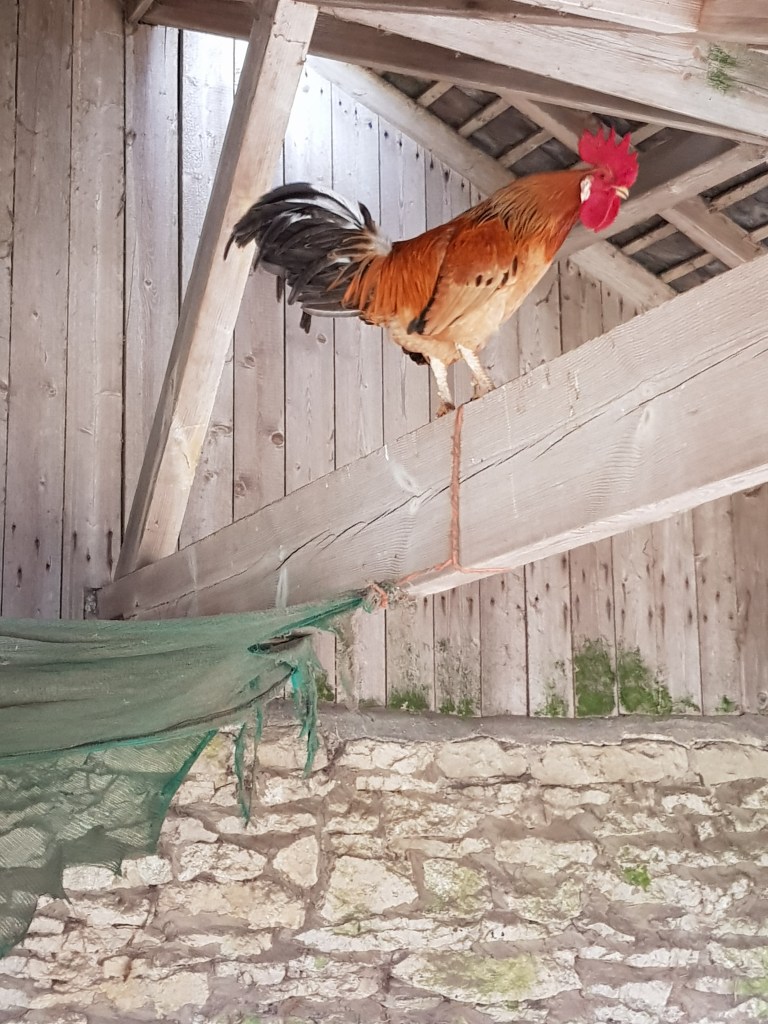
One of the high priest’s servants, a relative of the man whose ear Peter had cut off, challenged him, ‘Didn’t I see you with him in the garden?’ Again Peter denied it, and at that moment a cock began to crow.
* * *
The way St John has written this is interesting. He tells us about Peter’s first denial, then he switches the action to the high priest’s (Annas’) questioning of Jesus; and then, he switches back to Peter again. In part this is just good story-telling; but I think it’s also done with a purpose. John wants us thinking about the two scenes at the same time, because each illuminates an aspect of human nature.
Let’s start with Annas’ questioning of Jesus.
Jesus was before the court for…well, why was he there? No charge has been mentioned. Instead, the high priest starts to ask him about his disciples and his teaching. Jesus responds:
‘I have spoken openly to the world,’ Jesus replied. ‘I always taught in synagogues or at the temple, where all the Jews come together. I said nothing in secret. Why question me? Ask those who heard me. Surely they know what I said.’
The point Jesus is making is that his trial is not complying with the Law. The authorities should say what crime he has committed and produce witnesses. This is not idle quibbling about procedure. Both sides are fully aware that this is a capital case. If Jesus is found guilty, he will be put to death.
The Jews were (rightly) proud of their legal system. It was rigorous and demanded a high standard of proof. For a capital charge to be sustained, the court had to hear two witnesses who were present at the crime. Their testimony had to agree exactly. Furthermore, they had to have witnessed the act and shouted a warning that the perpetrator was about to commit a capital crime.
Jesus’ answer to the high priest prompts a violent response.
When Jesus said this, one of the officials nearby slapped him in the face. ‘Is this the way you answer the high priest?’ he demanded.
Jesus replies calmly, once again drawing attention to the illegal nature of the hearing.
‘If I said something wrong,’ Jesus replied, ‘testify as to what is wrong. But if I spoke the truth, why did you strike me?’’
He’s reminding them that summary ‘punishment’ – in this case a slap in the face – is not sanctioned by the Law. If the official believes Jesus has done something wrong, he should testify against him.
St John’s account then has Jesus moved to Caiaphas. They sent him bound. What a threat he must have seemed!
These six verses are a remarkable piece of writing. They are Jesus’ life in miniature. The sinless one is falsely accused, and responds by pointing to the Jews’ own Law.
And this is what St John wants us to understand. The Law – however good it is – is limited. It can define good and bad. It can prescribe sanctions for those who break it. It can be administered fairly and justly, and even with compassion. But it can’t change human nature.
In this questioning of Jesus, we see how readily those with power resort to violence. They’re quite prepared, too, to set aside the rules when it suits their purpose.
The Law can’t change human nature. Only Jesus can do that.
Which brings us to Peter’s denial.
Peter isn’t in the high priest’s courtyard to fulfil the Law. He’s there because the man he loves, in whom he recognises the ultimate good, is in danger. He’s doing whatever it takes to be ready to help if the opportunity arises. I doubt if he has a plan, beyond a hope that Jesus will be released. And his readiness to help includes the readiness to tell lies, even to deny knowing Jesus.
Even after we’ve recognised that Jesus is the Son of God; even when we’ve committed our lives to him, we will still make mistakes. Peter made a hideous mistake, that haunted him. But his commitment to Jesus meant that he could repent, receive forgiveness, and be healed.
And that is one of the big differences between obedience to the Law and following Jesus. The Law cannot forgive us. Jesus, who loves each one of us personally, can. And, by that forgiveness, Jesus can change us and redeem our fallen human nature.
Prayer
Heavenly Father,
Thank you so much for Jesus, and for the love that you have for each one of us. Please help me to dwell within that love.
When he had finished praying, Jesus left with his disciples and crossed the Kidron Valley. On the other side was a garden, and he and his disciples went into it.
Now Judas, who betrayed him, knew the place, because Jesus had often met there with his disciples. So Judas came to the garden, guiding a detachment of soldiers and some officials from the chief priests and Pharisees. They were carrying torches, lanterns and weapons.
‘I am he,’ Jesus said. (And Judas the traitor was standing there with them.) When Jesus said, ‘I am he,’ they drew back and fell to the ground.
Again he asked them, ‘Who is it you want?’
‘Jesus of Nazareth,’ they said.
Jesus answered, ‘I told you I am he. If you are looking for me, then let these men go.’ This happened so that the words he had spoken would be fulfilled: ‘I have not lost one of those you gave me.’
Then Simon Peter, who had a sword, drew it and struck the high priest’s servant, cutting off his right ear. (The servant’s name was Malchus.)
Jesus commanded Peter, ‘Put your sword away! Shall I not drink the cup the Father has given me?’
Then the detachment of soldiers with its commander and the Jewish officials arrested Jesus. They bound him and brought him first to Annas, who was the father-in-law of Caiaphas, the high priest that year. Caiaphas was the one who had advised the Jewish leaders that it would be good if one man died for the people.
* * *
St John’s gospel and the synoptics agree on the substance of Jesus’ arrest, and on the theological significance of it.
Jesus and his disciples are in a garden (John doesn’t identify it by name). Knowing that Jesus and the disciples often met there, Judas leads a body of men to arrest him. Note who St John says was in this group. “So Judas came to the garden, guiding a detachment of soldiers and some officials from the chief priests and Pharisees.” This was an official group that included Roman soldiers and Jewish officials. It was the establishment cracking down hard on a malcontent.
“They were carrying torches, lanterns and weapons.” They came equipped for trouble; they probably expected resistance.
Before they had chance to say what they wanted, Jesus calmly took the initiative. “Jesus, knowing all that was going to happen to him, went out and asked them, ‘Who is it you want?’”
They answered ‘Jesus of Nazareth’, but when Jesus replied they were thrown into confusion. “When Jesus said, ‘I am he,’ they drew back and fell to the ground.”
They were terrified.
What a contrast with Jesus! Jesus knew what was going to happen to him, and as he was fully human, he must have known fear at the thought. However, he had prayed earnestly and been assured that the Father’s will was that he should submit, and the prayer had brought peace.
Before the arrest party can recover their composure, Jesus takes the initiative once again. “Again he asked them, ‘Who is it you want?’” and once again they reply “‘Jesus of Nazareth.’”
Jesus then calmly steers matters in the direction the Father has told him they must go.
Jesus answered, ‘I told you I am he. If you are looking for me, then let these men go.’ This happened so that the words he had spoken would be fulfilled: ‘I have not lost one of those you gave me.’
Peter, passionate, impetuous – and wrong – draws his sword and slashes at the head of one of the arresting party, severing his ear. “Jesus commanded Peter, ‘Put your sword away! Shall I not drink the cup the Father has given me?’”
And here we see who is really in charge. It is Jesus. He is determined to ‘drink the cup the Father has given him.’ The Father has told him that he will be arrested, interrogated and crucified, and that this is necessary. Jesus has accepted this and is determined that it will happen. He has ensured that his supporters don’t protect him.
The combined secular and religious powers have gone to arrest Jesus, to have him killed. It looks in human terms as though they are in control. Instead, the radical self-giving of Jesus places him in control. He could have escaped – but he chose instead the path of submission to God’s will.
St Matthew puts it very dramatically.
‘Put your sword back in its place,’ Jesus said to him, ‘for all who draw the sword will die by the sword. Do you think I cannot call on my Father, and he will at once put at my disposal more than twelve legions of angels? But how then would the Scriptures be fulfilled that say it must happen in this way?’
* * *
St John doesn’t mention Jesus’ agony in the garden, when he suffers the human fear of pain and death, but the account is in all three of the synoptic gospels and there’s no reason to think they’re wrong. Jesus was fully human as well as divine, and any human would feel terror at the thought of being crucified. Jesus knows our fear through personal experience.
There’s a lot of fear in society at present, as the coronavirus rampages through nations, killing indiscriminately. How can we deal with our own fear?
Jesus dealt with his fear by prayer and by faith. He prayed earnestly to the Father and then placed his trust completely in God. He understood what his Father’s plan entailed for him, and he accepted it without reserve.
If God’s plan for me is that I should die of Covid 19, then I embrace that future. Jesus loves me. That is all I need to know.
Prayer
Heavenly Father
Thank you that you love me, and that Jesus loves me. Please help me to live so that those around me may also feel your love.
‘My prayer is not for them alone. I pray also for those who will believe in me through their message, that all of them may be one, Father, just as you are in me and I am in you. May they also be in us so that the world may believe that you have sent me. I have given them the glory that you gave me, that they may be one as we are one – I in them and you in me – so that they may be brought to complete unity. Then the world will know that you sent me and have loved them even as you have loved me.
‘Father, I want those you have given me to be with me where I am, and to see my glory, the glory you have given me because you loved me before the creation of the world.
‘Righteous Father, though the world does not know you, I know you, and they know that you have sent me. I have made you known to them, and will continue to make you known in order that the love you have for me may be in them and that I myself may be in them.’
* * *
“I pray also for those who will believe in me through their message.”
Starting on the day of Pentecost, the disciples passed on the message of Jesus. Initially this was done orally, but as the followers of Jesus increased in number, some of Jesus’ teaching was written down. Gradually those writings became our bible, and the followers of Jesus became the church, in its broadest sense. In that way, the message of those first disciples was passed on to us, and so this part of Jesus’ prayer is very specifically for us.
It is Jesus himself praying for each and every one of us.
And what does he pray?
“that all of them may be one, Father, just as you are in me and I am in you.”
He prays for the unity of all Christians.
And why does he pray this?
“May they also be in us so that the world may believe that you have sent me. I have given them the glory that you gave me, that they may be one as we are one – I in them and you in me – so that they may be brought to complete unity. Then the world will know that you sent me and have loved them even as you have loved me.”
In other words, that people will see our unity in love and know that God the Father sent Jesus. We are to witness to Jesus by our love for each other.
There is a video on YouTube which gives a graphic example of this, It’s called the UK Blessing. A large number of churches in the UK collaborated to produce the video, to show the love of God in action. I think it’s beautiful and very moving. Do listen to it if you have time.
While there are many denominations, and some profound doctrinal differences, wherever there is love Christians find they have brothers and sisters.
I grew up in the Anglican church. I was drawn closer to God by attending a Roman Catholic church and seeing the devout nature of their worship, and their devotion to prayer. When I was in my late twenties, God spoke very strongly to me. I’ll tell you what happened.
I had a new job, in a city 150 miles from where I had been working. During the week I lived in a bedsit, travelling home at the weekends.
The bedsit was cold, so cold that I used to walk to the reference library in the evening, and sit there reading. One evening as I walked there, I noticed that there were Christian posters in the window of a house I passed.
“Go and ring the door-bell.”
I stopped walking.
“Whaaat?!”
“Go and ring the door-bell.”
I thought for a moment. Perhaps another time. I took a few steps, and stopped. It was physically difficult for me to move
“Go and ring the door-bell.”
So I did.
“Excuse me, I’m sorry to disturb you, I saw your posters and I just felt I had to…er…um… you know, ring your door-bell.”
They welcomed me with open arms, insisted that I ate dinner with them, and took me to a Pentecostal prayer group. Which was exactly what I needed then.
Since then, I’ve worshipped mostly in the Methodist tradition, but because of God’s leading, I’m comfortable with any denomination. The love between the church members witnesses to the love of Jesus.
And that love is drawing me closer to Jesus. I prayed that I might become closer.
“You might try spending a little more time with me.”
“Oh.” (Blushes with shame) “Sorry.”
“You’re a writer. Start a blog. Start by reading and commenting on St John’s gospel. It doesn’t matter if you don’t have any readers. I will determine who needs to read it, and guide them to it. You just study and write – and don’t forget to talk to me about it!”
So that’s what I’m doing.
And if you’ve read this far, the message to you from Jesus is that he loves you and will live with you if you ask him. Amen!



 Seeking the Light