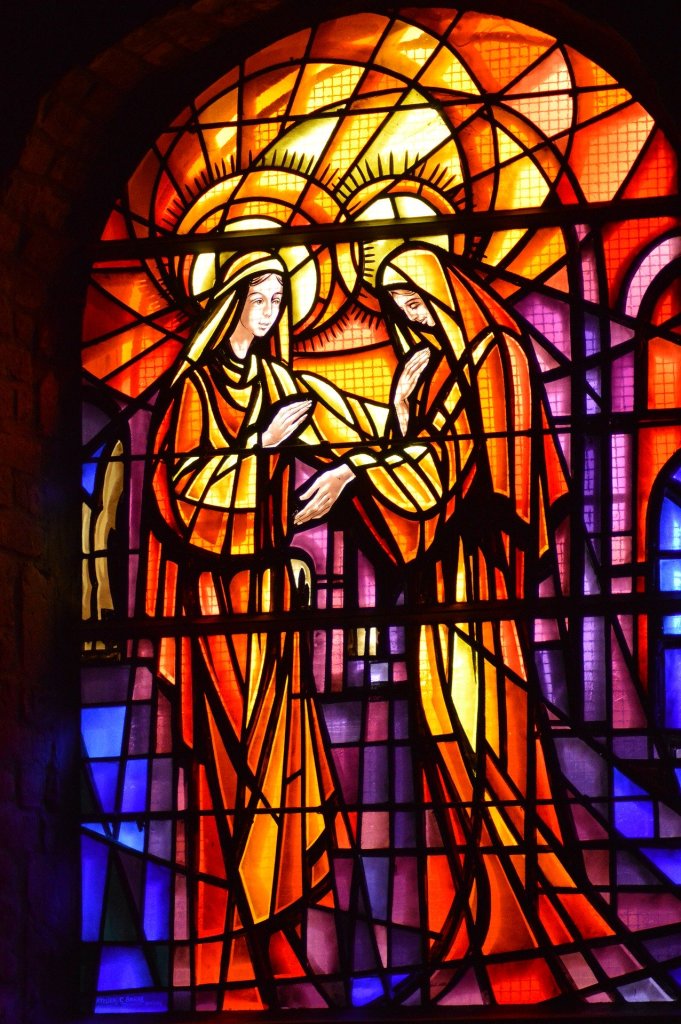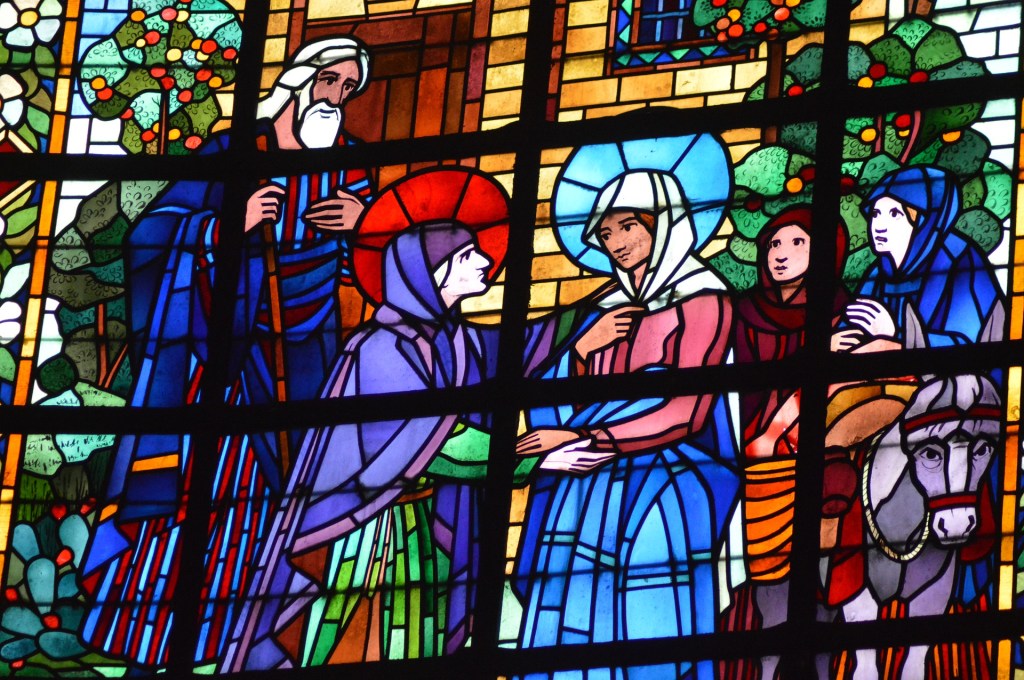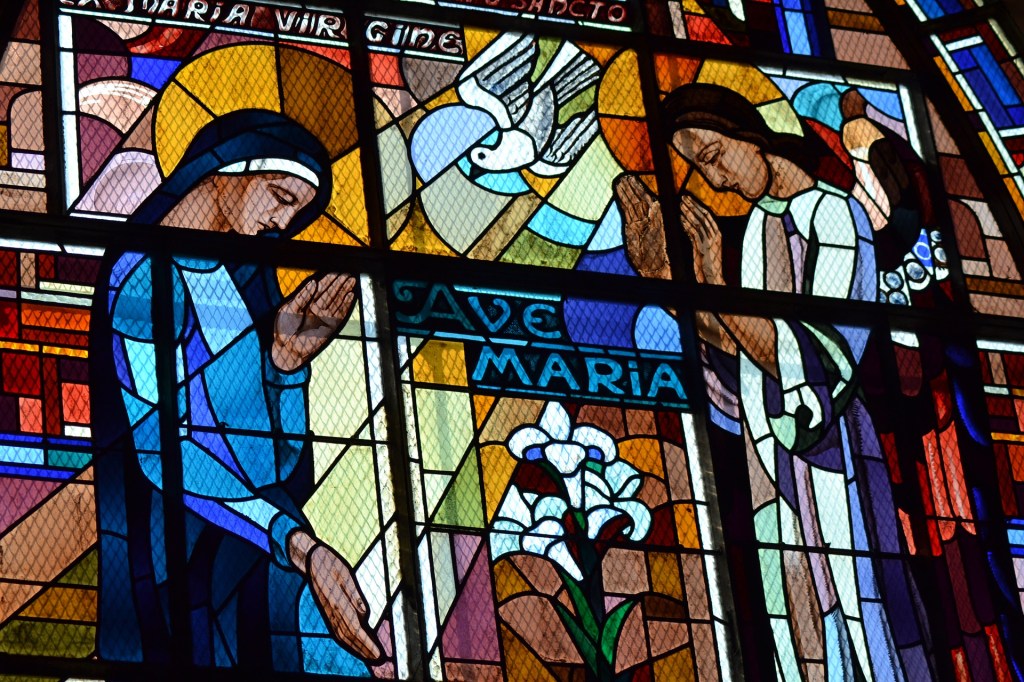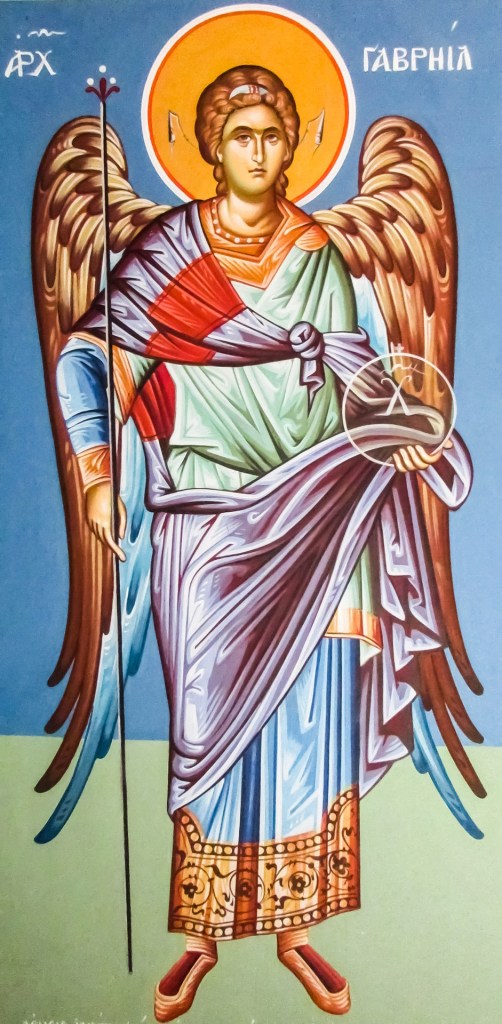
Luke 2: 22 – 40 Jesus presented in the temple

Luke 2: 22 – 40 Jesus presented in the temple

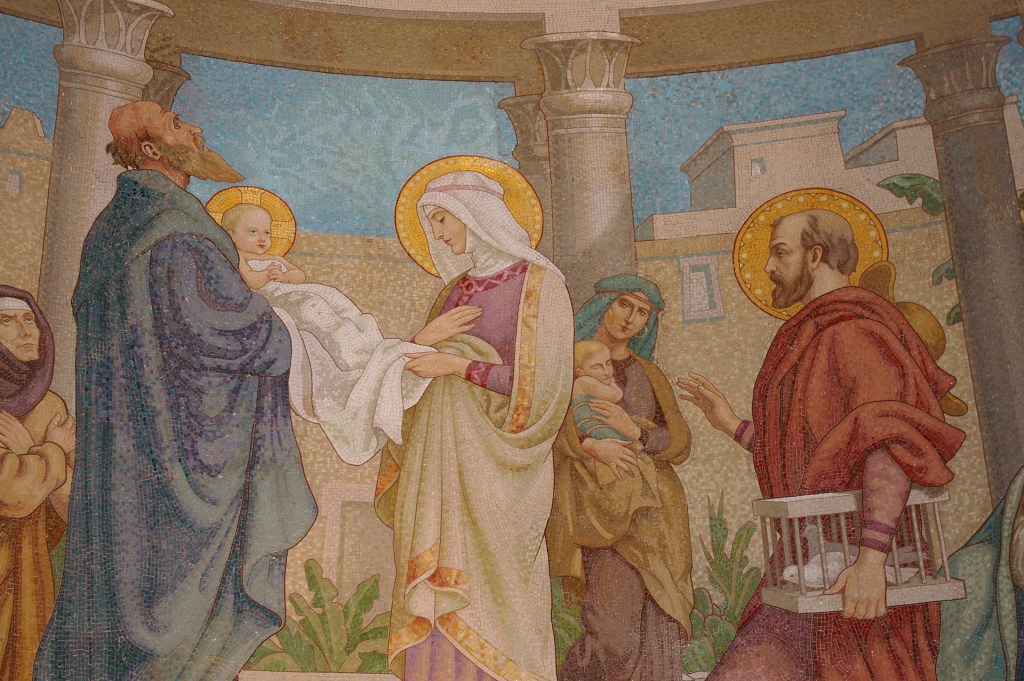
When the time came for the purification rites required by the Law of Moses, Joseph and Mary took him to Jerusalem to present him to the Lord (as it is written in the Law of the Lord, ‘Every firstborn male is to be consecrated to the Lord), and to offer a sacrifice in keeping with what is said in the Law of the Lord: ‘a pair of doves or two young pigeons’.

Now there was a man in Jerusalem called Simeon, who was righteous and devout. He was waiting for the consolation of Israel, and the Holy Spirit was on him. It had been revealed to him by the Holy Spirit that he would not die before he had seen the Lord’s Messiah. Moved by the Spirit, he went into the temple courts. When the parents brought in the child Jesus to do for him what the custom of the Lord required, Simeon took him in his arms and praised God, saying:

‘Sovereign Lord, as you have promised, you may now dismiss your servant in peace. For my eyes have seen your salvation, which you have prepared in the sight of all nations: a light for revelation to the Gentiles, and the glory of your people Israel.’

The child’s father and mother marvelled at was said about him. Then Simeon blessed them and said to Mary, his mother: ‘This child is destined to cause the falling and rising of many in Israel, and to be a sign that will be spoken against, so that the thoughts of many hearts will be revealed. And a sword will pierce your own soul too.’

There was also a prophet, Anna, the daughter of Penuel, of the tribe of Asher. She was very old; She had lived with her husband seven years after her marriage, and then was a widow until she was eighty-four. She never left the temple but worshipped night and day, fasting and praying. Coming up to them at that very moment, she gave thanks to God and spoke about the child to all who were looking forward to the redemption of Jerusalem.

When Joseph and Mary had done everything required by the Law of the Lord, they returned to Galilee to their own town of Nazareth. And the child grew and became strong; he was filled with wisdom, and the grace of God was on him.

*       *       *

I hope you’ll forgive me for today’s thoughts; they’re rather muddled. I’m not feeling much joy in my faith today – more a sense of the need to persist in the journey.

As I read the passage, my first thought was to check that the story could have happened as St Luke says. How far is it from Bethlehem to Jerusalem? It’s about five miles, so, yes, easily within a day’s walking distance.

Then I checked the sacrifice that Mary would have needed to offer for her purification after childbirth, which is itemised in Leviticus 12: 6 – 8. Verse 6 says that she is to bring a year-old lamb for a burnt offering and a young pigeon or a dove for a sin offering. But verse 8 says “But if she cannot afford a lamb, she is to bring two doves or two young pigeons, one for a burnt offering and the other for a sin offering”. From this we can see that Mary and Joseph were poor.

Then we have the story of Simeon. Moved by the Holy Spirit, he goes to the temple courts, where he is led to Mary and Joseph and the infant Jesus. He then prophesies. To me, the surprising aspect of his prophecy is that he identifies Jesus not as the Messiah but as God’s salvation, who is to be a light for revelation to the Gentiles, and the glory of God’s people Israel. In other words, Simeon doesn’t describe Jesus as a king who will rescue Israel, but as a light of revelation for the whole world. And he does this well before the ministries of John the Baptist and Jesus.

This slant on the prophecy may, of course, come from St Luke, who is writing with knowledge of the mission of the early church, and the way it spread to the Gentiles. But I have no difficulty accepting that it could have happened exactly as described. That fits entirely with my own experience of God’s prompting. It can be very specific and very powerful.

Finally, there’s the question of the provenance of this part of the gospel narrative. It reads as though St Luke had access to the memories of Mary, Jesus’ mother. This poses a slight difficulty.

Mary would have been born no later than 18 B.C. St Luke probably wrote his gospel no earlier than 90 A.D. That would be like me writing a narrative now, in 2020, based on the memories of someone who was born in 1912. Yes, we certainly could have met and spent time together, perhaps in the 1970s or 1980s, but how accurate would my memory be recounting what I had been told some 40 – 50 years earlier? And that’s assuming that Mary lived to be an old woman, and that St Luke was quite elderly when he wrote his gospel.

I think it could have happened like that, but that is a statement of faith, not of reason, nor of any historical evidence whatsoever.

It is perhaps more surprising that Mary is mentioned at all. St Luke actually tells us details about how she felt, as in verse 19, for example, ‘But Mary treasured up all these things and pondered them in her heart.’ Writings of that period seldom considered the feelings of women. I wonder whether this is the start of the movement in which women become spiritually equal to men?

Prayer

Heavenly Father,

You are great, and you have created a wonderful world. To bring your world to perfection, you sent Jesus. Thank you for the many witnesses to his life; thank you that he is your salvation, a light for revelation to the Gentiles.

In Jesus name, Amen.

Luke 2: 1 – 21 The birth of Jesus

Luke 2: 1 – 21 The birth of Jesus

In those days Caesar Augustus issued a decree that a census should be taken of the entire Roman world. (This was the first census that took place while Quirinius was governor of Syria.) And everyone went to their own town to register.

So Joseph also went up from the town of Nazareth in Galilee to Judea, to Bethlehem the town of David, because he belonged to the house and line of David. He went there to register with Mary, who was pledged to be married to him and was expecting a child. While they were there, the time came for the baby to be born, and she gave birth to her firstborn, a son. She wrapped him in cloths and placed him in a manger, because there was no guest room available for them.

And there were shepherds living out in the fields nearby, keeping watch over their flocks at night. An angel of the Lord appeared to them, and the glory of the Lord shone around them, and they were terrified. But the angel said to them, ‘Do not be afraid. I bring you good news, that will cause great jpy for all the people. Today in the town of David a saviour has been bron to you; he is the Messiah, the Lord. This will be a sign to you: you will find a baby wrapped in cloths and lying in a manger.’

Suddenly a great company of the heavenly host appeared with the angel, praising God and saying, ‘Glory to God in the highest heaven, and on earth peace to those on whom his favour rests.’

When the angels had left them and gone into heaven, the shepherds said to one another, ‘Let’s go to Bethlehem and see this thing that has happened, which the Lord has told us about.’

So they hurried off and found Mary and Joseph, and the baby, who was lying in he manger. When they had seen him, they spread the word concerning what had been told them about this child, and all who heard it were amazed at what the shepherds said to them. But Mary treasured up all these things and pondered them in her heart. The shepherds returned, glorifying and praising God for all the things they had heard and seen, which were just as they had been told.

On the eighth day, when it was time to circumcise the child, he was named Jesus, the name the angel had given him before he was conceived.

*       *      *

What a story!

The most important human in all history is born into poverty, to an unmarried mother. He is laid in the manger from which animals feed. Shepherds are given good news by an angel, and then see a host of angels praising God. The first sight of the new-born babe, the Messiah, is granted to people at the bottom of the social order.

St Luke writes this story as though he is aware that people will find it hard to believe, so he makes sure that the reader knows where the story is set, and when it happened. It’s in Bethlehem when Caesar Augustus ordered a census of the whole Roman world and when Quirinius was governor of Syria.

So when was that exactly? If you look up “Census of Quirinius” in Wikipedia, you find this entry

https://en.wikipedia.org/wiki/Census_of_Quirinius

The conclusion reached by Wikipedia is that St Luke must have made a mistake; there are just too many discrepancies with other sources for the chronology of the census.

I looked at some other articles. There are ways in which the discrepancies can be resolved, but they are hypothetical. They rely on possibilities rather than facts, for example that Quirinius was the officer responsible for a census in 6 BC. I couldn’t find any definitive answer. If you want to read some of the counter arguments, this link is helpful.

However, before spending much time on this, bear in mind that this has been a historical debate for at least two hundred years!

Does St Luke’s accuracy matter?

I think it does. He is describing events that are remarkable and miraculous. If we can’t trust him to be accurate in factual historical events, can we trust him to be accurate when it comes to the miraculous?

Prayer

Heavenly Father

Thank you for the miraculous birth of Jesus. Thank you that your word gives us so many witnesses to Jesus. Thank you that the first to witness his birth were the poor and humble. Please help us to follow their example.

In Jesus’ name, Amen.

Luke 1: 67 – 80 Zechariah’s song

Luke 1: 67 – 80 Zechariah’s song

His father Zechariah was filled with the Holy Spirit and prophesied:

‘Praise be to the Lord, the God of Israel, because he has come to his people and redeemed them.

He has raised up a horn of salvation for us in the house of his servant David (as he said through his holy prophets of long ago), salvation from our enemies and from the hand of all who hate us – to show mercy to our ancestors and to remember his holy covenant, the oath he swore to our father Abraham: to rescue us from the hand of our enemies, and to enable us to serve him without fear in holiness and righteousness before him all our days.

And you, my child, will be called a prophet of the Most High; for you will go on before the Lord to prepare the way for him, to give his people the knowledge of salvation through the forgiveness of their sins, because of the tender mercy of our God, by which the rising sun will come to us from heaven to shine on those living in darkness and in the shadow of death, to guide our feet into the path of peace.’

And the child grew and became strong in spirit; and he lived in the wilderness until he appeared publicly to Israel.

*       *       *

This song is Hebrew poetry and it uses figures of speech that would have been understood by those listening. Today’s readers are mostly unfamiliar with the idiom, and may find certain things obscure. One phrase in particular probably needs explanation.

“He has raised up a horn of salvation for us in the house of his servant David.”

This means that God has caused the birth of a strong king who is a direct descendant of King David. In this song, Zechariah is prophesying. God hasn’t yet caused the strong king to be born, but he will do in the near future, because the ‘strong king’ is Jesus.

Let’s have a look at the structure of the song.

The second and third paragraphs above (verses 68 – 75) refer to Jesus, the strong king who is being raised up by God. Zechariah looks back through Jewish history, and summarises where God has affirmed his promise of salvation – in King David, through the holy prophets, and going right back to Abraham and the covenant made between him and God (Genesis 17: 1 – 27).

Rather touchingly, Zechariah’s own vocation as a priest influences what he says in verses 74 – 75. He sings, “to enable us to serve him without fear in holiness and righteousness before him all our days.” The Jews’ freedom to worship in the temple was by no means assured. If the Romans had judged it politically necessary, they could have stopped worship there immediately.  

Note that Zechariah does not realise that the strong king is Mary’s child. If we look at the gospel narratives of Jesus’ baptism – and all four gospels include the event – we see that even John the Baptist didn’t know that Jesus was the Messiah until he baptised him. St John explicitly has John the Baptist say that he didn’t know (John 1: 31). Matthew has John recognise Jesus’ righteousness, but not explicitly identify him as the Messiah (Matthew 3: 14 – 15). Luke and Mark just tell the story of the baptism without commenting on whether John the Baptist knew Jesus identity as the Messiah.

In the fourth paragraph, Zechariah is referring to his own son, John, who will be called “a prophet of the Most High”. He is “to give his people the knowledge of salvation through the forgiveness of their sins,” something he accomplishes through his ministry of baptism. Note that here Zechariah is prophesying about the end of the primacy of temple worship and sacrifice as the way in which sin could be forgiven.

This section closes by summarising what “the knowledge of salvation through the forgiveness of their sins,” means with some of the most beautiful words of the bible: “because of the tender mercy of our God, by which the rising sun will come to us from heaven to shine on those living in darkness and in the shadow of death, to guide our feet into the path of peace.”

*       *       *

Zechariah’s Song contains a specific prophecy that I want to consider briefly. Jesus, the Messiah, the strong king, is “to rescue us from the hand of our enemies.”

Who are our enemies?

When Zechariah sang or chanted these words he almost certainly thought of the Romans, and of the Messiah driving them out. In fact, God’s plan was completely different. Jesus was to die to rescue all mankind from our enemies.

So Zechariah didn’t know that Mary’s child, Jesus, was the Messiah, and he would have misunderstood who the enemies were, and, indeed, he would have misunderstood who would be saved. We can learn two lessons from this. Firstly, you can prophesy authentically and truthfully without understanding what you are saying. Secondly, even though you deliver the prophecy faithfully and accurately, you can completely misunderstand what it means. I think this is probably as true now as it was in Zechariah’s time.

But back to the question.

Who are our enemies?

St Paul in Ephesians 6: 12 refers to them like this: “For our struggle is not against flesh and blood, but against the rulers, against the authorities, against the powers of this dark world and against the spiritual forces of evil in the heavenly realms.”

It can certainly feel like that when I’m struggling with temptation. It can feel like that when I look at the way so much of worldly power is organised for violence, either the ‘hard’ violence of war or the ‘soft’ violence of greed and exploitation. At a personal level this equates to a temptation to profit from violence, greed and exploitation. It is impossible to avoid complicity in the system when much of our national prosperity is based on an unjust trade system and the supply of weapons to other nations.

But it is also possible to understand these evils as arising naturally. They come from human traits that once gave a survival advantage to small groups of humans. They reflect our origins as a species. This understanding of them doesn’t deny human responsibility for sin; quite the opposite. It puts the responsibility squarely on the shoulders of each one of us. Original sin is the way in which these characteristics, once essential for survival, can lead to actions which are evil. God demands that we struggle against them.

But – praise God! – we don’t have to struggle alone. We have Jesus on our side, and he has won the victory.

Alleluia!

Prayer

Heavenly Father,

Thank you for Jesus. Please let me be constantly aware of his presence.

In Jesus name, Amen

Luke 1: 57 – 66 The birth of John the Baptist

Luke 1: 57 – 66 The birth of John the Baptist

When it was time for Elizabeth to have her baby, she gave birth to a son. Her neighbours and relatives heard that the Lord had shown her great mercy, and they shared her joy.

On the eighth day they came to circumcise the child, and they were going to name him after his father Zechariah, but his mother spoke up and said, ‘No! He is to be called John.’

They said to her, ‘There is no one among your relatives who has that name.’

Then they made signs to his father, to find out what he would like to name the child. He asked for a writing tablet, and to everyone’s astonishment he wrote, ‘His name is John.’ Immediately his mouth was opened and his tongue set free, and he began to speak, praising God. All the neighbours were filled with awe, and throughout the hill country of Judea people were talking about all these things. Everyone who heard this wondered about it, asking, ‘What then is this child going to be?’ For the Lord’s hand was with him.

*       *       *

Why did it matter that the child was named John?

He nearly wasn’t. Boys were given their name when they were circumcised on the eighth day after they were born. The relatives of Zechariah and Elizabeth had all come to John’s circumcision to share Elizabeth’s joy at the birth of her child. They all expected that the child would be called Zechariah after his father.

And this would have been customary. A boy would often be named after his father, especially if he was expected to follow in his father’s footsteps. In Zechariah’s case they were significant footsteps, because he was a priest from a long line of priests. Elizabeth, too, was a descendant of Aaron, and therefore of a priestly family. Of course the boy was going to follow his father into the priesthood; why else would God have done a miracle so that Elizabeth would conceive?

Except that this was not God’s plan for him. God had a different and better plan for John’s life.

Perhaps Zechariah had written down the boy’s name for her at some stage of her pregnancy. Or perhaps she spoke prophetically. At all events, Elizabeth knew that she had to stop the boy being given the wrong name. She spoke up and said, ‘No! He is to be called John.’

That must have caused consternation among the guests! ‘There is no one among your relatives who has that name,’ they expostulated. And while they were trying to convince Elizabeth that she was wrong, Zechariah took a writing tablet and wrote on it, ‘His name is John.’

Family and friends might still have argued, but as soon as Zechariah had written the words ‘his mouth was opened and his tongue set free, and he began to speak, praising God.’ Confronted with that sign, the friends and family capitulated and the boy was named John.

No longer was he bound to follow his father into the priesthood; he could follow his own, unique vocation.

In fact, the name John means ‘God is gracious’. John the Baptist lived to point the way to Jesus, the source of grace. As a symbol of this, John was called away from temple worship to a ministry out in the world, and in this he was a forerunner of Jesus. John’s ministry was not in the temple but in the wilderness, where he baptised many as a token of forgiveness for their sins. The centre of gravity of a godly life was shifting away from the temple and out into the world, to become focussed on Jesus.

*       *       *

There are several lessons in this for me, living my life two thousand years later.

The first is Elizabeth’s intervention. She was a woman, and would not have been expected to have spoken up on such an important matter as the child’s name. Yet she did, and her intervention was central to John receiving the right name. If God tells us to say something, we must be bold and say it.

The second is that we must practise listening to the prompting of the Holy Spirit. It’s not easy. Zechariah had an angel appear to him, and even then he didn’t believe what he was told about Elizabeth having a child. It took his own personal miracle to convince him. It should be easier for us, because as Christians we have God’s Holy Spirit living in us, but I find I have to tell myself over and over again to listen to him.

The third lesson is that God has a purpose for each one of us. Our choices actually matter, they really do. This life has been given to us on trust; it’s up to us to be good servants, worthy of that trust.

Prayer

Heavenly Father

Thank you for this life that I hold in trust from you. It’s a wonderful life, full of joy. Please help me to be a faithful servant.

In Jesus name, Amen.

Luke 1: 46 – 56 Mary’s song

Luke 1: 46 – 56 Mary’s song

Mary has been told by an angel that she is to bear a son by the power of the Holy Spirit. As quickly as possible she has hurried to see her relative, Elizabeth, who is also expecting a child despite being old and barren. When they met, Elizabeth spoke prophecy to Mary.

Mary replies with the song below.

And Mary said:

‘My soul glorifies the Lord and my spirit rejoices in God my Saviour, for he has been mindful of the humble state of his servant.

From now on all generations will call me blessed, for the Mighty One has done great things for me – holy is his name.

His mercy extends to those who fear him, from generation to generation.

He has performed mighty deeds with his arm; he has scattered those who are proud in their inmost thoughts. He has brought down rulers from their thrones but has lifted up the humble. He has filled the hungry with good things but has sent the rich away empty.

He has helped his servant Israel, remembering to be merciful to Abraham and his descendants for ever, just as he promised our ancestors.’

There is another song of praise sung in response to a son given by God, and that is Hannah’s Prayer. Hannah was barren, and, after much prayer she became pregnant with Samuel. When Samuel was still a small child, Hannah took him to the temple, and dedicated him to serve the Lord for the whole of his life. This is the prayer she made. You’ll find it in 1 Samuel 2: 1 – 10

Then Hannah prayed and said:

‘My heart rejoices in the LORD; in the LORD my horn (i.e. ‘strength’) is lifted high. My mouth boasts over my enemies for I delight in your deliverance.

‘There is no one holy like the LORD; there is no one besides you; there is no Rock like our God.

‘Do not keep talking so proudly or let your mouth speak such arrogance, for the LORD is a God who knows, and by him deeds are weighed.

‘The bows off the warriors are broken, but those who stumble are armed with strength. Those who were full hire themselves out for food, but those who were hungry are hungry no more. She who was barren has borne seven children, But she who has had many sons pines away.

‘The LORD brings death and makes alive; he brings down to the grave and raises up. The LORD sends poverty and wealth; he humbles and he exalts. He raises the poor from the dust and lifts the needy from the ash heap; he seats them with princes and makes them inherit a throne of honour.

‘For the foundations of the earth are the LORD’S; on them he has set the world. He will guard the feet of his faithful servants, But the wicked will be silenced in the place of darkness.

‘It is not by strength that one prevails; those who oppose the LORD will be broken. The Most High will thunder from heaven; the LORD will judge the ends of the earth.

He will give strength to his king and exalt the horn of his anointed.’

These songs have many things in common. They are both prayers of rejoicing for a child given by God. They both acknowledge God as the source of goodness and life. They both recognise God as powerful, and capable of toppling the rulers of this world. They both talk about the humble being raised and those who have good things now, being stripped of them in the future.

We can see from a comparison of Mary’s Song with Hannah’s Prayer that they fall within the same tradition. St Luke’s gospel is firmly rooted in a variant of Judaism that emphasizes social justice.

By that, I don’t mean that St Luke says all individual prosperity is bad – although he comes close to that at times – but that wealth and power are often obtained at the cost of disobeying God.

Look at this sentence from Mary’s Song

‘His mercy extends to those who fear him, from generation to generation.’

What does this word ‘fear’ mean? God is merciful and loving. What part does fear play in a loving relationship? I suggest that, in the sense that it’s used here, it means obedience to God. It is what we do that shows whether we ‘fear’ God. And to do God’s will requires us to place it above our own desires and wishes. It takes humility to do God’s will. If we do God’s will, we are humble, and we are showing, by the way we live, that we ‘fear’ God.

Perhaps the most important thing we can do to deepen our Christian life is to practise listening to God’s Holy Spirit and doing what he says.

If we do this, far from cowering, we can do God’s will joyfully, and exult when we see his purposes working out.

One final comment. Hannah’s Prayer contains prophecy. In verse 6 she says, ‘The LORD brings death and makes alive; he brings down to the grave and raises up’ and in verse 10 she says, ‘He will give strength to his king and exalt the horn of his anointed.’ Who was raised by God? Who is the king given strength by God? Why, Jesus of course!

Prayer

Heavenly Father

Thank you for your indwelling Holy Spirit who leads us into the truth. Thank you for Mary and Hannah, humble women of faith, who proclaimed your goodness to them so fervently that we still read their words today.

In Jesus name, Amen

Luke 1: 39 – 45 Mary visits Elizabeth

Luke 1: 39 – 45 Mary visits Elizabeth

At that time Mary got ready and hurried to a town in the hill country of Judea, where she entered Zechariah’s home and greeted Elizabeth. When Elizabeth heard Mary’s greeting, the baby leaped in her womb, and Elizabeth was filled with the Holy Spirit. In a loud voice she exclaimed, ‘Blessed are you among women, and blessed is the child you will bear! But why am I so favoured, that the mother of my Lord should come to me? As soon as the sound of your greeting reached my ears, the baby in my womb leaped for joy. Blessed is she who has believed that the Lord would fulfil his promises to her!’

*       *       *

What a wonderful, joyful passage!

The angel who told Mary that she will give birth to Jesus also told her that her relative Elizabeth had conceived, and was in the sixth month of her pregnancy. As soon as possible (or, ‘At that time’ as St Luke puts it), Mary hurries to visit her. Elizabeth would not have known about the angel’s message to Mary, and Mary wouldn’t have been showing any signs of pregnancy. Despite this, as soon as Mary greets her, the Holy Spirit prompts Elizabeth to prophesy:

  • She recognises and acknowledges Mary as being miraculously pregnant.
  • She recognises and acknowledges that Mary’s child is even more special than her own, and refers to Mary as ‘The mother of my Lord’.
  • She describes how her own baby had ‘leaped for joy’ in her womb.
  • She speaks out a blessing on Mary that affirms the blessing spoken by the angel at the annunciation.

Elizabeth is not discreet. In verse 42, St Luke says, ‘In a loud voice she exclaimed’. She proclaimed the messages given to her by the Holy Spirit.

When was the last time I ‘proclaimed’ something that the Holy Spirit gave me to say? I’m not sure that I ever have. The most I’ve done is suggest, tentatively, that I feel I’m being led in a particular direction. And maybe, most of the time, that’s appropriate.

But is it appropriate all the time?

Sometimes a word of prophecy can change a life. I remember fifty years ago at university I had been to a service at which a bishop had preached. As I left, the bishop stopped me, shook hands, looked me straight in the eyes and asked, “Are you one of us?” I looked away and mumbled something like, “I’m thinking about it…”. “Don’t think too long,” he said. He released my hand and I walked away. I wasn’t aware at the time that I’d made a decision, but in retrospect that was the moment I chose to follow Jesus. And it was a word of prophecy that won me for him.

In writing this blog, I’m trying to be consciously aware of the guidance of the Holy Spirit. I’m finding that I need to show faith and obedience. If I feel that the Holy Spirit prompts me to do something, I have to have the faith to do it and see what happens.

Elizabeth spoke out in a loud voice. Her words may have been exactly what Mary needed to hear at that moment. And her words have been passed on through two millennia and still bring us joy today. How wonderful!

Prayer

Heavenly Father,

Thank you for speaking through your Holy Spirit. Thank you for this story of Mary and Elizabeth. Thank you that you sent Jesus as a human child to live among us. Thank you for the joy of knowing him.

In Jesus’ name, Amen

Luke 1: 26 – 38 The birth of Jesus foretold

Luke 1: 26 – 38 The birth of Jesus foretold

In the sixth month of Elizabeth’s pregnancy, God sent the angel Gabriel to Nazareth, a town in Galilee, to a virgin pledged to be married to a man named Joseph, a descendant of David. The virgin’s name was Mary. The angel went to her and said, ‘Greetings, you who are highly favoured! The Lord is with you.’

Mary was greatly troubled at his words and wondered what kind of greeting this might be. But the angel said to her, ‘Do not be afraid, Mary, you have found favour with God. You will conceive and give birth to a son, and you are to call him Jesus. He will be great and will be called the Son of the Most High. The Lord God will give him the throne of his father David, and he will reign over Jacob’s descendants for ever; his kingdom will never end.’

‘How will this be,’ Mary asked the angel, ‘since I am a virgin?’

The angel answered, ‘The Holy Spirit will come on you, and the power of the Most High will overshadow you. So the holy one to be born will be called the Son of God. Even Elizabeth your relative is going to have a child in her old age, and she who was said to be unable to conceive is in her sixth month. For no word from God will ever fail.’

‘I am the Lord’s servant,’ Mary answered. ‘May your word to me be fulfilled.’ Then the angel left her.

*       *       *

You may think this is odd, but I have much less difficulty with this angelic appearance than I do with that which foretold the birth of John the Baptist. I think this is because I can see the need for it.

Jesus was the Son of God, but he was also perfectly human. Our understanding and appreciation of him as a historical figure is greatly strengthened by knowing that he was born in Bethlehem, that his mother was Mary and his step-father was Joseph. It helps us to know a little of his early biography.

But turn around that first sentence. Jesus was perfectly human, but he was also the Son of God. It helps my personal faith that there is a record of an angel telling Mary what was going to happen. In my twenty-first century life, I expect to hear God speak quietly. I find I have to be cautious in seeking to understand prophecy, and I tend to find it through the results of action taken in response to the prophecy.

Would that have been enough? No, I don’t think so. If you know the mother, you need to know the father too. You need to understand why the child is special. And you need the birth narrative to be credible, which means asking how Mary escaped disgrace as a woman who conceived a child out of wedlock. You need something extraordinary – like an angel visiting.

The aspect of this passage that moves me deeply is Mary’s obedience. She had so much to lose, not least her husband and her reputation, and yet she didn’t hesitate.

‘I am the Lord’s servant,’ Mary answered. ‘May your word to me be fulfilled.’

Some years ago, I wrote a story that tried to fill in some of the background to the annunciation. I’ve added it below. It’s fiction, but I’ve tried to stick to the biblical story where we know it. You might like to read it as though it were the story that Mary told Luke.

I could have said “No”

Although I was only fifteen years old, I knew enough to realise that I was expecting a baby. As I helped Susannah, the Rabbi’s wife, prepare the family meal, I was queasily aware of my belly. I hoped that my father and brother would soon have finished their conversation with the elders, and we could go home together.

“Don’t worry, girl,” Susannah chided. “Things happen. You’ll be fine. My Reuben will see that everything is managed discreetly.”

I wanted to weep. Everybody would know. I would be disgraced. Look! Susannah had guessed already, and I wasn’t six weeks gone.

“There now, child, of course I know. There’s only one reason why a girl would come here with her father to speak to the Rabbi and the elders.”

“It happens most years, Mary. A girl will be betrothed and then have to marry a little sooner than planned. The baby comes early. Everybody can count the months, but nobody says anything. You’ll still be a respectable married woman with a fine child.”  I stayed silent.

“It’s not Joseph’s child, is it?” Susannah spoke casually, almost without interest you might think. I shook my head.

“Well, that’s not so good, but Joseph, he’s generous and he wants a wife. At his age that’s not always easy”. Her eyes were far away as she thought about how things could be worked out. “Tell me about it, girl. Maybe I can help.”

I started slowly. “It was six weeks ago – the first hot day of the year. Everybody was laughing and joking as we got on with spring-cleaning. Dad and Jesse were in the lower part of the house, mending the animal stall, and I had just come down from the upper room with an armful of bedding to wash.

Then I saw the stranger. He was standing right beside the door, and he seemed to shine. He was tall and straight. His face was like a king’s, very handsome and stern.”

I looked doubtfully at Susannah. She nodded, slowly and thoughtfully. “Go on,” she encouraged me.

“Dad noticed him too, and stepped towards him with Jesse following. ‘Shalom’ said Dad. The stranger held up his hand and they stopped. I thought Dad was trying to say something, but no sound was coming out.

‘Hail, Mary,’ said the stranger. ‘You have found favour with Yahweh.’

‘Don’t be afraid.’ His voice was beautiful. It was gentle and yet, had he shouted, rocks would have tumbled from the mountains and the sea risen in tumult. ‘Yahweh is pleased with you,’ he said. ‘Listen!’

’You are going to become pregnant, and give birth to a son, and you must name him Jesus. He will be great, and will be called Son of the Most High. Yahweh will give him the throne of his ancestor David. He will rule over the House of Jacob and his reign will have no end.’

What would you have thought, Susannah? All I could think was how on earth could I be pregnant? I’d never done anything that would get me pregnant. So I just said, ‘I’m sorry, sir, I how that can be? I’m not married yet, and I’m a virgin.’

‘The Holy Spirit will come upon you, and so the child will be holy, and will be called the Son of God.

And, Mary, your kinswoman Elizabeth has conceived a son, and is now in her sixth month. Everybody said that she was barren, but nothing is impossible to God.’

He stopped speaking then, Susannah, and stood looking at me. It was the strangest thing. Somehow I knew that I had to choose. There was the life I had always dreamed of as a wife and mother, loved by my family and respected by my neighbours – or there was the promise of the….angel.”

“What did you answer?” Susannah’s voice was hoarse.

“I said ‘Let Yahweh’s will be done.’”

Susannah sighed. “You did well. It will be hard for you, though. It’s lucky that your father and brother witnessed the angel. Is that what they’re telling the elders?”

I nodded.

“Even so, you’ll have to go away. Go and see your relative Elizabeth. Have the baby somewhere else. The townsfolk would accept an illegitimate child if you were discreet, but some people might call your story blasphemy.”

She was right, of course, and Joseph, that good, dear, trusting man took me to Elizabeth, and then to Bethlehem. And since then, what a life it’s been! We fled from Herod’s soldiers into exile in Egypt. My son grew up, worked miracles, healed the sick, even raised the dead. And then that terrible day; I can’t talk about it; it was a day no mother should ever have to see. My soul was pierced with the agony.

I know it was Yahweh’s will. I believe that through it great good will come. My son’s closest disciples told me that they’d met him again after that day, talked with him, eaten with him. But he never appeared to me. Perhaps that was best. He who died was flesh of my flesh; He who rose – who was he? My son died; it was Yahweh’s son who rose.

And so I wait. I’m old, my braided hair is snow white and my face is furrowed. Yahweh’s will has been done, as it had to be. And yet I wonder greatly.

You see, I could have said “No”.

Luke 1: 5 – 25 The birth of John the Baptist foretold

Luke 1: 5 – 25 The birth of John the Baptist foretold

In the time of Herod king of Judea there was a priest named Zechariah, who belonged to the priestly division of Abijah; his wife Elizabeth was also a descendant of Aaron. Both of them were righteous in the sight of God, observing all the Lord’s commands and decrees blamelessly. But they were childless because Elizabeth was not able to conceive, and they were both very old.

Once when Zechariah’s division was on duty and he was serving as priest before God, he was chosen by lot, according to the custom of the priesthood, to go into the temple of the Lord and burn incense. And when the time for the burning of incense came, all the assembled worshippers were praying outside.

Then an angel of the Lord appeared to him, standing at the right side of the altar of incense. When Zechariah saw him, he was startled and gripped with fear. But the angel said to him: ‘Do not be afraid, Zechariah; your prayer has been heard. Your wife Elizabeth will bear you a son, and you are to call him John. He will be a joy and delight to you, and many will rejoice because of his birth, for he will be great in the sight of the Lord. He is never to take wine or other fermented drink, and he will be filled with the Holy Spirit even before he is born. He will bring back many of the people of Israel to the Lord their God. And he will go on before the Lord, in the spirit and power of Elijah, to turn the hearts of the parents to their children and the disobedient to the wisdom of the righteous – to make ready a people prepared for the Lord.’

Zechariah asked the angel, ‘How can I be sure of this? I am an old man and my wife is well on in years.’

The angel said to him, ‘I am Gabriel. I stand in the presence of God, and I have been sent to speak to you and to tell you this good news. And now you will be silent and not able to speak until the day this happens, because you did not believe my words, which will come true at their appointed time.’

Meanwhile, the people were waiting for Zechariah and wondering why he stayed so long in the temple. When he came out, he could not speak to them. They realised he had seen a vision in the temple, for he kept making signs to them but remained unable to speak.

When his time of service was completed, he returned home. After this, his wife Elizabeth became pregnant and for five months remained in seclusion. ‘The Lord has done this for me,’ she said. ‘In these days he has shown his favour and taken away my disgrace among the people.’

*       *       *

Before anything else, I suggest that you read yesterday’s post if you haven’t already done so, because it gives a brief introduction to St Luke and what to bear in mind when reading his gospel. You can find the post by clicking here.

We have a decision to make on how we read today’s passage. Is it the literal truth? Was there really an angel announcing the forthcoming pregnancy of an old and childless woman?

What is the origin of this story? Would St Luke have heard about it from an eye-witness? How did he know about Zechariah’s dumbness, and the subsequent birth of John to Elizabeth his wife? We don’t know. It’s a story that is unique to St Luke, which relies on source, L. Some scholars believe this source is Mary, the mother of Jesus.

Another way we can read the passage is as a literary device to make a theological point.

There is certainly good reason for viewing it as making a theological point. Look at the list of barren women who gave birth to sons who went on to play a big role in God’s plan:

  • Way back in Genesis, Abraham’s wife Sarah was barren. God intervened, and with Abraham at 100 years old and Sarah at 90, Sarah conceived and gave birth to Isaac (Genesis 21: 1 – 7);
  • Isaac’s wife Rebekah was barren until Isaac prayed to the Lord, after which she conceived twin boys, Esau and Jacob (Genesis 25: 21 – 26);
  • Jacob’s wife, Rachel, was barren but later conceived and bore Joseph (Genesis 30: 22 – 24)
  • Manoah’s wife, who is not named in the bible, was barren. She had an encounter with angels who told her that she must abstain from alcohol, and would give birth to a son. who would be a Nazirite (i.e. someone dedicated to God who, as a sign of his dedication, would never drink alcohol, nor allow his head to be touched by a razor.) She later gave birth to Samson. (Judges 13: 1 – 25)
  • Hannah was barren. She prayed to God and promised that if he gave her a son she would dedicate the child to God as a Nazirite. She subsequently gave birth to Samuel. (1 Samuel 1: 1 – 20)

When St Luke writes about the prophecy of John the Baptist’s birth, he is placing him firmly in the old Jewish covenant as one of God’s chosen champions.

Does it matter whether this account is literally true? In some ways, no. The important messages are:

  • that John the Baptist is part of God’s plan for redemption;
  • that God is intervening supernaturally;
  • that the life of Jesus arises out of the ongoing revelation to the Jews. He is the Messiah.

In other ways, though, it’s important to know the manner in which a narrative is true. If we write down this passage as only a literary device, how does that affect our subsequent reading of miracles – for example, the resurrection of Jesus?

I believe God has occasionally spoken directly and specifically to me; indeed, this blog is a result of his prompting. I believe I have seen him heal people. Consequently, I believe he works in a supernatural way when it’s necessary to achieve his ends. However, for this passage, I have just a niggling doubt in my mind about the physical reality of this story. I don’t say that I don’t believe it; I think it could be literally true; but I think it’s more likely to be a metaphor for the spiritual truths it reveals. They don’t depend upon the account being literally true. (If I’m wrong about that, please forgive me, Lord).

Prayer

Heavenly Father,

Thank you for calling me to study your word. Please guide me in understanding what you are saying to me. When I am mistaken in what I think I hear, please forgive me.

In Jesus’ name, Amen

Luke 1: 1 – 4 Introduction

Luke 1: 1 – 4 Introduction

Many have undertaken to draw up an account of the things that have been fulfilled among us, just as they were handed down to us by those who from the first were eye witnesses and servants of the word. With this in mind, since I myself have carefully investigated everything from the beginning, I too decided to write an orderly account for you, most excellent Theophilus, so that you may know the certainty of the things you have been taught.

*       *       *

Who was St Luke, the author to whom Luke’s gospel and the Acts of the Apostles are ascribed?

We don’t know for certain. It’s possible that he was a disciple of St Paul who accompanied him on many of his travels. Much of the narrative of Acts records St Paul’s journeys, with some sections written in the third person and others written in the first person. It is surmised that the author wishes to differentiate between those occasions when he was actually present and those where he is recording what has been told to him. However, this is by no means certain, and there are differences between St Paul’s theology as revealed in the epistles and St Luke’s theology expressed in the gospel and in Acts.

Whoever he was, he was an educated man who wrote in elegant Greek. He was familiar with the way Greek scholars thought and wrote about history.

What does St Luke tell us about himself, in this introduction to his gospel?

Firstly, he refers to “an account of the things that have been fulfilled among us, just as they were handed down to us by those who from the first were eye witnesses and servants of the word”. In other words, he himself was not an eye witness, and, indeed, some of those on whom he relies were not eye witnesses either; they were “servants of the word”. This would make sense if he were a disciple of St Paul, for St Paul was not an eye witness to Jesus’ ministry.

Secondly, he says that he has “decided to write an orderly account”. He means two things by this:

  • that the account will not be a simple narrative but will contain the theological teaching of Jesus; and
  • that the account will be structured to justify the role of the Christian church. It will do this by showing the progression from the Jewish Law, to the human life of Jesus, and on to the actions of the church inspired and empowered by the Holy Spirit.

What do we know of the provenance of St Luke’s gospel?

There is no autograph copy. The earliest texts are at least third generation copies.

There are two ancient texts that rival each other for authenticity, the Western text and the Alexandrian text. There are significant differences between the two.

Bible scholars tell us that St Luke draws on three distinct sources: the gospel of St Mark; a hypothetical collection of sayings of Jesus known as Q (from the German “Quelle”, meaning “source”); and material that is unique to St Luke designated L.

Irenaeus, one of the early church fathers, says that Luke wrote while being “moved by the Holy Spirit”. St John’s gospel has this to say about the Holy Spirit. “But when he, the Spirit of truth, comes, he will guide you into all the truth.” Irenaeus’s comment is both a validation and a warning. Prophetic truth as revealed by the Holy Spirit is often expressed symbolically, and needs interpretation.

So, these are some of the pitfalls I have to negotiate in trying to understand what Jesus is saying to me as I negotiate my 21st century world. Lord Jesus, be close beside me; there’s so much scope for me to make mistakes. But thank you for being with me, and walking beside me.

Prayer

Heavenly Father

Thank you for sending your Holy Spirit. Please help me to welcome him and allow him to enrich my understanding of your will.

In Jesus’ name, Amen

John 21: 15 – 25 Jesus reinstates Peter

John 21: 15 – 25 Jesus reinstates Peter

When they had finished eating, Jesus said to Simon Peter, ‘Simon son of John, do you love me more than these?’

‘Yes, Lord,’ he said, ‘you know that I love you.’

Jesus said, ‘Feed my lambs.’

Again Jesus said, ‘Simon son of John, do you love me?’

He answered, ‘Yes, Lord, you know that I love you.’

Jesus said, ‘Take care of my sheep.’

The third time he said to him, ‘Simon son of John, do you love me?’

Peter was hurt because Jesus asked him the third time, ‘Do you love me/’ He said, ‘Lord you know all things; you know that I love you.’

Jesus said, ‘Feed my sheep. Very truly I tell you, when you were younger you dressed yourself and went where you wanted; but when you are old you will stretch out your hands, and someone else will dress you and lead you where you do not want to go.’ Jesus said this to indicate the kind of death by which Peter would glorify God. Then he said to him, ‘Follow me!’

Peter turned and saw that the disciple whom Jesus loved was following them. (This was the one who had leaned back against Jesus at the supper and had aid, ‘Lord, who is going to betray you?’) When Peter saw him, he asked, ‘Lord, what about him?’

Jesus answered, ‘If I want him to remain alive until I return, what is that to you? You must follow me.’ Because of this, the rumour spread among the believers that this disciple would not die. But Jesus did not say that he would not die; he only said, ‘If I want him to remain alive until I return, what is that to you?’

This is the disciple who testifies to these things and who wrote them down. We know that his testimony is true.

Jesus did many other things as well. If every one of them were written down, I suppose that even the whole world would not have room for the books that would be written.

*       *       *

Jesus asks Peter three times, ‘Simon, son of John, do you love me?’

Note the formality of these questions, the form of address, ‘Simon, son of John’. It’s not at all a casual question. It’s important. It’s being asked of this specific Simon at this precise moment. Note, too, that the name used is not Peter – it is Simon. Peter, who was to be the rock on which the church was built (Matthew 16: 18 and John 1: 42) is on trial; is he fit for the job for which Jesus had selected him?

The first time Jesus asks the question, Peter answers readily enough. ‘Yes, Lord, you know that I love you.’

‘Feed my lambs,’ responds Jesus. We can imagine Peter thinking about what Jesus means, and perhaps feeling glad that he’s had the opportunity to declare his love.

Jesus then asks again ‘Simon son of John, do you love me?’

I expect this time Peter wondered what was coming next. What else was he going to be asked to do?

I wonder if he was disappointed when Jesus responded ‘Take care of my sheep.’ Is there a difference between this and Peter’s first commission, to feed Jesus’ lambs? It must have felt to Peter as though his declaration of love was somehow deficient.

So, when Jesus asks a third time ‘Simon son of John, do you love me?’ Peter is hurt. Confronted by the gentle but insistent questioning of Jesus, Peter’s mind goes back to the shaming events that led up to the crucifixion.

Peter had said to Jesus, ‘I will lay down my life for you’, and yet, far from laying down his life, he had denied even knowing him. Peter must have wondered over and over again what would have happened had he admitted knowing Jesus. Would he have had to live up to his boast of laying down his life? Would he have had the courage to do so?

Three times Peter had denied knowing Jesus; three times Jesus asked him whether he loves him.

‘Lord you know all things; you know that I love you,’ he says.

And Jesus replies with a very similar exhortation ‘Feed my sheep.’

But this time, he adds a prophecy.

‘Very truly I tell you, when you were younger you dressed yourself and went where you wanted; but when you are old you will stretch out your hands, and someone else will dress you and lead you where you do not want to go.’ Jesus said this to indicate the kind of death by which Peter would glorify God. Then he said to him, ‘Follow me!’

He is telling Peter that eventually he, too, will be crucified.

He is saying, ‘You will live up to your boast. You will have the courage. You will follow me to the very end, and glorify God.’

And with that, Peter’s guilt is healed and he can go on to truly become the rock on which Jesus builds his church. But, being Peter, we have to be reminded just how fallible and human he is. He asks Jesus what is going to happen to ‘the disciple whom Jesus loved’.

Jesus answered, ‘If I want him to remain alive until I return, what is that to you? You must follow me.’

Stay focussed Peter! Your job is to follow me. Don’t worry about what will happen to the others. Follow me!

And that’s the message that has come through to me loud and clear while I’ve been studying St John’s gospel. Follow Jesus! Follow him! He’s the one who matters. Following him is the way to do God’s will.

Follow Jesus!

Prayer

Heavenly Father

Thank you for Jesus. Thank you for the understanding of his life brought to us by St John in his gospel. Please help me to follow Jesus as closely as I can.

In Jesus’ name, Amen

Going on

I’ve found blogging about my journey in faith to be a very productive way of working. God has made it clear to me that the blog is secondary to my own walk of obedience and that he will send readers as and when he chooses. I am forbidden (yes, forbidden, and I write the word with some surprise) to focus on how to build the blog.

But I believe I can ask for feedback from people who have already found the blog.

I am currently planning to study St Luke’s gospel, starting on Monday 25th May. If anyone has any suggestions to share, I would be delighted if you used the ‘Comment’ facility at the bottom of each post.

With love to everyone who has read my words.

Penny