Luke 10: 38 – 42 At the home of Martha and Mary

Luke 10: 38 – 42 At the home of Martha and Mary

As Jesus and his disciples were on their way, he came to a village where a woman named Martha opened her home to him. She had a sister called Mary, who sat at the Lord’s feet listening to what he said. But Martha was distracted by all the preparations that had to be made. She came to him and asked, ‘Lord, don’t you care that my sister has left me to do the work by myself? Tell her to help me!’

‘Martha, Martha,’ the Lord answered, ‘you are worried and upset about many things, but few things are needed – or indeed only one. Mary has chosen what is better, and it will not be taken away from her.’

*       *       *

I find it interesting how often Jesus shows that God’s plan overrides human fairness. Think of the older brother of the prodigal son; or the workers who receive a full day’s wages despite having only worked for one hour.

Martha seems to have a genuine grievance; she’s doing all the work while her sister sits listening to Jesus. How would we respond to that? Maybe we’d suggest that the sisters split the work, finished it in half the time that Martha on her own could manage, and then both together listen to Jesus’ teaching?

Uh-uh.

That’s not Jesus’ solution.

He tells Martha that Mary has made a better choice, and he’s not going to ask her to change it.

How do we understand this?

Firstly, what would be the negatives if Martha stopped working and sat down with her sister and listened? A cold dinner? An untidy house? Dirty bed linen?

And the positives? An hour or two in the physical presence of Jesus, just listening to him and learning about the kingdom of God. It’s an opportunity that may only come once in the women’s lives.

Secondly, what is Martha’s motivation for doing so much work? Is it the desire to show hospitality to guests (that is to say, human convention)? Is it a way of giving something back to Jesus in the form of hospitality (that is to say, as if hospitality were a fair exchange for Jesus’ teaching)?

And Mary’s motivation? To listen eagerly to the voice of Jesus. To accept with love and gratitude the free and precious gift of Jesus’ time and attention.

Note that Jesus has great compassion for Martha.

‘Martha, Martha,’ the Lord answered, ‘you are worried and upset about many things, but few things are needed – or indeed only one. Mary has chosen what is better, and it will not be taken away from her.’

Jesus wishes that Martha weren’t worried and upset by many things. He doesn’t say she’s doing a bad thing, rather that her sister has chosen something better.

We have the opportunity of spending time with Jesus, in prayer, in study and in worship. Let’s remember when there seems to be a conflict of interest between spending time with Jesus or being busy (even with good, charitable actions) that:

  • The kingdom of God comes first, before anything else.
  • God’s free gift of Jesus cannot be repaid, and cannot be shackled by human convention.

Prayer

Heavenly Father

Thank you for your wonderful gift of Jesus. Help us to love him so much that we want to spend all our time in his company.

In Jesus’ name, Amen
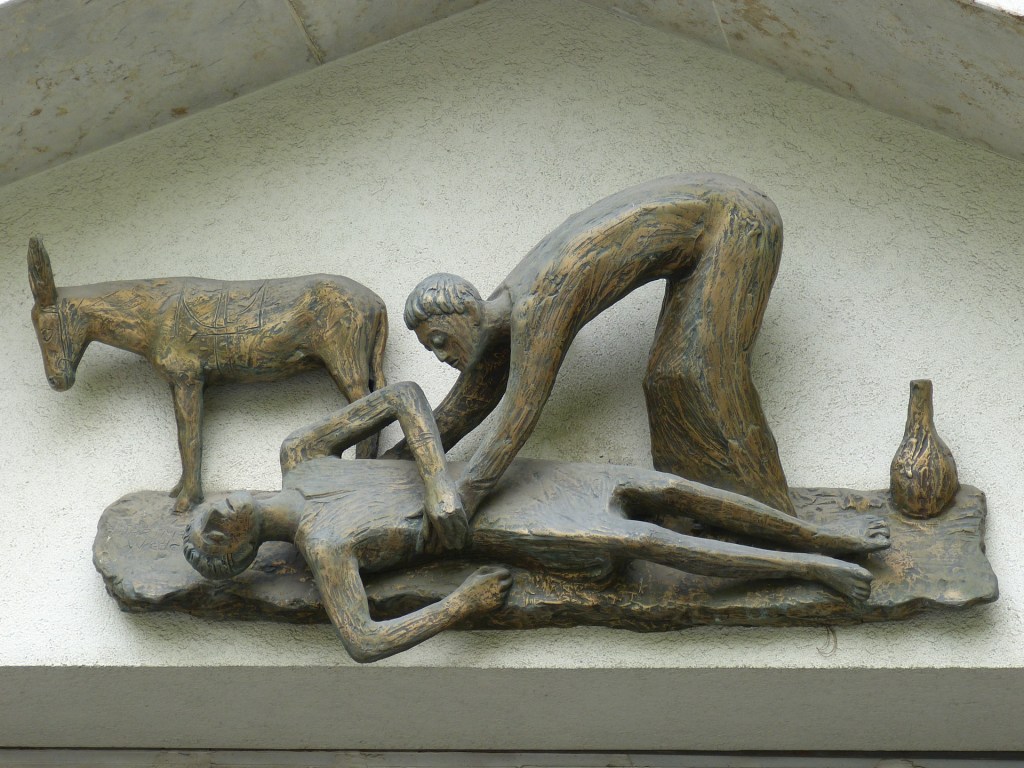
Luke 10: 25 – 37 The parable of the good Samaritan

Luke 10: 25 – 37 The parable of the good Samaritan

On one occasion an expert in the law stood up to test Jesus. ‘Teacher,’ he asked, ‘what must I do to inherit eternal life?’

‘What is written in the Law?’ he replied. ‘How do you read it?’

He answered, ‘ “Love the Lord your God with all your heart and with all your soul and with all your strength and with all your mind”; and, “Love your neighbour as yourself.” ‘

‘You have answered correctly,’ Jesus replied. ‘Do this and you will live.’

But he wanted to justify himself, so he asked Jesus, ‘And who is my neighbour?’

In reply Jesus said: ‘A man was going down from Jerusalem to Jericho, when he was attacked by robbers. They stripped him of his clothes, beat him and went away, leaving him half-dead. A priest happened to be going down the same road, and when he saw the man, he passed by on the other side. So too, a Levite, when he came to the place and saw him, passed by on the other side. But a Samaritan, as he travelled came where the man was; and when he saw him, he took pity on him. He went to him and bandaged his wounds, pouring on oil and wine. Then he put the man on his own donkey, brought him to an inn and took care of him. The next day he took out two denarii and gave them to the inn-keeper. “Look after him,” he said “and when I return, I will reimburse you for any extra expense you may have.”

‘Which of these three do you think was a neighbour to the man who fell into the hands of robbers?’

The expert in the law replied, ‘The one who had mercy on him.’

Jesus told him, ‘Go and do likewise.’  

*       *       *

There were all sorts of reasons why the priest and the Levite might not have stopped to help the man who had been attacked.

They were almost certainly frightened. The road was notoriously dangerous and they were alone. The road had a reputation for robbers, and here was the evidence. Why, they could still be hiding in the rocks above, waiting for another victim!

There may have been an element of mistrust. They may have thought that the man was feigning injury, as a tactic to delay the traveller, giving time for the robbers to ambush him.

And what if he was dead, or died while they were helping him? They would be ritually unclean for seven days.

Now the Jews hated Samaritans. Their religion was very similar to Judaism, but based around a temple on Mt Gerizim. During the first century, Jews and Samaritans were constantly feuding; lives were lost on both sides. If you were a Jew, you wouldn’t pick a Samaritan as the hero of your story.

Except that Jesus did.

Jesus makes the parable as sharp as possible. For the expert in the law, priests and Levites were virtuous almost by definition. They were men with a vocation to serve God. They were men who had studied and understood their faith. They were men like the expert on the law himself; and we have already seen from his reply to Jesus that he knew what his faith taught as the way to gain eternal life.

Yet with the parable presented as it is, the expert is forced to choose the Samaritan as the example to copy.

Perhaps the priest was a man whose sense of vocation to a high calling blinded him to the urgent needs of the world.

Perhaps the Levite was a man who couldn’t see the moral imperative to help an injured man because of the blinkers of human convention.

How understandable. How human. How forgivable.

And yet, here they are, held up to us as a warning – almost an eternal ‘naming and shaming’. Our sins of omission have consequences not just for those around us, but for us too.

The expert in the law swallows his pride and resentment and answers correctly, and Jesus says, ‘Go and do likewise.’

What is the lesson here? It is that our response to human need is what marks out the genuine worshipper of God.

But this parable is very rich, and there’s more we can learn.

Consider the innkeeper, who is often a forgotten character. When he left, the Samaritan paid some money to the innkeeper, not just for the care already given to the injured man, but for care into the future. And with it, he gave a promise that if the bill came to more than he had left, he would settle it on his return. It’s clear that we are meant to understand that the innkeeper was prepared to accept this – an open-ended commitment to take care of the victim. And that says two things. Firstly, the innkeeper was trusting, he had faith, and because of that he was prepared to take on a task that he probably wouldn’t otherwise have tackled. And secondly, the Samaritan was trustworthy; his words, actions and demeanour had convinced the innkeeper that any debt would be honoured.

Jesus himself is often regarded as the Good Samaritan; and we can all play the part of the innkeeper. By trusting in Jesus we are empowered to do good, that is to say, we can do something to heal the hurts of those around us.

We don’t need to feel a vocation; that can even get in the way, as it did for the priest.

We don’t need book-learning and consecration like the Levite; again, that may sometimes be an obstacle.

All we need is trust in Jesus, and the willingness to care for those who come to us in our normal, everyday, humdrum lives.

And there’s still more in this parable for us.

Why was the Samaritan so effective as a contrast to the priest and Levite? It was because he was part of a despised minority.

Does this parable have anything to say to us about racism?

Martin Luther King evidently thought so. Listen to what he said:

“On the one hand we are called to play the good Samaritan on life’s roadside; but that will be only an initial act. One day we must come to see that the whole Jericho road must be transformed so that men and women will not be constantly beaten and robbed as they make their journey on life’s highway. True compassion is more than flinging a coin to a beggar; it is not haphazard and superficial. It comes to see that an edifice which produces beggars needs restructuring.”

Prayer

Heavenly Father

Thank you for Jesus’ teaching, and thank you especially for this parable. Please help me to put it into practice.

In Jesus’ name, Amen

Luke 10: 1 – 24 Jesus sends out the seventy-two

Luke 10: 1 – 24 Jesus sends out the seventy-two

After this the Lord appointed seventy-two others and sent them two by two ahead of him to every town and place where he was about to go. He told them, ‘The harvest is plentiful, but the workers are few. Ask the Lord of the harvest, therefore, to send out workers into his harvest field. Go! I am sending you out like lambs among wolves. Do not take a purse or bag or sandals; and do not greet anyone on the road.

‘When you enter a house, first say, “Peace to this house.” If someone who promotes peace is there, your peace will rest on them; if not, it will return to you. Stay there, eating and drinking whatever they give you, for the worker deserves his wages. Do not move around from house to house.

‘When you enter a town and are welcomed, eat what is offered to you. Heal those there who are ill and tell them, “The kingdom of God has come near to you.” But when you enter a town and are not welcomed, go into its streets and say, “Even the dust of your town we wipe from our feet as a warning to you. Yet be sure of this: the kingdom of God has come near.” I tell you, it will be more bearable on that day for Sodom than for that town.

‘Woe to you, Chorazin! Woe to you, Bethsaida! For if the miracles that were performed in you had been performed in Tyre and Sidon, they would have repented long ago, sitting in sackcloth and ashes. But it will be more bearable for Tyre and Sidon at the judgment than for you. And you, Capernaum, will you be lifted to the heavens? No, you will go down to Hades.

‘Whoever listens to you listens to me; whoever rejects you rejects me; but whoever rejects me rejects him who sent me.’

The seventy-two returned with joy and said, ‘Lord, even the demons submit to us in your name.’

He replied, ‘I saw Satan fall like lightning from heaven. I have given you authority to trample on snakes and scorpions and to overcome all the power of the enemy; nothing will harm you. However, do not rejoice that the spirits submit to you, but rejoice that your names are written in heaven.’

At that time Jesus, full of joy through the Holy Spirit, said, ‘I praise you, Father, Lord of heaven and earth, because you have hidden these things from the wise and learned, and revealed them to little children. Yes, Father, for this is what you were pleased to do.

‘All things have been committed to me by my Father. No one knows who the Son is except the Father, and no one knows who the Father is except the Son and those to whom the Son chooses to reveal him.’

Then he turned to his disciples and said privately, ‘Blessed are the eyes that see what you see. For I tell you that many prophets and kings wanted to see what you see but did not see it, and to hear what you hear but did not hear it.’

*       *       *

“The kingdom of God has come near to you.”

This sentence is right at the heart of the passage. Whether the disciples are welcomed or rejected by a town, the kingdom of God has come near to those people.

There will be blessings for those who welcome the disciples; their peace will rest on the household who accommodate them, and those in the town who are ill will be cured.

But there are severe warnings for those who do not accept the disciples, because, “whoever rejects you rejects me; but whoever rejects me rejects him who sent me.” Those who do not accept Jesus are rejecting God the Father. Indeed, Jesus speaks about judgment, and identifies Chorazin, Bethsaida and Capernaum as condemned for their lack of faith.

As I said yesterday, I have difficulty with doctrines of judgment. I’m trying to find a way of reconciling punishment with a loving God. Evidence is mounting that a positive, loving approach to people is far more effective at changing their behaviour than punishment. It’s clear that many criminal and anti-social acts arise from mental illness and often from poor upbringing. The justification for punishment either for reform or retribution looks increasingly ethically untenable. I’ll keep wrestling, and praying!

Then we have this rather obscure passage:

At that time Jesus, full of joy through the Holy Spirit, said, ‘I praise you, Father, Lord of heaven and earth, because you have hidden these things from the wise and learned, and revealed them to little children. Yes, Father, for this is what you were pleased to do.”

At first glance this reads as though thinking about our faith is being discouraged. I don’t think that’s the case, though. Rather, I think it’s more to do with how we welcome God, and love, into our lives.

A small child is totally dependent on its family, and it knows this. It accepts and returns love instinctively. So far, so good.

It accepts what it is taught about the world without question. Without question? Yes, surely. But why does a parent teach their child about the world? It’s so that the child, as it matures, can live independently of the parents.

I think what this passage is teaching us is that we have to accept Jesus simply, as a child would, and trust him to teach us what we need to know. And as we grow up and mature, we have to keep going back to Jesus for understanding.

“The kingdom of God has come near to you.”

Yes, we can be sure of this. And one of the things that I believe it means is that Jesus is close to us. Just like a small child, I can rest on him. I can be confident of a loving reception when I pray, or study, or worship, or just hold onto him in my thoughts.

Praise God for such love!

Prayer

Heavenly Father

Thank you that your kingdom is close to me. Please help me to trust you and your teaching, and guide my understanding.

In Jesus name, Amen

Luke 9: 51 – 62 Samaritan opposition (and) The cost of following Jesus

Luke 9: 51 – 62 Samaritan opposition (and) The cost of following Jesus

As the time approached for him to be taken up to heaven, Jesus resolutely set out for Jerusalem. And he sent messengers on ahead, who went into a Samaritan village to get things ready for him; but the people there did not welcome him, because he was heading for Jerusalem. When the disciples James and John saw this, they asked, ‘Lord, do you want us to call fire down from heaven to destroy them?’ But Jesus turned and rebuked them. Then he and his disciples went to another village.

As they were walking along the road, a man said to them, ‘I will follow you wherever you go.’

Jesus replied, ‘Foxes have dens and birds have nests, but the Son of Man has nowhere to lay his head.’

He said to another man, ‘Follow me.’

But he replied, ‘Lord, first let me go and bury my father.’

Jesus said to him, ‘Let the dead bury their own dead, but you go and proclaim the kingdom of God.’

Still another said, ‘I will follow you, Lord; but first let me go back and say goodbye to my family.’

Jesus replied, ‘No one who puts a hand to the plough and looks back is fit for service in the kingdom of God.’

*       *       *

When the disciples James and John saw this, they asked, ‘Lord, do you want us to call fire down from heaven to destroy them?’

My first response to this question is to wonder how James and John could make such a spectacular mistake. What reasons could they have had? Let’s start by looking at the context.

Jesus is heading for Jerusalem, “resolutely” as St Luke puts it. Twice, now, he has spoken to the disciples about his forthcoming death. They haven’t understood, but they’re starting to understand that there’s a crisis ahead. They can sense that time is running short.

In addition, there was a strand of Jewish thinking at the time that anticipated the end of the world with judgment and the creation of a new heaven and earth. This carried over into early Christian thought, too. In fact, in Luke 10: 13 – 15 we see very clearly that St Luke’s understanding of Jesus’ teaching was that there would be a day of reckoning for those towns that had rejected him.

So it would seem that the disciples’ mistake was one of timing rather than outcome. The Samaritan village would suffer a judgment as terrible as fire falling from heaven to destroy it.

I’m sorry; I don’t buy that. Even human justice doesn’t go that far. Indeed, when a nation rains down fire from heaven on civilian villages, we refer to the act as a war crime.

Is this a misunderstanding of God’s purpose by St Luke, or is this genuinely what God wants us to understand from this teaching? I am going to hold onto the thought that St Luke is understanding Jesus’ teaching in the intellectual context of his time, and that the message is not as harsh as it appears here. However, I do this with trepidation, because I want to take the bible seriously.

The next five verses are about the cost of following Jesus. When you follow Jesus, he has to come first.

He has no dwelling. Why should a disciple expect more?

You may think you have a very good family reason for not immediately following Jesus, but if you have been given a task by Jesus you must put that task first.

You may even be happy to do as you’re told, you just want to say goodbye to your family. The trouble is that this is a distraction. If you look back while you’re ploughing, you’re likely to plough in the wrong place. The task needs your full attention.

Now while Jesus must come first for each one of us, it’s not always the case that you have to leave your family; that you have no home; that family duties aren’t important. We know that Jesus had friends who showed their faith in their ordinary daily lives. Mary, Martha and Lazarus, for example, were people like that, living normal lives, and Jesus loved them.

But for each of us there is likely to be a time when Jesus says, “Now, I want all your attention, all your love.” When that day comes, we need to be ready to say “Yes, Lord,” with love and gratitude, for it is our beloved speaking.

Prayer

Heavenly Father

I’m sorry; I really struggle with the teaching about judgment. Please help me to understand and accept what I need in order to follow Jesus faithfully.

In Jesus name, Amen

Luke 9: 43 – 50 Jesus predicts his death a second time

Luke 9: 43 – 50 Jesus predicts his death a second time

While everyone was marvelling at all that Jesus did, he said to his disciples, ‘Listen carefully to what I am about to tell you: the Son of Man is going to be delivered into the hands of men.’ But they did not understand what this meant. It was hidden from them, so that they did not grasp it, and they were afraid to ask him about it.

An argument started among the disciples as to which of them would be the greatest. Jesus, knowing their thoughts, took a little child and made him stand beside him. Then he said to them, ‘Whoever welcomes this little child in my name welcomes me; and whoever welcomes me welcomes the one who sent me. For it is the one who is least among you all who is the greatest.’

‘Master,’ said John, ‘we saw someone driving out demons in your name and we tried to stop him because he is not one of us.’

‘Do not stop him,’ Jesus said, ‘for whoever is not against you is for you.’

*       *       *

Despite the fact that Jesus had already told his disciples that he was to suffer and die (Luke 9: 21 – 27) Luke says in this passage that when Jesus told them the second time, the disciples didn’t understand what he meant. “It was hidden from them, so that they did not grasp it, and they were afraid to ask him about it.” That’s very human, isn’t it? We tell ourselves that we don’t understand something but in reality we’re frightened that we understand it only too well.

If Jesus is going to be killed, the disciples will be leaderless and without a plan. They’ll probably be arrested and killed too. What good will that achieve? And what good will all this time spent with Jesus be, when daily life has been continuing around them? Of course they didn’t want to understand, they didn’t want to believe.

I know from training sessions that when we are faced with something new and difficult, there is a great temptation to go back to the old ways. They feel warm and comfortable. We know where we are with them. And that is what the disciples do now. Jesus has been leading them to the hard truths of what is to happen to him, but they go back to thinking that he will be establishing an earthly kingdom. All earthly kingdoms have a hierarchy, so the disciples will be ranked. I bet they’ve had this argument a dozen times! And I bet it feels reassuring! But it’s missing the point. It’s taking their eyes off Jesus and looking instead at the way the world works. It’s sin, and has the potential to disrupt God’s plan.

Jesus deals with it is a subtle way; he takes away the comfort of the old ways of thinking, while simultaneously teaching the disciples about the reality of God’s kingdom.

The disciples were thinking of status and power. They were thinking of a world where the respect people give you depends on what they can get from you. Tit for tat. Quid pro quo. You scratch my back, and I’ll scratch yours. So Jesus shows them a small child, someone who can give nothing at all, and who therefore has no status at all.

What you must do, Jesus was saying, is to welcome and to show respect even to those who have nothing to give you and cannot increase your prestige among men. ‘For it is the one who is least among you all who is the greatest.’ He overturns the disciples’ old, familiar habits of thought, and puts their focus back onto God’s plan.

I find this quite profound teaching. Jesus actually seems to be calling us to focus on him all the time. I confess that I find this difficult. When I think logically about it, I can see that to say I want to spend time away from Jesus suggests that I don’t like his company, or that I’m bored and want a change. That doesn’t say much for my faith or my imagination!

Finally, just a brief note about the last two verses. John wants to show Jesus that he is fully committed to God’s plan. ‘Master,’ said John, ‘we saw someone driving out demons in your name and we tried to stop him because he is not one of us.’

Once again we see wrong ideas about the kingdom of God.

‘Do not stop him,’ Jesus said, ‘for whoever is not against you is for you.’

Firstly, we are either for or against Jesus; there is no middle ground.

Secondly, we don’t know the detail of God’s plan. If someone is preaching and healing in Jesus’ name they are likely to be inspired by God.

Thirdly, God does not need us to defend his plan by condemning others; he needs us to implement his plan by prayer and faithful service.

Prayer

Heavenly Father

Your plan is perfect, just as you are perfect. Please open my eyes to the beauty of your truth.

In Jesus name, Amen

Mark 9: 14 – 29 Jesus heals a boy possessed by an impure spirit

Mark 9: 14 – 29 Jesus heals a boy possessed by an impure spirit

“When they came to the other disciples, they saw a large crowd around them and the teachers of the law arguing with them. As soon as all the people saw Jesus, they were overwhelmed with wonder and ran to greet him.”

‘What are you arguing with them about?’ he asked.

A man in the crowd answered, ‘Teacher, I brought you my son, who is possessed by a spirit that has robbed him of speech. Whenever it seizes him, it throws him to the ground. He foams at the mouth, gnashes his teeth and becomes rigid. I asked your disciples to drive out the spirit but they could not.’

‘You unbelieving generation,’ Jesus replied, ‘how long shall I stay with you? How long shall I put up with you? Bring the boy to me.’

So they brought hi. When the spirit saw Jesus, it immediately threw the boy into a convulsion. He fell to the ground and rolled around, foaming at the mouth.

Jesus asked the boy’s father, ‘How long has he been like this?’

‘From childhood,’ he answered. ‘It has often thrown him into fire or water to kill him. But if you can do anything, take pity on us and help us.’

‘ “If you can?” ‘ said Jesus. ‘Everything is possible for one who believes.’

Immediately the boy’s father exclaimed, ‘I do believe; help me to overcome my unbelief!’

When Jesus saw that a crowd was running to the scene, he rebuked the impure spirit. ‘You deaf and mute spirit,’ he said. ‘I command you, come out of him and never enter him again.’

The spirit shrieked, convulsed him violently and came out. The boy looked so much like a corpse that many said, ‘He’s dead.’ But Jesus took him by the hand and lifted him to his feet, and he stood up.

After Jesus had gone indoors, his disciples asked him privately, ‘Why couldn’t we drive it out?’

He replied, ‘This kind can come out only by prayer.’

*       *       *

This describes the same event that I wrote about yesterday, but is from St Mark’s gospel. I found as I walked and prayed this morning that there was more to say based on this miracle.

I was thinking about heaven.

Many years ago I had a vision, not of heaven, but of what it was like to die in faith. All the symbols of faith poured past my perception; the flames of the Holy Spirit at Pentecost; the Lamb of God; the body and blood of Christ in the sacrament of the Eucharist. I was flooded with a great joy, because I experienced a sense of total acceptance. It was wonderful.

Now, one of the challenges to my faith is the existence of suffering. Much suffering is caused by human sin; greed, anger, lust. One only has to look at the situation in Yemen to see how appalling the consequences can be. However, a great deal of suffering is not caused by human agency, but by the consequences of natural phenomena. I am occasionally told forcefully that a Creator who made a world containing such horrors must be wicked – or non-existent.

The only answer I have is that God is greater than me. I am not able to comprehend his plan. I go a little further, and say that I believe that suffering in this world must be more than balanced out in our life after death, but even as write this I know that I’m just guessing. I have faith in a loving God, and a just God, but how he implements his love and his justice are unknowable for as long as I’m in this material world – and quite possibly afterwards.

But, as I said earlier, I was out walking and praying, and I thought of the vision I’d had so many years ago. Was heaven perhaps something like that, a perfect acceptance of me as a whole person? The joy that I felt in the few seconds the vision lasted was intense.

But there is so much sin in my life, so many hours of the day when it is not Jesus to whom I am paying attention, it is food, or television, or fiction. What would it be like to lose those things? – because I’m pretty sure that sin will not exist in heaven.

And then I thought once more about this miracle of healing.

The boy possessed by an impure spirit was probably an epileptic. In modern knowledge a cure would require a profound change to the way the boy’s brain functioned. Jesus accomplished this miraculously and healed him of a severe disorder. The bible describes the miracle as the driving out of a demon, and that’s an excellent metaphor here, because the core person, the spirit of the boy, was not harmed by the exorcism. Indeed, it was quite the reverse; he was given a much fuller life.

And maybe that’s what happens in heaven. The sin that we find so alluring in this world will be shown up for what it is – an irrelevance to true life.

Do you think the epileptic boy was glad to be cured? I bet he was!

Prayer

Heavenly Father

You have created a wonderful world for us to live in, and you’ve given us each a spirit that can respond to its beauty. Thank you.

In Jesus name, Amen

Luke 9: 37 – 43 Jesus heals a demon-possessed boy

Luke 9: 37 – 43 Jesus heals a demon-possessed boy

The next day, when they came down from the mountain, a large crowd met him. A man in the crowd called out, ‘Teacher, I beg you to look at my son, for he is my only child. A spirit seizes him and he suddenly screams; it throws him into convulsions so that he foams at the mouth. It scarcely ever leaves him and is destroying him. I begged your disciples to drive it out, but they could not.’

‘You unbelieving and perverse generation,’ Jesus replied, ‘how long shall I stay with you and put up with you? Bring your son here.’

Even while the boy was coming, the demon threw him to the ground in a convulsion. But Jesus rebuked the impure spirit, healed the boy and gave him back to his father. And they were all amazed at the greatness of God.

*       *       *

This is another event that is described in all three of the synoptic gospels. The parallel passages are Matthew 17: 14 – 20, and Mark 9: 14 – 29.

Jesus, Peter, James and John return from the wonderful experience of the transfiguration to a scene of disorder. St Luke only talks of a large crowd, but St Mark says “When they came to the other disciples, they saw a large crowd around them and the teachers of the law arguing with them. As soon as all the people saw Jesus, they were overwhelmed with wonder and ran to greet him.”

I’m sure Jesus already knew what was going on, and how he would handle it, but he asks the question, ‘What are you arguing with them about?’. He asks this so that everybody present knows what the trouble is, and will know what they have witnessed.

The man explains the symptoms from which his son suffers, and adds (in St Mark’s account) ‘I asked your disciples to drive out the spirit, but they could not.’

Ah. So that’s the root of the problem. The disciples had failed to heal the boy, and the teachers of the law had criticised them for their failure.

This failure is important for us. Jesus had specifically given the disciples authority to cast out demons and heal diseases. They had successfully used that authority and healed people miraculously. Why did they fail this time?

Jesus’ reply to the father and to the crowd was scathing. ‘You unbelieving and perverse generation,’ Jesus replied, ‘how long shall I stay with you and put up with you? Bring your son here.’

The problem was lack of faith. The father had a little faith – he wouldn’t have come to Jesus at all if he hadn’t. The crowd were probably like crowds everywhere, eager to see a miracle, and if that failed, eager to crow over the discredited miracle worker. Jesus could see the whole frustrating cycle. The more hostile the crowd, the harder for the disciples to use their faith and the less likely they were to heal the boy.

Even while the boy was coming, the demon threw him to the ground in a convulsion.

I wonder how the disciples felt? I wonder if there was any vestige of doubt in their minds that Jesus himself might fail to heal the boy? Faith would have been difficult, I’m sure.

But Jesus rebuked the impure spirit, healed the boy and gave him back to his father. And they were all amazed at the greatness of God.

Despite the hostility, despite the scepticism, despite the lack of faith of the crowd, and despite the father’s doubts, Jesus heals the boy. It is an act of compassion to the boy, a free gift. It is an object lesson to the disciples, and a powerful boost to their faith. To any in the crowd who are prepared to receive it, it is a sign that Jesus’ ministry comes from God.

I said earlier that the disciples’ failure was important for us. The disciples had direct, personal teaching from Jesus. They had been given a specific commission to cast out demons and heal the sick. They had performed miracles themselves.

And yet they still failed!

The message I take from that is that when I fail, I must not give up. I must go to Jesus in prayer and ask him what I need to do to stop failing.

Prayer

Heavenly Father

I’m sorry for failing you. Please teach me what I need to do to follow Jesus better, and help me have the strength to do it.

In Jesus name, Amen

Luke 9: 28 – 36 The transfiguration

Luke 9: 28 – 36 The transfiguration

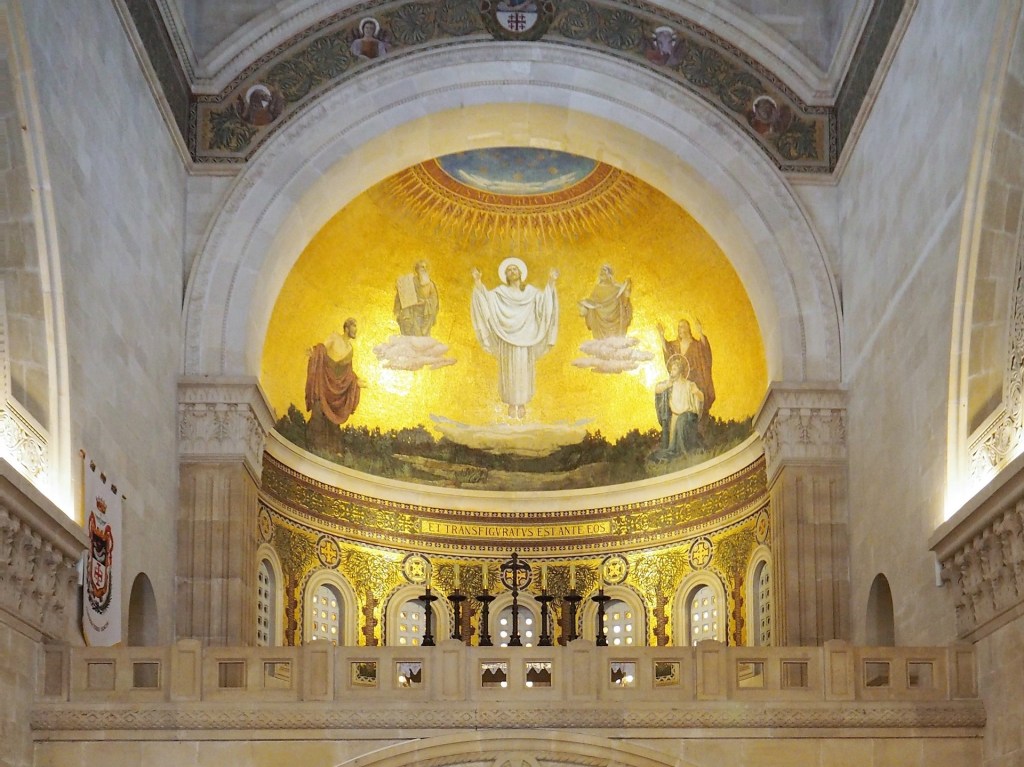
About eight days after Jesus said this, he took Peter, John and James with him and went up onto a mountain to pray. As he was praying, the appearance of his face changed, and his clothes became as bright as a flash of lightning. Two men, Moses and Elijah, appeared in glorious splendour, talking with Jesus. They spoke about his departure, which he was about to bring to fulfilment at Jerusalem. Peter and his companions were very sleepy, but when they became fully awake, they saw his glory and the two men standing with him. As the men were leaving Jesus, Peter said to him, ‘Master, it is good for us to be here. Let us put up three shelters – one for you, one for Moses and one for Elijah.’ (He did not know what he was saying.)

While he was speaking, a cloud appeared and covered them, and they were afraid as they entered the cloud. A voice came from the cloud, saying, ‘This is my Son, whom I have chosen; listen to him.’ When the voice had spoken, they found that Jesus was alone. The disciples kept this to themselves and did not tell anyone at that time what they had seen.

*       *       *

I’m afraid that my first response to this passage was sceptical. It’s dramatic – cinematic, even – seeming more like Star Trek than scripture. That discomfited me, so I prayed for understanding and started studying.

This event is recorded in all three of the synoptic gospels, (Matthew 17: 1 – 13; and Mark 9: 2 – 13) and also in 2 Peter 1: 16 – 18. Of these, 2 Peter 1: 16 – 18 is perhaps the most striking, because the author of the letter is St Peter, and he writes, “We ourselves heard this voice that came from heaven when we were with him on the mountain.”

An eye-witness account. Wow!

But when was 2 Peter written? Could it really have been early enough? I read that this was controversial, with many scholars concluding that it wasn’t written by St Peter, but by someone else, much later, probably not before 150 AD. Even very early in the church’s existence there was apparently doubt about the authorship. However, some scholars supported the view that it really had been written by St Peter shortly before his martyrdom.

I looked at various summaries of the evidence, and the evidence for doubting St Peter’s authorship seemed slim, resting on arguments such as style, inconsistency with 1 Peter, and the use of quotations from the letter of Jude. There didn’t seem to be any fundamental reason not to accept the letter at face value as being from “Simon Peter, a servant and apostle of Jesus Christ.”

So, yes, an eye-witness account. Wow! I really must take this very seriously.

And it was while I was looking at the arguments for Peter’s authorship that I came across a very interesting article about the accuracy of the New Testament that you can find here https://evidenceforchristianity.org/if-the-bible-was-written-so-long-ago-and-interpreted-in-many-different-ways-and-has-been-re-written-so-many-times-how-can-we-be-sure-the-version-we-read-today-is-not-complete-fiction/

The evidence presented in the article has changed my view of the accuracy of the New Testament. We may challenge what should be understood from the texts, but in terms of whether or not the texts have been corrupted in copying there’s really no doubt at all. We have the same texts as Christians from the first and second centuries.

I’m forced to the conclusion that something dramatic – indeed, something quite extraordinary – happened on that mountain.

As to why it happened and its significance, I think I shall quote 2 Peter 1: 16 – 18, which seems to me to put it more clearly than St Luke in his gospel.

For we did not follow cleverly devised stories when we told you about the coming of our Lord Jesus Christ in power, but we were eyewitnesses of his majesty. He received honour and glory from God the Father when the voice came to him from the Majestic Glory, saying, ‘This is my Son, whom I love; with him I am well pleased.’ We ourselves heard this voice that came from heaven when we were with him on the sacred mountain.

Prayer

Heavenly Father

Thank you for your words that have been faithfully and accurately transmitted through the millennia. Please let them be fruitful in our hearts and lives.

In Jesus name, Amen

Luke 9: 21 – 27 Jesus predicts his death

Luke 9: 21 – 27 Jesus predicts his death

[ ‘But what about you?’ he asked. ‘Who do you say I am?’

Peter answered, ‘God’s Messiah.’ ] (Luke 9: 20)

Jesus strictly warned them not to tell this to anyone. And he said, ‘The Son of Man must suffer many things and be rejected by the elders, the chief priests and the teachers of the law, and he must be killed and on the third day be raised to life.’

Then he said to them all: ‘Whoever wants to be my disciple must deny themselves and take up their cross daily and follow me. For whoever wants to save their life will lose it, but whoever loses their life for me will save it. What good is it for someone to gain the whole world, and yet lose or forfeit their very self? Whoever is ashamed of me and my words, the Son of Man will be ashamed of them when he comes in his glory and in the glory of the Father and of the holy angels.

‘Truly I tell you, some who are standing here will not taste death before they see the kingdom of God.’

*       *       *

Surely this prophesy and this teaching must have been shocking? The Son of Man will be killed by the authorities? A would-be disciple must take up their cross daily and follow Jesus? And yet there is no hint of shock in Luke’s account.

However, St Matthew and St Mark also record this event. St Matthew’s account is more graphic.

From that time on Jesus began to explain to his disciples that he must go to Jerusalem and suffer many things at the hands of the elders, the chief priests and the teachers of the law, and that he must be killed and on the third day be raised to life.

Peter took him aside and began to rebuke him. ‘Never, Lord!’ he said. ‘This shall never happen to you!’

Jesus turned and said to Peter, ‘Get behind me, Satan! You are a stumbling block to me; you do not have in mind the concerns of God, but merely human concerns.’

Then Jesus said to his disciples, ‘Whoever wants to be my disciple must deny themselves and take up their cross and follow me.’ (Matthew 16: 21 – 24)

(You can read St Mark’s version at Mark 8: 31 – 33)

This teaching is in all three synoptic gospels. Even more compelling, the gospel writers choose to emphasise different elements of the teaching, just as reliable witnesses would. It is clear that this is Jesus’ teaching. What exactly does it mean?

At the very least it must mean that whenever there is a clash between our human plans and following Jesus, we must choose following Jesus. And we are told, with no ambiguity at all, that this will be difficult; it will be to ‘take up our cross’.

Jesus knew exactly what that meant, and so did the early church. It meant unremitting effort and pain; it meant the loss of any human freedom and dignity; and it only ended with death. That’s a big ask.

The compensation in this lifetime is two-fold. Firstly, the more we take up the cross, the more aware we can be of the presence of Jesus. We will be walking in the way he walked, and he will go with us every step of the way. Secondly, we will become more like Jesus in character; we will become part of God’s solution to the evils in the world.

Prayer

Heavenly Father

I’m sorry I find it so hard to follow Jesus with my whole heart. Please take the little I offer and help me to increase it.

In Jesus name, Amen

Luke 9: 18 – 20 Peter declares that Jesus is the Messiah

Luke 9: 18 – 20 Peter declares that Jesus is the Messiah

Once when Jesus was praying in private and his disciples were with him, he asked them, ‘Who do the crowds say I am?’

They replied, ‘Some say John the Baptist; others say Elijah; and still others, that one of the prophets of long ago has come back to life.’

‘But what about you?’ he asked. ‘Who do you say I am?’

Peter answered, ‘God’s Messiah.’

*       *       *

The way St Luke writes this passage makes it appear that Peter’s answer is cut and dried. However, when I started to look into what the Jews of the first century AD would have understood by the term “Messiah” I discovered that it wasn’t.

One thing that the term “Messiah” didn’t mean to a Jew was “Son of God”, and a part of the Godhead. The Jewish faith is strictly monotheistic, and such an interpretation would never have occurred to them. As far as I can tell – and I am not a theological scholar – the Jewish concept of the Messiah was that he would be a man, or perhaps an angel. He would unify the whole worldwide Jewish nation, restoring them to their original homeland of Israel and ushering in a golden age of peace, prosperity and justice.

But we have to consider as well why St Luke wrote his gospel. It was written to provide “an orderly account for you, most excellent Theophilus, so that you may know the certainty of the things you have been taught.” (Luke 1: 3 – 4) In other words, it was written to confirm and reinforce the teaching of the early church.

St Luke’s gospel was probably written sometime in the 90s AD, that is to say about sixty years after the life of Jesus, and substantially later than Paul’s epistles. By this time, the early church was well on the way to viewing God as a Trinity, with the Father, the Son, and the Holy Spirit.

So what does Peter’s confession that Jesus is the Messiah mean? It certainly includes the belief that Jesus was chosen and anointed by God. It probably also implies that Jesus is the Son of God.

And for me. What is my confession of faith? In my heart of hearts, who do I really believe Jesus to be?

Prayer

Heavenly Father,

Sometimes it seems easy to believe in Jesus and trust him, and sometimes it feels difficult. When I read of the numerous ways in which the same scriptures can be interpreted, and when I read of the doubt about sources, it can feel hard to believe in simplicity. Please forgive me for my doubts.

In Jesus name, Amen