‘I have come to bring fire on the earth, and how I wish it were already kindled! But I have a baptism to undergo, and what constraint I am under until it is completed! Do you think I came to bring peace on earth? No, I tell you, but division. From now on there will be five in one family divided against each other, three against two and two against three. They will be divided, father against son and son against father, mother against daughter and daughter against mother, mother-in-law against daughter-in-law and daughter-in-law against mother-in-law.’
* * *
These are violent and disruptive images. What is the Prince of Peace talking about?
The baptism Jesus speaks of is his crucifixion. He knows that the time is close, and he knows, too, how much he still has to do.
It is this baptism that will enable the Holy Spirit to dwell in those who believe in Jesus. It was necessary for Jesus to die on the cross and be raised from the dead in order for the Holy Spirit to be sent. It is the Holy Spirit who binds the followers of Jesus into his body, the church. We see this when the Holy Spirit came down on the early church like tongues of fire. (Acts 2: 1 – 4).
‘When Jesus says ‘I have come to bring fire on the earth, and how I wish it were already kindled!’ he is expressing his longing for his followers to receive the Holy Spirit.
However, what will be the result? Many will be converted and follow Jesus, but many will not. The calling to follow Jesus requires complete commitment. Our love for family and friends may be very strong but we are called to love Jesus even more.
As followers of Jesus we are called to love our neighbours as ourselves. The bible teaches us that we must try hard to live at peace with all men.
If it is possible, as far as it depends on you, live at peace with everyone. (Romans 12:18)
But the life we are called to live as followers of Jesus challenges the wisdom of the world. Other people, even family members, are going to disagree with us and oppose us. In some cases, such opposition may be violent; imagine, for example, the reaction of a Muslim family if one of them converts to Christianity.
So when Jesus says ‘Do you think I came to bring peace on earth? No, I tell you, but division’ he doesn’t mean that he wants to cause violence or discord, but that the response to the message he brings will polarise people.
The tension between the message of Jesus and the desirability of peace is summed up nicely in this quotation from the Sacred Space website
“Conformity and harmony are never to be imposed or sought for themselves. They are not a mould into which life is to be forced. When life is properly arranged, they will be the result.”
Prayer
Heavenly Father
Please help me to be a peacemaker. But please also help me to take your message with the utmost seriousness.
‘Be dressed ready for service and keep your lamps burning, like servants waiting for their master to return from a wedding banquet, so that when he comes and knocks they can immediately open the door for him. It will be good for those servants whose master finds them watching when he comes. Truly I tell you, he will dress himself to serve, will make them recline at the table and will come and wait on them. It will be good for those servants whose master finds them ready, even if he comes in the middle of the night or towards daybreak. But understand this: if the owner of the house had known at what hour the thief was coming, he would not have let his house be broken into. You also must be ready, because the Son of Man will come at an hour when you do not expect him’
Peter asked, ‘Lord, are you telling this parable to us, or to everyone?’
The Lord answered, ‘Who then is the faithful and wise manager, whom the master puts in charge of his servants to give them their food allowance at the proper time? It will be good for that servant whom the master finds doing so when he returns. Truly I tell you, he will put him in charge of all his possessions. But suppose the servant says to himself, “My master is taking a long time in coming,” and he them begins to beat the other servants, both men and women, and to eat and drink and get drunk. The master of that servant will come on a day when he does not expect him and at an hour he is not aware of. He will cut him to pieces and will assign him a place with the unbelievers.
‘The servant who knows his master’s will and does not get ready or does not do what the master wants will be beaten with many blows. But the one who does not know and does things deserving punishment will be beaten with few blows. From everyone who has been given much, much will be demanded; and from the one who has been entrusted with much, much more will be asked.
* * *
The first thing to realise about this passage is that Jesus is speaking in parables.
A good servant is likened to one who waits up all night, in his uniform, with his lamp lit, so that however late the master arrives from a wedding banquet he will have the door opened promptly by someone who is all ready to serve him. Such a servant is praised.
It will be good for those servants whose master finds them watching when he comes. Truly I tell you, he will dress himself to serve, will make them recline at the table and will come and wait on them.
If the master does this for his good servants, then he is treating them as though they were family rather than just servants.
But this is a parable. What does it mean in practice?
I think it means we need to be trying to do God’s will at all times; at church, at work, while shopping, at the hairdresser (remember not to gossip about others!), even in the middle of the night if we’re woken by a phone call at 2 a.m. and it’s a neighbour whose car has broken down and who needs rescuing.
It means aligning ourselves as closely as we can to God’s will. It means being attentive to the prompting of the Holy Spirit within us.
If we want to do God’s will at all times, if we sincerely try to obey Jesus, if we allow ourselves to be led by the Spirit of God, then we are children of God.
“For those who are led by the Spirit of God are the children of God.” (Romans 8:12)
If we are children of God, we are members of his family, exactly as this parable implies.
However, the encouragement comes with a warning:
‘If the owner of the house had known at what hour the thief was coming, he would not have let his house be broken into. You also must be ready, because the Son of Man will come at an hour when you do not expect him’
It’s several verses ago, but the scene for this teaching was set in Luke 11:53 – 12:1. Jesus was surrounded by a large crowd. He started his teaching by warning his disciples against hypocrisy.
The warning that the Son of Man will come when we don’t expect him is likewise a warning against hypocrisy. Doing the will of God means doing it all the time. We shouldn’t consciously do things that contravene God’s will. If we do, can we really say we are led by the Spirit of God?
When Peter questions Jesus as to whether this teaching is just for the disciples, or whether it also applies to the crowd, Jesus seems to make a distinction between the two groups. Those who have a leadership role will be expected to carry out that service faithfully. But such a role gives more scope for disobedience. If a leader abuses his position and exploits his fellow servants his punishment will be severe. Even if he is merely lazy, he can expect ‘many blows’. Those who are ignorant of God’s will, on the other hand, will receive ‘few blows’, and by this, I take it that Jesus was referring to the members of the crowd rather than his disciples
I find this question of punishment a difficult one. Certainly, God has the authority to punish, but why would he do so? It seems to go against other expectations we have of God. We are asked to trust him; but do we trust someone who threatens us with punishment? What sort of world do you get when fear is the driver?
I can understand from a human point of view that a household where an overseer abuses junior staff needs to be reformed. But the point to be addressed is surely the abuse of the junior staff rather than the punishment of the overbearing overseer?
For the present, I must just ask Jesus to forgive my doubts and questionings, and help me to understand what he wants.
Prayer
Heavenly Father
I’m sorry that I don’t understand (and, to be honest, I don’t like) what you are teaching here about punishment. Please help me to understand how you can be both a loving and a vengeful God. Please help me to understand how this teaching aligns with your revelation that it is love that can change the world.
Then Jesus said to his disciples: ‘Therefore I tell you, do not worry about your life, what you will eat; or about your body, what you will wear. For life is more than food, and the body more than clothes. Consider the ravens: they do not sow or reap, they have no storeroom or barn; yet God feeds them. And how much more valuable you are than birds! Who of you by worrying can add a single hour to your life? Since you cannot do this very little thing, why do you worry about the rest?
‘Consider how the wild flowers grow. They do not labour or spin. Yet I tell you, not even Solomon in all his splendour was dressed like one of these. If that is how God clothes the grass of the field, which is here today, and tomorrow is thrown into the fire, how much more will he clothe you – you of little faith! And do not set your heart on what you will eat or drink; do not worry about it. For the pagan world runs after all such things, and your Father knows that you need them. But seek his kingdom, and these things will be given to you as well.
Do not be afraid, little flock, for your Father has been pleased to give you the kingdom. Sell your possessions and give to the poor. Provide purses for yourselves that will not wear out, a treasure in heaven that will never fail, where no thief comes near and no moth destroys. For where your treasure is, there your heart will be also.’
* * *
For where your treasure is, there your heart will be also.
This sentence is the key to the whole passage.
For the last four months, I’ve been trying to walk at least 10,000 paces every day. (I understand from experts that this is the best single action I can take to boost my immune system against the risk of Covid 19). It’s a noticeable commitment of time and energy, and occupies nearly two hours every day.
What do I think about as I walk?
Work on my novel.
Whether we need to change the car.
How I am going to cook skate wings.
Whether my sister and I need to be urging our mother towards sheltered accommodation.
What I haven’t been doing until recently is thinking about God. I’m starting to realise that this is a clue that my treasure is not in heaven; it’s right here in this life. And at 69 however many precautions I take, against Covid 19 or anything else, I probably don’t have much of this life left.
And now, as I re-read what I’ve written, all I see is “I” and “my”; how revealing is that? That is the power of scripture; it shows us starkly the difference between God’s expectations of us and our response.
Jesus offers advice to help us make sure we have treasure in heaven.
First, we can stop worrying. God will provide all we need. Our Father knows we need food and drink and clothing, and if we are seeking his kingdom he will provide them.
Second, we can give to the poor – the more generously the better. If we really want treasure in heaven, we should be selling our possessions and giving away the proceeds.
This takes trust. It takes faith. God wants us to trust him. He wants us to enjoy a relationship with him, through Jesus. The essence of a relationship is that it is between individuals, and he approaches each one of us over and over again with the offer of his love. And, as Jesus said:
“And how much more valuable you are than birds!”
Thank you, Jesus, for your friendship.
Prayer
Heavenly Father
Thank you for your love. Please help me to be more mindful of your presence, and more generous to those who need my help.
Someone in the crowd said to him, ‘Teacher, tell my brother to divide the inheritance with me.’
Jesus replied, ‘Man, who appointed me a judge or an arbiter between you?’ Then he said to them, ‘Watch out! Be on your guard against all kinds of greed; life does not consist in an abundance of possessions.’
And he told them this parable: ‘The ground of a certain rich man yielded an abundant harvest. He thought to himself, “What shall I do? I have no place to store my crops.”
‘Then he said, ‘This is what I’ll do. I will tear down my barns and build bigger ones, and there I will store my surplus grain. And I’ll say to myself, ‘You have plenty of grain laid up for many years. Take life easy; eat, drink and be merry.’”
‘But God said to him, “You fool! This very night your life will be demanded from you. Then who will get what you have prepared for yourself?”
‘This is how it will be with whoever stores up things for themselves but is not rich towards God.’
* * *
Someone in the crowd said to him, ‘Teacher, tell my brother to divide the inheritance with me.’
I wonder what the voice from the crowd thought they would achieve by asking Jesus to intervene in a family dispute. Was it a sense of injustice or unfairness that prompted the question? Was Jesus seen as someone wise whose decision would be seen as impartial and just by the brother and their neighbours?
Whatever the reason, Jesus has no time for it:
Jesus replied, ‘Man, who appointed me a judge or an arbiter between you?’
And then, looking behind the question he says:
‘Watch out! Be on your guard against all kinds of greed; life does not consist in an abundance of possessions.’
Jesus pinpoints the man’s motivation; it is greed. He then tells a straightforward parable about a rich farmer whose land yields an abundant harvest. Just as the farmer is about to enjoy his wealth, he dies. What then does he have that he can offer God? His wealth is useless.
Now the first thing to notice is that it’s easy to make the parable apply to 21st century life. A rich entrepreneur sold a software company to Google/ A merchant banker made a killing/ Penny Gadd was given a six-figure advance on her novel (as if!)/ An unemployed man won a lottery jackpot. The rich farmer could be any of us.
Okay, so what is the parable teaching us; let’s look at the detail.
The farmer’s first mistake is that he doesn’t thank God; instead he plans how he will enjoy his prosperity.
The second mistake is that he will use his riches for his own pleasure. Take life easy; eat, drink and be merry.
Where was God in the farmer’s plans? Nowhere. He could have used the time freed by prosperity to worship God; to study the scriptures; to do works of charity; and then, when his time came to face God he would have been better prepared.
God wants us to use this life to prepare to meet him for our eternal life, and the way we do this is by worship, prayer, study and care for our neighbour.
Greed is such an insidious sin. It tempts us to take our eyes of God. Jesus made his farmer rich, but, you know, in contemporary Europe or the USA, we’re pretty much all rich by comparison with most of the rest of humanity.
And, laughingly, I suggested that my version of the parable was a six-figure advance, but in fact it doesn’t need to be anywhere near as high as that. I am perfectly capable of being greedy by not sharing my employment pension generously with others; not contributing with zeal to missionary efforts.
And, as one of the worst effects of greed is that it takes your eyes off God, I am deeply grateful that God insists that I write this blog before writing anything else on a weekday. This constraint is, in part, a gift to me, that I start my day thinking about Jesus.
Prayer
Heavenly Father
Thank you for your love. Thank you that I have enough and to spare. Please help me always to recognise that all I have comes from you; please help me to be more generous; please help me to see and love Jesus better day by day.
[When Jesus went outside, the Pharisees and the teachers of the law began to oppose him fiercely and to besiege him with questions, waiting to catch him in something he might say. Luke 11: 53 – 54 ]
Meanwhile, when a crowd of many thousands had gathered, so that they were trampling on one another, Jesus began to speak first to his disciples, saying: ‘Be on your guard against the yeast of the Pharisees, which is hypocrisy. There is nothing concealed that will not be disclosed, or hidden that will not be made known. What you have said in the dark will be heard in the daylight, and what you have whispered in the ear in the inner rooms will be proclaimed from the roofs.
‘I tell you, my friends, do not be afraid of those who kill the body and after that can do no more. But I will show you whom you should fear: fear him who, after your body has been killed, has authority to throw you into hell. Yes, I tell you, fear him. Are not five sparrows sold for two pennies? Yet not one of them is forgotten by God. Indeed, the very hairs on your head are all numbered. Don’t be afraid; you are worth more than many sparrows.
‘I tell you, whoever publicly acknowledges me before others, the Son of Man will also acknowledge before the angels of God. But whoever disowns me before others will be disowned before the angels of God. And everyone who speaks a word against the Son of Man will be forgiven, but anyone who blasphemes against the Holy Spirit will not be forgiven.
‘When you are brought before synagogues, rulers and authorities, do not worry about how you will defend yourselves or what you will say, for the Holy Spirit will teach you at that time what you should say.’
* * *
If we are to set the scene properly for Chapter 12 we have to look at the last two verses of Chapter 11. I’ve put these at the top of today’s study passage in square brackets.
Meanwhile, when a crowd of many thousands had gathered, so that they were trampling on one another…
Jerusalem used to become very crowded during religious festivals, as all pious Jews tried to attend worship in the temple. But at this time, Jesus and his disciples weren’t in Jerusalem; they were travelling around Galilee, telling people about the kingdom of heaven. Jesus had attracted a massive crowd. It was disorderly, too; they were trampling on each other.
Furthermore, the Pharisees and the teachers of the law were besieging him with questions. Doubtless, the crowd was becoming polarised between those who saw Jesus as sent by God, and those who hated him and rejected his message. It would have been a threatening environment. It would be very understandable if the disciples found it frightening.
Jesus knew this polarising of opinion was going to get worse, until eventually he would be seized, tried and crucified. He knew, too, that his disciples would be persecuted and killed. And, as they stood surrounded by this crowd of thousands, they were starting to realise the danger of Jesus’ ministry,
Rather than addressing the crowd immediately, Jesus speaks to his disciples.
Firstly, he warns them against hypocrisy, which he describes as the yeast of the Pharisees. He encourages them to be straightforward in their actions, because “There is nothing concealed that will not be disclosed, or hidden that will not be made known.”
The Pharisees were hypocrites because they hid their desire for status and influence behind a façade of religious ritual. Surely Jesus does not need to warn his disciples against this? Sadly he did – and does. Followers of Jesus still hide their sin in an attempt to retain their reputation.
However, the most insidious temptation for the disciples was going to be to deny or downplay their faith in Jesus.
Knowing that all but one of the Twelve will be martyred, Jesus says ‘I tell you, my friends, do not be afraid of those who kill the body and after that can do no more.’ Reading that with verse 8 is, indeed, quite encouraging. ‘I tell you, whoever publicly acknowledges me before others, the Son of Man will also acknowledge before the angels of God.
Unfortunately, between verse 4 and verse 8 comes teaching that baffles me.
But I will show you whom you should fear: fear him who, after your body has been killed, has authority to throw you into hell. Yes, I tell you, fear him. Are not five sparrows sold for two pennies? Yet not one of them is forgotten by God. Indeed, the very hairs on your head are all numbered. Don’t be afraid; you are worth more than many sparrows.
There are two things that cause me painful confusion about this teaching.
Firstly, it reads as though “humans have a stick to beat you with, but God has a bigger stick, and can go on beating you for ever”. I find it hard to reconcile that with a God of mercy. I can tell myself that of course God has that authority but wouldn’t use it – but there’s nothing that even hints at that here or elsewhere.
Secondly, Jesus seems to be making some sort of equivalence between God and those humans who will martyr the saints. Surely, though, God’s nature is radically different?
Now, I really wish to understand this, and I pray that God will open my eyes to see the truth and my heart to believe it.
The final piece of this encouragement is ‘When you are brought before synagogues, rulers and authorities, do not worry about how you will defend yourselves or what you will say, for the Holy Spirit will teach you at that time what you should say.’
Now this really is encouragement. It’s saying that when you’re facing hostility because of your witness to Jesus, the Holy Spirit will be with you, and will tell you what to say. That’s great reassurance. God will give us the words we need for the situation.
There is just one tiny fly in the ointment. It’s “When you are brought before synagogues, rulers and authorities,” not “If…”. If we’re witnessing to Jesus, we can expect opposition, criticism, mockery – and in some parts of the world even today, martyrdom.
By this standard, my witness is not very effective.
Prayer
Heavenly Father
I’m sorry for my lack of understanding, for my lack of faith and for my lack of zeal. Please help me to know Jesus better, and to witness to him more powerfully.
Luke 11: 37 – 54 Woes on the Pharisees and the experts in the law
When Jesus had finished speaking, a Pharisee invited him to eat with him; so he went in and reclined at the table. But the Pharisee was surprised when he noticed that Jesus did not first wash before the meal.
Then the Lord said to him, ‘Now then, you Pharisees clean the outside of the cup and dish, but inside you are full of greed and wickedness. You foolish people! Did not the one who made the outside make the inside also? But now as for what is inside you – be generous to the poor, and everything will be clean for you.
‘Woe to you Pharisees, because you give God a tenth of your mint, rue and all other kinds of garden herbs, but you neglect justice and the love of God. You should have practised the latter without leaving the former undone.
‘Woe to you, Pharisees, because you love the most important seats in the synagogues and respectful greetings in the market-places.
‘Woe to you, because you are like unmarked graves, which people walk over without knowing it.’
One of the experts in the law answered him, ‘Teacher, when you say these things, you insult us also.’
Jesus replied, ‘And you experts in the law, woe to you, because you load people down with burdens they can hardly carry, and you yourselves will not lift one finger to help them.
‘Woe to you, because you build tombs for the prophets, and it was your ancestors who killed them. So you testify that you approve of what your ancestors did; they killed the prophets, and you build their tombs. Because of this, God in his wisdom said, “I will send them prophets and apostles, some of whom they will kill and others they will persecute.” Therefore this generation will be held responsible for the blood of all the prophets that has been shed since the beginning of the world, from the blood of Abel to the blood of Zechariah, who was killed between the altar and the sanctuary. Yes, I tell you, this generation will be held responsible for it all.
‘Woe to you experts in the law, because you have taken away the key to knowledge. You yourselves have not entered, and you have hindered those who were entering.’
When Jesus went outside, the Pharisees and the teachers of the law began to oppose him fiercely and to besiege him with questions, waiting to catch him in something he might say.
* * *
Jesus was invited to eat with one of the Pharisees. This was not a private meal; it was packed with Pharisees and experts in the law. I wonder if they thought they would be able to shout Jesus down if he wasn’t surrounded by the disciples and the crowds who flocked to listen to him?
The atmosphere must have been antagonistic, because as soon as Jesus reclined at table he was criticised for not performing the ‘correct’ ritual washing. In response, Jesus launched a devastating verbal attack on the assembly.
I made a list of their sins that he pinpointed.
Greed. Wickedness. Status-loving. Tokenism. Secret, hidden corruption. Exploitation. Nullifying the message of the prophets. Taking away the key to knowledge, while not entering it themselves.
In contrast to these, Jesus set three virtues that he said they should be practising.
Being generous to the poor. Justice. Demonstrating the love of God.
Every single one of the sins is directed towards increasing the status of the sinner at the expense of the weak.
Every single one of the virtues would act to protect the weak and affirm their value to God.
This teaching shows us what St Luke considers to be the heart of Jesus’ message. To follow Jesus means to express the love of God in the world. This necessarily requires us to be concerned for social justice and generous to the poor.
I would go further. If we are to avoid the sins listed, we must recognise and respect (or love) others. Because greed hurts others, wickedness hurts others, status-seeking hurts others by putting them down, tokenism, hidden corruption, exploitation, nullifying the message of the prophets and taking away the key of knowledge, all these hurt others.
God loves every single human being. He loves those I love, certainly, but he also loves everybody else, including those who have hurt me, wish to exploit me, and may cause me harm in the future. They are all precious to him.
They must be precious to us too.
Prayer
Heavenly Father
Thank you that you love me and that I am precious to you. Thank you for your love for all people. Help me to understand more and more clearly how precious we all are in your sight.
‘No one lights a lamp and puts it in a place where it will be hidden, or under a bowl. Instead they put it on its stand, so that those who come in may see the light. Your eye is the lamp of your body. When your eyes are healthy, your whole body also is full of light. But when they are unhealthy, your body also is full of darkness. See to it, then, that the light within you is not darkness. Therefore, if your whole body is full of light, and no part of it dark, it will be just as full of light as when a lamp shines its light on you.’
* * *
This passage puzzled me at first. It seemed to be two stories run together, especially when I compared it with the parallel passage in St Matthew’s gospel which omits the sentence about where a lamp should be placed to light a room. (Matthew 6:22 – 23)
I read a few expositions on what it means, and that prompted me to look at the original Greek. The word that the NIV translates as “healthy” is “απλους” which means “single”.
So this passage is about singleness of vision; or, to put it another way, purity of heart. If you are focussed on God, if your eye is single, if your heart is pure, then your life will reflect that. Your actions will express that singleness of purpose.
St Luke has positioned this teaching of Jesus in a different place from St Matthew, and this is significant. He is, I think, tying it in with the passage immediately preceding it, where he describes how many in the crowds around Jesus were challenging him, even to the extent of claiming that he drove out demons by the power of Beelzebul (Luke 11: 15). They did not recognise Jesus as the light of the world. Their eyes were unhealthy.
The previous passage also tells us that in response to Solomon’s wisdom, the Queen of the South took action; she came from the ends of the earth to hear his wisdom for herself. It tells us that at the preaching of Jonah, the people of Nineveh took action; they repented in sackcloth and ashes.
St Luke’s implied question to us is “Where do we stand? Is the light of Jesus our single desire?” The challenge is that, like the Queen of the South, like the people of Nineveh, we should take action in response to Jesus’ teaching.
And while this is a challenge, it is also encouraging, because:
When your eyes are healthy, your whole body also is full of light, and:
Therefore, if your whole body is full of light, and no part of it dark, it will be just as full of light as when a lamp shines its light on you.’
Prayer
Heavenly Father
Thank you for sending Jesus as the light of the world. Please help me to have single vision and purity of heart, so that I may love and follow Jesus better every day.
As the crowds increased, Jesus said, ‘This is a wicked generation. It asks for a sign, but none will be given it except the sign of Jonah. For as Jonah was a sign to the Ninevites, so also will the Son of Man be to this generation. The Queen of the South will rise at the judgment with the people of this generation and condemn them, for she came from the ends of the earth to listen to Solomon’s wisdom; and now something greater than Solomon is here. The men of Nineveh will stand up at the judgment with this generation and condemn it, for they repented at the preaching of Jonah; and now something greater than Jonah is here.
* * *
The teaching recounted by St Luke is also included in St Matthew’s gospel, where it includes the story of Jonah and the whale. This is what St Matthew says:
“(Jesus) answered, ‘A wicked and adulterous generation asks for a sign! But none will be given it except the sign of the prophet Jonah. For as Jonah was three days and three nights in the belly of a huge fish, so the Son of Man will be three days and three nights in the heart of the earth.’ ”
St Matthew then resumes the teaching in the same words as St Luke.
In brief, the story of Jonah is this:
Nineveh was a huge pagan city, an enemy of Israel. God tells Jonah to go to the city and prophesy that it will be destroyed unless it repents. Jonah is terrified. Surely the Ninevites will just laugh at him, beat him and kill him? He buys a place on board a ship going in the opposite direction; he tries to flee from God.
While Jonah is on the boat, far out to sea, God raises a mighty storm that threatens to sink the vessel. Jonah confesses that he is the cause of the storm. At first the sailors try to row the boat to safety, but the storm intensifies. At Jonah’s urging, the sailors throw him into the sea. The storm passes and the waves quieten.
Jonah is swallowed by a great fish, and he remains in the fish for three days and nights, before being vomited onto the shore.
Once again, God tells Jonah to go to Nineveh, and he goes. He preaches his call to repentance, and the whole city, from the king to the humblest inhabitant, repents in sackcloth and ashes.
St Matthew, in this passage of his gospel, is concerned to draw the parallel between the death, entombment and resurrection of Jesus and Jonah’s miraculous experience in the great fish. Just as Jonah was in the fish’s belly, as good as dead for three days and three nights, before being released alive, so Jesus was dead and in the tomb for three days and three nights before being raised to life by the power of God. The sign of Jonah that will be given to us all is the resurrection of Jesus.
St Luke, by contrast, says that the sign of Jonah is that when Jonah preached to the Ninevites they repented with deep and sincere contrition, despite not following God. He changes the emphasis of the story by omitting the account of the great fish. The focus of the story is now on the “wicked generation”. Luke is saying that in demanding a sign, the Jewish leaders are refusing to believe in Jesus. Just as in the days of Jonah, the Israelites will be humiliated because the message of God’s mercy that they are rejecting will be preached to non-Jews, who will repent and be saved. This is a very important theme throughout St Luke’s gospel, because Luke was a missionary to the Gentiles.
For us today, the message that comes through strongly is that the basis of our faith is the resurrection of Jesus. If Jesus was not raised then our faith is in vain. But – praise God – Jesus was raised to life, and our faith is founded upon a rock!
Prayer
Heavenly Father
Thank you that you raised Jesus to life, and that he is at your right hand in heaven. Please continually increase my faith so that I may draw closer to him.
Jesus was driving out a demon that was mute. When the demon left, the man who had been mute spoke, and the crowd was amazed. But some of them said, ‘By Beelzebul, the prince of demons, he is driving out demons.’ Others tested him by asking for a sign from heaven.
Jesus knew their thoughts and said to them: ‘Any kingdom divided against itself will be ruined, and a house divided against itself will fall. If Satan is divided against himself, how can his kingdom stand? I say this because you claim that I drive out demons by Beelzebul. Now if I drive out demons by Beelzebul, by whom do your followers drive them out? So then, they will be your judges. But if I drive out demons by the finger of God, then the kingdom of God has come upon you.
‘When a strong man, fully armed, guards his own house, his possessions are safe. But when someone stronger attacks and overpowers him, he takes away the armour in which the man trusted and divides up his plunder.
‘Whoever is not with me is against me, and whoever does not gather with me scatters.
‘When an impure spirit comes out of a person, it goes through arid places seeking rest and does not find it. Then it says, “I will return to the house I left.” When it arrives, it finds the house swept clean and put in order. Then it goes and takes seven other spirits more wicked than itself, and they go in and live there. And the final condition of that person is worse than the first.’
As Jesus was saying these things, a woman in the crowd called out, ‘Blessed is the mother who gave you birth and nursed you.’
He replied, ‘Blessed rather are those who hear the word of God and obey it.’
* * *
I’m sorry – I find this a difficult passage to understand, so I’m just going to put down a few thoughts. They don’t add up to any coherent exposition, but hopefully they will witness to Jesus.
‘Whoever is not with me is against me, and whoever does not gather with me scatters.’
There is no middle ground. We either obey Jesus or our actions will ultimately oppose God’s plan.
‘When an impure spirit comes out of a person, it goes through arid places seeking rest and does not find it. Then it says, “I will return to the house I left.” When it arrives, it finds the house swept clean and put in order. Then it goes and takes seven other spirits more wicked than itself, and they go in and live there. And the final condition of that person is worse than the first.’
The way to avoid the return of the impure spirit is to invite the Holy Spirit into our lives. The Holy Spirit will guide us into all truth. When we seek to obey Jesus, we need to respond to the urging of the Spirit, who will call us to pray, to worship, and to study. Perhaps above all, the Holy Spirit will enable us to become aware of Jesus. We should expect to experience his presence with us – because he loves us.
As Jesus was saying these things, a woman in the crowd called out, ‘Blessed is the mother who gave you birth and nursed you.’
He replied, ‘Blessed rather are those who hear the word of God and obey it.’
This matter of obedience is immensely important. It is, if you like, the proof of our faith. It is true that our salvation depends solely on our faith in Jesus, but if we truly have faith we will want to obey Jesus. To have faith in him means to respond to what we know of his life and message, to affirm that we believe in that life and message. Of course we’re going to want to do his will, because we’ve seen and understood that it’s good!
Prayer
Heavenly Father
Thank you for the presence of your Holy Spirit in my life. Please help me to understand what you want me to do, and help me have the strength to do it.
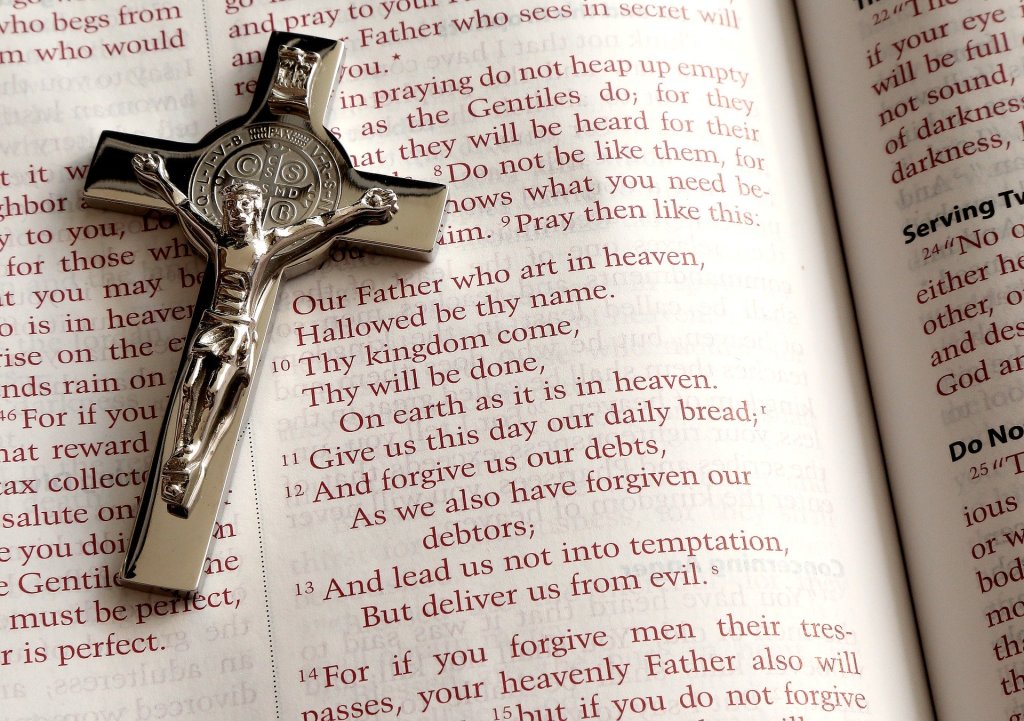
One day Jesus was praying in a certain place. When he finished, one of his disciples said to him, ‘Lord, teach us to pray, just as John taught his disciples.’
He said to them, ‘When you pray, say:
‘ “Father, hallowed be your name, your kingdom come.
Give us each day our daily bread.
Forgive us our sins, for we also forgive everyone who sins against us.
And lead us not into temptation.” ‘
Then Jesus said to them, ‘Suppose you have a friend, and you go to him at midnight and say, “Friend, lend me three loaves of bread; a friend of mine on a journety has come to me, and I have no food to offer him.” And suppose the one inside answers, “Don’t bother me. The door is already locked, and my children and I are in bed. I can’t get up and give you anything.” I tell you, even though he will not get up and give you the bread because of friendship, yet because of your shameless audacity he will surely get up and give you as much as you need.
‘So I say to you: ask and it will be given to you; seek and you will find; knock and the door will be opened to you. For everyone who asks receives; the one who seeks finds; and to the one who knocks, the door will be opened.
‘Which of you fathers, if your son asks for a fish will give him a snake instead? Or if he asks for an egg, will give him a scorpion? If you then, though you are evil, know how to give good gifts to your children, how much more will your Father in heaven give the Holy Spirit to those who ask him!’
* * *
Today, I’m going to start at the end:
If you then, though you are evil, know how to give good gifts to your children, how much more will your Father in heaven give the Holy Spirit to those who ask him!’
There are two things I want to note.
The first is that this paragraph about fish and snakes, eggs and scorpions is referring specifically to the gift of the Holy Spirit. The book of Acts, which St Luke also wrote, starts at Pentecost, when the Holy Spirit was first given to the nascent church, and then is full of examples of people being baptised and receiving the Holy Spirit. St Luke had experience of the power of the Holy Spirit, and I think that he wanted some reference to this in his gospel. He’s saying, in effect, that receiving the Holy Spirit is a good thing and we can trust God to give the Holy Spirit to us when we ask.
The other thing about this paragraph is that it says that the Father only wants to give us good gifts. The prayer that Jesus taught his disciples to pray is a mirror image of the gifts that God wants to give us. You could almost say it’s an approved list of things we can ask for.
Father, hallowed be your name, your kingdom come.
Our Father wants us to keep his name holy in our hearts and lives.
Our Father wants his kingdom to come in our hearts and lives.
Give us each day our daily bread.
Our Father wants to give us the nourishment that we need for each day; not more, not less.
Our Father wants to give us the spiritual nourishment we need for each day. That is why we need to spend time with him every single day.
Forgive us our sins, for we also forgive everyone who sins against us.
Our Father wants to forgive our sins.
Our Father wants us to forgive those who sin against us; indeed, if we won’t forgive others, it makes it difficult for God to forgive us.
And lead us not into temptation
Our Father doesn’t want us to be tempted. No, really, he doesn’t. Sin is not doing God’s will. The only way to do God’s will is to focus on him day and night – with all our soul, all our heart, all our mind and all our strength. Our Father doesn’t want us tempted, because he wants us to look steadfastly at him.
Prayer
Heavenly Father
May you be holy in my heart and life, through the presence of the Holy Spirit.






 Seeking the Light