People were also bringing babies to Jesus for him to place his hands on them. When the disciples saw this, they rebuked them. But Jesus called the children to him and said, ‘Let the little children come to me, and do not hinder them, for the kingdom of God belongs to such as these. Truly I tell you, anyone who will not receive the kingdom of God like a little child will never enter it.’
* * *
What do children do that adults don’t?
Before I start suggesting answers to that question, I would say that I’m both a parent and a grandparent. I know that even the littlest child can exhibit self-will, temper and be generally obnoxious!
Small children trust their parents wholeheartedly. They copy them. They believe the answers parents give to their questions. They cuddle their parents. They go to sleep soothed by them. They eat the food that is prepared by them. They love their parents uncritically and with devotion.
What do adults do that children don’t?
They doubt. They want their own way. They treat answers to prayer with scepticism. They reject God’s teaching in favour of secular thinking. Their love for God is critical and often half-hearted.
Now, as I’m an adult and not a child, I have all the faults that I list above. You can replace “They” with “I”, and “Their” with “My” and you sum me up pretty exactly. And I’m not sure that’s entirely bad.
It seems to me that the teaching of the bible is not always straightforward, and it needs thinking about as well as praying about. Likewise, ethical questions are not always easy to answer and need prayerful, but also thoughtful, consideration. Indeed, I think that Jesus positively encourages us to engage with ethics, and not simply apply a set of rules – because no matter how comprehensive your rules, you will always miss certain nuances.
The summary “Love the Lord your God with all your heart and with all your soul and with all your strength and with all your mind,” and “Love your neighbour as yourself,” (Luke 10: 27) both summarises Mosaic Law and increases its scope. Note the specific injunction to love the Lord with all your mind. Note, too, that the parable of the good Samaritan to which this passage is a prologue is precisely about engaging with ethics, and avoiding the traps of legalism and ritualism.
But Jesus is recorded as saying ‘Truly I tell you, anyone who will not receive the kingdom of God like a little child will never enter it.’
The first thing we can say in response is that our adult approach will never be sufficient on its own. We cannot think our way into the kingdom of God. We must become like children.
On the positive side, we must trust in God, copy Jesus, and believe the answers he gives in response to prayer. We must love God wholeheartedly (and that’s said right there in the passage (Luke 10: 27) that I quoted above).
We must be like children in trusting, loving, believing and imitating, because “the kingdom of God belongs to such as these”.
Prayer
Heavenly Father
Thank you that you have made your kingdom open to all. Thank you that you are our father and that you love us. Please bless us with the purity of heart to trust you, to love you, to believe you and to imitate Jesus.
Luke 18: 9 – 14 The parable of the Pharisee and the tax collector
To some who were confident of their own righteousness and looked down on everyone else, Jesus told this parable: ‘Two men went up to the temple to pray, one a Pharisee and the other a tax collector. The Pharisee stood by himself and prayed: “God, I thank you that I am not like other people – robbers, evildoers, adulterers – or even like this tax collector. I fast twice a week and give a tenth of all I get.”
‘But the tax collector stood at a distance. He would not even look up to heaven, but beat his breast and said, “God, have mercy on me, a sinner.”
‘I tell you that this man, rather than the other, went home justified before God. For all those who exalt themselves will be humbled, and those who humble themselves will be exalted.’
* * *
The Pharisee was a good man by human standards. He avoided ‘big’ sins, like robbery or adultery. He did good things, fasting twice a week and giving a tenth of everything he got. He thanked God for the things he saw as his blessings.
The tax collector, by contrast, was not a good man. He worked for the hated Roman rulers and he was probably on the fiddle. He certainly had serious sins on his conscience because “He would not even look up to heaven, but beat his breast and said, “God, have mercy on me, a sinner.”
Yet Jesus says that it was the tax collector, not the Pharisee, who went home justified before God. Why was this?
Look at the words of the Pharisee’s prayer. “God, I thank you that I am not like other people – robbers, evildoers, adulterers – or even like this tax collector. I fast twice a week and give a tenth of all I get.” The prayer is about what the Pharisee has done, not about what God has done. The tax collector says “God, have mercy on me, a sinner.” The focus is on God, and what God is doing.
That is the big difference between the men; the Pharisee is relying on his own efforts, while the tax collector is trusting wholly to the mercy of God. That is why the tax collector and not the Pharisee went home justified before God.
We can learn more from this parable.
Let’s start by thinking about the Pharisee. What is wrong with his self-reliance?
Luke says it is wrong because the Pharisee feels himself superior to other people. He trusts in his own righteousness. Feeling superior to others is always bad, because it immediately puts a barrier between us and them. Ultimately, it is the cause of oppression and war. How often have people used the supposed superiority of their race to justify exploiting others?
Is it always wrong to be pleased with the way we live our life? Can’t we take any credit?
Actually, I don’t think we can. When we do God’s will, it is through his grace. We have to come to him in prayer to learn his will, and then trust him for the strength to do it obediently.
Does this mean we have to be always abasing ourselves like the tax collector? That’s not a very attractive prospect…
No, I don’t think we do. God welcomes us. God affirms who we truly are. God accepts us and loves us. To be called to do his will is a privilege. Our very best prayer is the prayer of worship when we look towards God and catch a glimpse of his glory.
We’re not expected to wallow in guilt; we can rejoice in God’s grace!
Prayer
Heavenly Father
Thank you for creating us in your image. Thank you that you love each of us, and accept each of us. Thank you for the privilege of prayer and worship. Please help us to reach out with your love to all our brothers and sisters wherever they live.
Luke 18: 1 – 8 The parable of the persistent widow
Then Jesus told his disciples a parable to show them that they should always pray and not give up. He said: In a certain town there was a judge who neither feared God nor cared what people thought. And there was a widow in that town who kept coming to him with the plea, “Grant me justice against my adversary.”
‘For some time he refused. But finally he said to himself, “Even though I don’t fear God or care what people think, yet because this widow keeps bothering me, I will see that she gets justice, so that she won’t eventually come and attack me!” ‘
And the Lord said, ‘Listen to what the unjust judge says. And will not God bring about justice for his chosen ones, who cry out to him day and night? Will he keep putting them off? I tell you, he will see that they get justice, and quickly. However, when the Son of Man comes, will he find faith on the earth?’
* * *
This parable is odd. Other parables that Jesus told were razor sharp. Each character was carefully drawn to illustrate precisely what the teaching was all about. Think of the sower of seed (Luke 8: 1 – 15), the good Samaritan (Luke 10: 25 – 37), and, especially, the prodigal son (Luke 15: 11 – 32).
By contrast, this parable has as a main character, an unjust judge. Furthermore, the story seems to encourage us to pray to God with the tenacity that we would show if he were an unjust judge.
Mosaic Law made provision for widows:
Do not take advantage of the widow or the fatherless. If you do and they cry out to me, I will certainly hear their cry. (Exodus 22:22)
He defends the cause of the fatherless and the widow, and loves the foreigner residing among you, giving them food and clothing. (Deuteronomy 10:18)
When you are harvesting in your field and you overlook a sheaf, do not go back to get it. Leave it for the foreigner, the fatherless and the widow. (Deuteronomy 24: 19 – 22)
In showing hardness of heart towards the widow, the unjust judge was clearly ignoring the spirit of the Law, even if he were not strictly obliged to act for her. Can we really say that the unjust judge represents God the Father in his approach to the petitions of believers?
Instead, let’s try focussing on the widow.
She was persistent. She harried the judge; she stalked him; her behaviour towards him was plainly threatening and potentially violent, as we see when the judge says, ‘I will see that she gets justice, so that she won’t eventually come and attack me!”
Is that really how we’re supposed to approach God with our prayers of intercession?
The take home message is clearly, “Keep praying for what you need, and don’t be put off if it’s slow in coming. Keep praying!”
Even St Luke seems to think that the parable needs explanation, because he explains right at the start what the parable is meant to teach us. “Then Jesus told his disciples a parable to show them that they should always pray and not give up.”
Both parable and the teaching based on it seem unhelpful in some circumstances. We’ve all prayed earnestly for people and situations and the prayer hasn’t been answered in the way we would expect. The widow would, I am sure, have shouted at the judge!
But isn’t it more productive to think harder about what we are actually praying for? After all, if God is to grant our petition, it has to be in accordance with his will. If we are not to be disappointed, perhaps we should spend more time and effort in listening to God and seeking his will.
What do you think?
Prayer
Heavenly Father
Thank you that you are not an unjust judge, but rather a merciful father who knows what his children need before they ask. Help me to pray as you would wish me to pray, so that I may be better aligned with your will, and walk more closely with Jesus.
Once, on being asked by the Pharisees when the kingdom of God would come, Jesus replied, ‘The coming of the kingdom of God is not something that can be observed, nor will people say, “Here it is,” or “There it is,” because the kingdom of God is in your midst.’
Then he said to his disciples, ‘The time is coming when you will long to see one of the days of the Son of Man, But you will not see it. People will tell you, “There he is!” or “Here he is!” Do not go running off after them. For the Son of Man in his day will be like the lightning, which flashes and lights up the sky from one end to the other. But first he must suffer many things and be rejected by this generation.
‘Just as it was in the days of Noah, so also will it be in the days of the Son of Man. People were eating, drinking, marrying and being given in marriage up to the day Noah entered the ark. Then the flood came and destroyed them all.
‘It was the same in the days of Lot. People were eating and drinking, buying and selling, planting and building. But the day Lot left Sodom, fire and sulphur rained down from heaven and destroyed them all.
‘It will be just like this on the day the Son of Man is revealed. On that day no one who is on the housetop, with possessions inside, should go down to get them. Likewise, no one in the field should go back for anything. Remember Lot’s wife! Whoever tries to keep their life will lose it, and whoever loses their life will preserve it. I tell you, on that night two people will be in one bed; one will be taken and the other left. Two women will be grinding corn together; one will be taken and the other left.’
‘Where, Lord?’ they asked.
He replied, ‘Where there is a dead body, there the vultures will gather.’
* * *
This passage starts with a question from the Pharisees. “When will the kingdom of God come?”
Why might they have asked the question? A desire to see the rule of Rome replaced by Jewish autonomy? A plan to secure an answer from Jesus that could be presented to the Romans as revolutionary, and persuade them to deal with him?
At all events, they have the wrong idea about the nature of the kingdom of God, imagining it as an earthly realm. Jesus tells them that they will not find it, because they are looking for the wrong thing. It is not a physical kingdom, but a spiritual one.
That is a good reminder for us, too. In the sense that the Holy Spirit is within us, we are already living in the kingdom of God. Alleluia!
Jesus then speaks to his disciples about his return to earth, when he will come in glory to show the kingdom of God in its final, perfected state; his second coming.
He warns them not to be misled by imposters who will claim to be the Son of Man. He tells them (and us) that we won’t need telling when he comes again; it will be obvious. “For the Son of Man in his day will be like the lightning, which flashes and lights up the sky from one end to the other.”
We then have this difficult passage, where Jesus uses imagery from the Old Testament to emphasise what he is saying. He reminds the disciples that in Noah’s day, human life was carrying on in its usual manner right up until the rain started. Once that happened, it was too late to build an ark. In Lot’s day, human life was carrying on normally right up until the time fire and sulphur rained down from heaven. It was too late then to flee the city.
The warning in these verses is that we must be prepared. It is the same teaching as we see in Matthew 24: 36 – 51, which can be summarised as “Be prepared for the coming of the Son of Man. Let him find you doing your duty”. It’s also similar to Luke 12: 35 – 48, which has the same message.
The difference here is that Jesus chooses imagery that strongly emphasise the enormous importance of being prepared for his return. We don’t know the place or the hour of his return, but we know that it will be obvious and of supreme importance to us. And of course, even if we don’t see the second coming, we still have to die physically, and that could happen at any time.
I would like to skate over the imagery that Jesus chooses. Was Noah’s flood really the deliberate destruction of most of humanity by God? Were Sodom and its inhabitants really destroyed by a deliberate act of God? I find it very hard to believe that a loving God would do such things. And yet it is inescapably true that our world has natural disasters that cause death and great suffering for innocent people, and God created it like that.
I won’t duck the issue. But I will say that I don’t understand. The best I can do is believe that after death there is consolation for those who have suffered, and that this outweighs the suffering by so great an amount that the suffering no longer matters. Perhaps it is like giving birth. I have been told that although the pain of childbirth is great, as soon as the child is born and in the mother’s arms the pain stops and is replaced by joy. But I don’t know.
Sometimes, we need to remember that where there is faith, there is always doubt, too.
Prayer
Heavenly Father
Thank you for calling me to serve you. Thank you for your Holy Spirit who helps me accept your teaching. Please help me to be doing my duty when you come for me.
Now on his way to Jerusalem, Jesus travelled along the border between Samaria and Galilee. As he was going into a village, ten men who had leprosy met him. They stood at a distance and called out in a loud voice, ‘Jesus, Master, have pity on us!”
When he saw them, he said, ‘Go, show yourselves to the priests.’ And as they went, they were cleansed.
One of them, when he saw he was healed, came back, praising God in a loud voice. He threw himself at Jesus feet and thanked him – and he was a Samaritan.
Jesus asked, ‘Were not all ten cleansed? Where are the other nine? Has no one returned to give praise to God except this foreigner?’ Then he said to him, ‘Rise and go; your faith has made you well.’
* * *
In 1st century Palestine, suffering from leprosy had consequences beyond the physical effects of the illness. You were ritually unclean. That meant you couldn’t join in any of the community activities and, especially, you couldn’t join in the worship. You had to live outside the town or village. You were cut off from human contact except with others who had leprosy.(Leviticus 13: 1 – 46)
It was a terrible fate.
The ten lepers in this narrative had clearly banded together for mutual support. We are told that they lived on the border between Samaria and Galilee, and that one of them was a Samaritan. His presence in the group is interesting, because Jews would usually have nothing to do with Samaritans. Their shared misfortune seems to have drawn them together and overcome the usual hostility.
When they learned that Jesus was passing, they acted together to attract his attention. They stood respectfully at a distance, and cried out loudly, imploring Jesus’ pity.
Jesus told them to go and show themselves to the priests. This was what the law required to certify healing from leprosy (Leviticus 14:1 – 32). The lepers showed faith and obedience and set off to the priests. As they went, they realised that they had indeed been healed.
One of them – only one – came back to Jesus to thank him for the healing, and it was the Samaritan, the foreigner, the one that most Jews would despise and have nothing to do with. As a result of returning to give thanks and praise to God, he receives the special blessing of a word from Jesus. He is told that his faith has made him whole.
Prayer
Heavenly Father
Through the life of Jesus you have shown us how great is your grace and mercy. Thank you for all the healing I have received, physical, emotional and spiritual.
Jesus said to his disciples: ‘Things that cause people to stumble are bound to come, but woe to anyone through whom they come. It would be better for them to be thrown into the sea with a millstone tied round their neck than to cause one of these little ones to stumble. So watch yourselves.
‘If your brother or sister sins against you, rebuke them; and if they repent, forgive them. Even if they sin against you seven times in a day and seven times come back to you saying “I repent,” you must forgive them.’
The apostles said to the Lord, ‘Increase our faith!’
He replied, ‘If you have faith as small as a mustard seed, you can say to this mulberry tree, “Be uprooted and planted in the sea,” and it will obey you.
‘Suppose one of you has a servant ploughing or looking after the sheep. Will he say to the servant when he comes in from the field, “Come along now and sit down to eat”? Won’t he rather say, “Prepare my supper, get yourself ready and wait on me while I eat and drink; after that you may eat and drink”? Will he thank the servant because he did what he was supposed to do? So you also, when you have done everything you were told to do, should say, “We are unworthy servants: we have only done our duty.” ’
* * *
This passage starts with the words, “Jesus said to his disciples.” This is a change. The previous teaching had all been addressed to the crowd, with special and pointed reference to the Pharisees present. Now we’re hearing Jesus speaking privately to his disciples.
I wonder what they had said or done that was sufficiently mistaken to make this criticism necessary?
First, we have a violent image of a disciple being thrown into the sea with a millstone tied around their neck; this would be better for them, Jesus is recorded as saying, than causing someone to stumble in their faith. There is no doubt about who needs to take the message to heart, because verse 3 says, “So watch yourselves.”
Secondly, we have teaching about forgiving someone’s sin against us, even if they keep on doing the same thing. Had there been hardness of heart by one of the disciples? Had they split into factions? There was a need for forgiveness in the group, perhaps.
The teaching is plainly in accordance with the whole of Jesus’ life, to the very end, when he forgave those who crucified him. It’s hard to do, though, as we see from the disciples apparent failure.
Thirdly, we have the reply to the apostles’ request to Jesus for more faith. This seems to me almost to mock them. It’s as though Jesus is telling them they don’t even have the smallest amount of the faith required to work miracles. And, perhaps that’s the point. Perhaps the apostles wanted the spectacular. They had healed the sick and cast out demons (Luke 10: 17 – 18), but they’d seen Jesus carry out dramatic acts – feeding the five thousand; walking on water; calming the storm. Were they asking for ‘more faith’ so they could do the same?
Fourthly, we have a parable about the demands on servants. Jesus says, seemingly, that the master will make great demands of his servants. Had the disciples been grumbling about how hard they were working?
The situation Jesus uses for his parable is still prevalent in many parts of the world, although in the prosperous West we would possibly think the demands were unreasonable, breaching working hours legislation, for example.
Or would we? Those on minimum wage may work two or even three jobs to make ends meet. Those who want to climb the corporate ladder often put in many hours’ effort every week. Perhaps we can after all understand the demands Jesus makes.
So this whole passage reads to me like a response to mistakes and discontent among the disciples.
As such, it is relevant today. We still need to be warned to be careful how we speak and how we live our lives so that we won’t cause others to stumble. We still need to practise forgiveness. We still need faith, in just the amount that God chooses to give each of us. And we certainly need encouragement to work hard to serve God. After all, what could be more rewarding than serving God?
Prayer
Heavenly Father
Thank you for calling us to love and serve you. Help us all to carry out our tasks with joy.
‘There was a rich man who was dressed in purple and fine linen and lived in luxury every day. At his gate was laid a beggar named Lazarus, covered with sores and longing to eat what fell from the rich man’s table. Even the dogs came and licked his sores.
‘The time came when the beggar died and the angels carried him to Abraham’s side. The rich man also died and was buried. In Hades, where he was in torment, he looked up and saw Abraham far away, with Lazarus by his side. So he called to him, “Father Abraham, have pity on me and send Lazarus to dip the tip of his finger in water and cool my tongue, because I am in agony in this fire.”
‘But Abraham replied, “Son, remember that in your lifetime you received your good things, while Lazarus received bad things, but now he is comforted here and you are in agony. And besides all this, between us and you a great chasm has been set in place, so that those who want to go from here to you cannot, nor can anyone cross over from there to us.”
‘He answered, “Then I beg you, father, send Lazarus to my family, for I have five brothers. Let him warn them, so that they will not also come to this place of torment.”
‘Abraham replied, “They have Moses and the Prophets; let them listen to them.”
‘ “No, father Abraham,” he said, “but if someone from the dead goes to them, they will repent.”
‘He said to him, “If they do not listen to Moses and the Prophets, they will not be convinced even if someone rises from the dead.” ‘
* * *
There is no doubt that the rich man is a hard case.
He had much more than he needed. Indeed, he lived in luxury, with fine clothes and food.
Lazarus, meanwhile, was destitute. Lazarus would have been happy with the scraps from the rich man’s table, but he was allowed nothing. He lived at the rich man’s gates, so close as to be almost a part of his household. The rich man couldn’t fail to be aware of him and of his desperate need, but he deliberately ignored him.
Even after the rich man’s death, when he’s in agony, he seeks to treat Lazarus as a servant, and have Abraham send him with water to ease his pain. And he argues with Abraham and contradicts him.
Oh, yes. They don’t come more presumptuous than this rich man.
What might this parable have meant to Jesus’ contemporaries?
This parable was initially told to the Jews. Among the listeners were Pharisees. Their assumption was that they were righteous by virtue of the covenant between God and Abraham. From the preaching of Jesus, we can infer that many of the Pharisees and teachers of the law were rich and powerful, and exploited those who were less fortunate.
What does the rich man of this parable do wrong?
He oppresses and exploits the poor.
He closes his eyes to human suffering.
He assumes that because he is descended from Abraham he is righteous.
Even after death he doesn’t repent; he still wants to exploit Lazarus
He argues with Abraham, the very person on whom he claims to rely.
And what does Abraham tell him?
Your suffering and Lazarus’ comforting is just. It balances the books.
You can’t avoid the suffering.
The Law and the Prophets is sufficient to guide people.
Anybody who doesn’t listen to Moses and the Prophets will not be convinced, even if someone rises from the dead.
For the first hearers, the parable is not so much about the need to care for the poor, as about the standing and meaning of the Law and the Prophets. It takes their teaching on social justice as the starting point, and uses the story to emphasise that the Law and the Prophets, when correctly understood, are sufficient to define how God requires humans to live. It follows on exactly from the teaching of Luke 16: 16 – 18.
What might this parable mean to us today?
First and foremost, it warns us in a most powerful image that we must not overlook the needs of the poor. If we harden our hearts against them, we will pay a price after death. Love for our neighbour must be at the very centre of our faith.
Note, I am not interpreting this parable as an account of heaven and hell; it is a story that was designed for the mindset of first century Palestine. The story itself does not actually claim to be about heaven and hell. What it does claim is that the way we live this earthly life has consequences for us in the world to come.
I’m also not suggesting that being generous to the poor will somehow earn us a place in heaven. We are saved by God’s free gift of Jesus. In response to that salvation, we want to do God’s will. Our generosity to the poor is an indication of our faith in Jesus. This parable makes it clear that God is deeply concerned about the fate of the poor, and therefore we should be too.
‘The Law and the Prophets were proclaimed until John. Since that time, the good news of the kingdom of God is being preached, and everyone is forcing their way into it. It is easier for heaven and earth to disappear than for the least stroke of a pen to drop out of the Law.
‘Anyone who divorces his wife and marries another woman commits adultery, and the man who marries a divorced woman commits adultery.
* * *
We’ve just had a big chunk of teaching about the correct value of money (i.e. we mustn’t care for it at all). We’re just about to read the parable of the rich man and Lazarus, which is again about the right use of wealth and the dire consequences of letting it blind us to human need. So what is this random passage that the NIV rather coyly labels “Additional teachings”?
‘The Law and the Prophets were proclaimed until John.
This seems straightforward. John the Baptist’s life marked a transition. Up until John’s ministry, the Jews had been God’s chosen people in covenant with him. God had given them the Law to tell them how he wanted them to live, and sent prophets to guide them as they struggled to do his will in the world.
Then Jesus came. That marked the beginning of a different way of relating to God. Righteousness ceased to be a matter of sacrifice in the temple, and became a matter of following Jesus. It ceased to be an exclusive covenant between God and the Jews; God’s kingdom, as revealed by Jesus, was thrown open to all humankind.
Since that time, the good news of the kingdom of God is being preached, and everyone is forcing their way into it.
This sentence does not seem to have a clear meaning.
Perhaps it is the broadening of the covenant to include the whole of humankind that Jesus meant by this; Gentiles as well as Jews are now scrambling to take advantage of access to the kingdom.
One scholar points out that the Greek verb translated as “forcing” has several different meanings, among them the idea of struggling with great zeal to accomplish something. That would certainly fit with the mood of the rest of chapter 16. Jesus must be first in our lives if we are to follow him, and that requires complete commitment on our part. We must seize the opportunity while we have it.
If we accept this meaning for “forcing”, we must take care not to misunderstand what we are saying.
Salvation comes from faith in Jesus. It doesn’t come from anything we do. However, once we have committed ourselves to Jesus, we want to do his will, and we want to make the effort to obey him. Our actions spring from our love for Jesus, which in turn is our response to God’s love. It is God’s love that comes first. Our actions are the consequence of loving Jesus, and they witness that we follow him.
It is easier for heaven and earth to disappear than for the least stroke of a pen to drop out of the Law.
Just in case the previous sentence should be misunderstood as relaxing the criteria for entry to the kingdom of God – perhaps because Jewish early Christians were worried about the admission of Gentiles to the church – St Luke affirms in the strongest possible terms that the requirements of the Law still stand.
How are we to understand this? We’ve just read that everything changed after John the Baptist. That was because the old covenant between the Jews and God had not been sufficient to bring people to righteousness. A new covenant was needed, and Jesus was bringing it about.
And now we’re reading that the Law is still valid?
I think the key to this is God’s love.
The old covenant did not make people righteous. You cannot make someone good by law; you can only prohibit wrongdoing and impose sanctions if a prohibition is broken. No, the way to make someone righteous is to love them, to forge a friendship with them, and to show them by example what is needed.
The Law remains constant, but we have been given the grace of God’s love in Jesus. We have been shown by Jesus’ example how we should live. We have been filled with the Holy Spirit so that we can experience the presence of Jesus with us constantly. And when we sin, we have Jesus’ promise that when we repent we will be forgiven.
‘Anyone who divorces his wife and marries another woman commits adultery, and the man who marries a divorced woman commits adultery.’
At the time of Jesus’ ministry, there was a strand of Pharisaic teaching that made divorce easy. One rabbi apparently ruled that a woman could be divorced for burning her husband’s breakfast. Another taught that finding a prettier woman could be a cause for divorce. By including this sentence about divorce and adultery, St Luke is using a contemporary example to add even more force to the teaching that the Law is unchanging.
(I feel I should add here that I do not want in this blog post to contribute to the debate over the remarriage of those who divorce. My personal view is that God knows people make mistakes, and that he is compassionate towards those who do and I praise and thank him for that mercy.)
Prayer
Heavenly Father
Thank you for opening my eyes this morning, and changing my understanding of this passage of scripture. Thank you for the compassion that you always show to all humankind.
Jesus told his disciples: ‘There was a rich man whose manager was accused of wasting his possessions. So he called him in and asked him, “What is this I hear about you? Give an account of your management, because you cannot be manager any longer.”
‘The manager said to himself, “What shall I do now? My master is taking away my job. I’m not strong enough to dig, and I’m ashamed to beg – I know what I’ll do so that, when I lose my job here, people will welcome me into their houses.”
‘So he called in each one of his master’s debtors. He asked the first, “How much do you owe my master?”
‘ “Three thousand litres of olive oil,” he replied.
‘The manager told him, “Take your bill, sit down quickly, and make it fifteen hundred.”
‘Then he asked the second, “And how much do you owe?”
‘ “Thirty tons of wheat,” he replied.
‘He told him, “Take your bill and make it twenty-four.”
‘The master commended the dishonest manager because he had acted shrewdly. For the people of this world are more shrewd in dealing with their own kind than are the people of the light. I tell you, use worldly wealth to gain friends for yourselves, so that when it is gone, you will be welcomed into eternal dwellings.
‘Whoever can be trusted with very little can also be trusted with much, and whoever is dishonest with very little will also be dishonest with much. So if you have not been trustworthy in handling worldly wealth, who will trust you with true riches? And if you have not been trustworthy with someone else’s property, who will give you property of your own?
‘No one can serve two masters. Either you will hate the one and love the other, or you will be devoted to the one and despise the other. You cannot serve both God and Money.’
The Pharisees, who loved money, heard all this and were sneering at Jesus. He said to them, ‘You are the ones who justify yourselves in the eyes of others, but God knows your hearts. What people value highly is detestable in God’s sight.’
* * *
“No one can serve two masters. Either you will hate the one and love the other, or you will be devoted to the one and despise the other.”
That is what the dishonest steward of the parable was doing even before his master had dismissed him. He hated the master who had caught him out in deception and, at least in the short-term, he loved his master’s debtors by discounting a substantial fraction of their debt. In reality, of course, he was a bad servant who was only serving himself. He wanted an easy life and was prepared to swindle people to have it. He loved money. The NIV translation gives Money an upper-case letter; other translations refer to it as Mammon, a diabolical love of money.
“No one can serve two masters. Either you will hate the one and love the other, or you will be devoted to the one and despise the other.”
What is my view of money? What are the excuses I use for having money in the bank? Do I view it as security for this life? Why do I have a nice car? To make it easy for me to visit family?
If Jesus challenged me to radical poverty, would I obey? What excuses would I offer?
Do I love Money – or do I love God? This passage is saying very clearly that I cannot do both, because “What people value highly is detestable in God’s sight.”
The reason why it matters is that we are called to trust God to provide for our needs. If we do not trust him to provide for our earthly needs, how will we trust him to provide for our spiritual needs? If we cling on to money and possessions, we’re placing them ahead of God, making idols of them – and that never ends well.
“No one can serve two masters. Either you will hate the one and love the other, or you will be devoted to the one and despise the other.”
Prayer
Heavenly Father
Thank you for promising to provide all I need. Please give me the faith and the imagination to trust your promise, because I find it very difficult.
Jesus continued: ‘There was a man who had two sons. The younger one said to his father, “Father, give me my share of the estate.” So he divided his property between them.
‘Not long after that, the younger son got together all he had, set off for a distant country and there squandered his wealth in wild living. After he had spent everything, there was a severe famine in that whole country, and he began to be in need. So he went and hired himself out to a citizen of that country, who sent him to his fields to feed pigs. He longed to fill his stomach with the pods the pigs were eating, but no one gave him anything.
‘When he came to his senses, he said, “How many of my father’s hired servants have food to spare, and here I am starving to death! I will set out and go back to my father and say to him: Father, I have sinned against heaven and against you. I am no longer worthy to be called your son; make me like one of your hired servants” So he got up and went to his father.
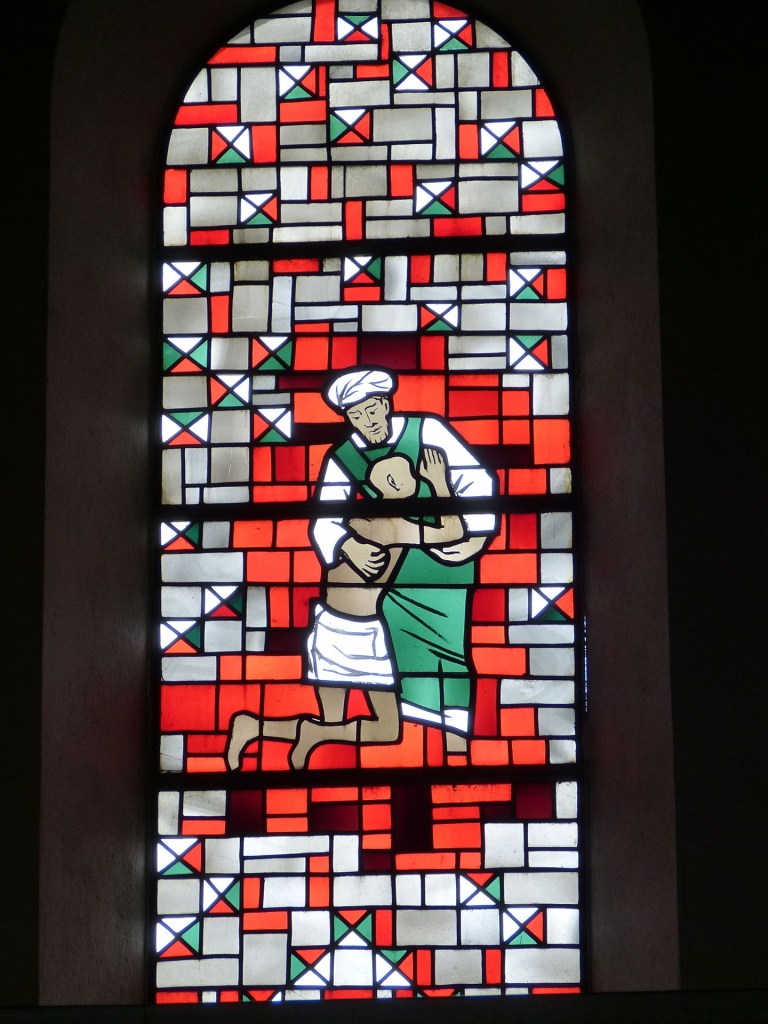
‘But while he was still a long way off, his father saw him and was filled with compassion for him; he ran to his son, threw his arms round him and kissed him.
‘The son said to him, “Father, I have sinned against heaven and against you. I am no longer worthy to be called your son.”
‘But the father said to his servants, “Quick! Bring the best robe and put it on him. Put a ring on his finger and sandals on his feet. Bring the fattened calf and kill it. Let’s have a feast and celebrate. For this son of mine was dead and is alive again; he was lost and is found.” So they began to celebrate.
Meanwhile, the elder son was in the field. When he came near the house, he heard music and dancing. So he called one of the servants and asked him what was going on. “Your brother has come,” he replied, “and your father has killed the fattened calf because he has him back safe and sound.
‘The elder brother became angry and refused to go in. So his father went out and pleaded with him. But he answered his father, “Look! All these years I’ve been slaving for you and never disobeyed your orders. Yet you never gave me even a young goat so I could celebrate with my friends. But when this son of yours who has squandered your property with prostitutes comes home, you kill the fattened calf for him!”
‘ “My son,” the father said, “you are always with me, and everything I have is yours. But we had to celebrate and be glad, because this brother of yours was dead and is alive again; he was lost and is found.” ‘
* * *
The three characters in this parable are very clearly drawn and convey Jesus’ message precisely.
The youngest son starts the story as an immature wastrel. He’s rude – outrageously rude – to his father. “Father, give me my share of the estate.” I mean! “Dad, for me you’re as good as dead, so you might as well give me my inheritance now.” He clearly neither knows nor cares about his father’s business.
He squanders his money in a dissolute life until he runs out of cash, and then he works in the most menial job imaginable, herding pigs – animals which are unclean to the Jews. He’s as lost as he could be.
Then he remembers what it was like at home. Everybody had a roof over their head and plenty to eat. “Perhaps I could go home,” he thinks – and then is overwhelmed by shame as he thinks of what he’s done. How can he possibly go back? He’s cut himself off from his father.
Hunger, though, makes him desperate. Obviously, he can’t go back as a son of the household, but maybe his dad would give him a job. At least he’d be fed.
He doesn’t have much hope; just the faintest gleam. It’s his last chance. If he doesn’t take it, he might as well die. What gave him that gleam of hope, I wonder? Something in the way his father treated him as a child and a young man must have encouraged him to trust.
The father has a deep love for his son. He sees him approach “while he was still a long way off” – he’s looking out for him, always hoping to see him.
“He ran to his son.” Now, in 1st century Palestine, this would have astonished Jesus’ hearers, because a rich, high status man would never run; it would be far too undignified. But the father of the spendthrift son runs to meet him. He is absolutely thrilled by his return!
His son says the words of repentance that he’s prepared “Father, I have sinned against heaven and against you. I am no longer worthy to be called your son.”
The father hardly seems to notice. He throws his arms around his son, kisses him, has his servants dress him in the best robe, with a ring on his finger and sandals on his feet – all showing that he is accepted back as a son – and he’s so excited that he arranges a feast with music and dancing to celebrate his son’s return.
Jesus doesn’t stress the repentance, but his story mentions it twice.
The first time is when the son is starving in a foreign land, at the moment when he realises he must return home or he will die. If he hadn’t set out for home, he would not have been restored to his position as son, he would have died.
The second time is when his father comes to greet him. The son acknowledges out loud to his father that he has fallen a long way short, and relies entirely on his father’s mercy. Note, his father’s forgiveness doesn’t depend on this – his father knows that he’s repented because he’s come back. So why does Jesus repeat it? I think it’s to make the point that we need to make a proper statement of our repentance for our own spiritual health. Forgiveness by God is a matter of the greatest importance and seriousness, and a formal act of repentance can keep us mindful of that.
The third character in the story is the elder brother. He’s worked hard for years and his father has never even allowed him a young goat to enjoy with his friends, much less thrown a party for him. He sulks outside, and won’t join in the party.
He’s not shut out; he chooses not to enjoy the party. His human nature makes him resent his father’s seeming preference for the sinful younger son. Although he has worked many years with his father, lived with him, learned a little of how he thinks and works, he has missed a vital detail of his father’s nature; he hasn’t realised how lavish his father is with his love, and how much he loves both his sons. If the elder son had learned that capacity, he would have been waiting with his father, watching for his brother’s return.
Listen to how gently his father deals with him.
“My son,” the father said, “you are always with me, and everything I have is yours.”
And he explains why his younger son’s return is so important to him
“But we had to celebrate and be glad, because this brother of yours was dead and is alive again; he was lost and is found.”
Prayer
Heavenly Father
Thank you for this parable that reminds me of how much you love me. I’m sorry for all those times I fall short and don’t do your will.







 Seeking the Light