Luke 22: 47 – 53 Jesus arrested

Luke 22: 47 – 53 Jesus arrested

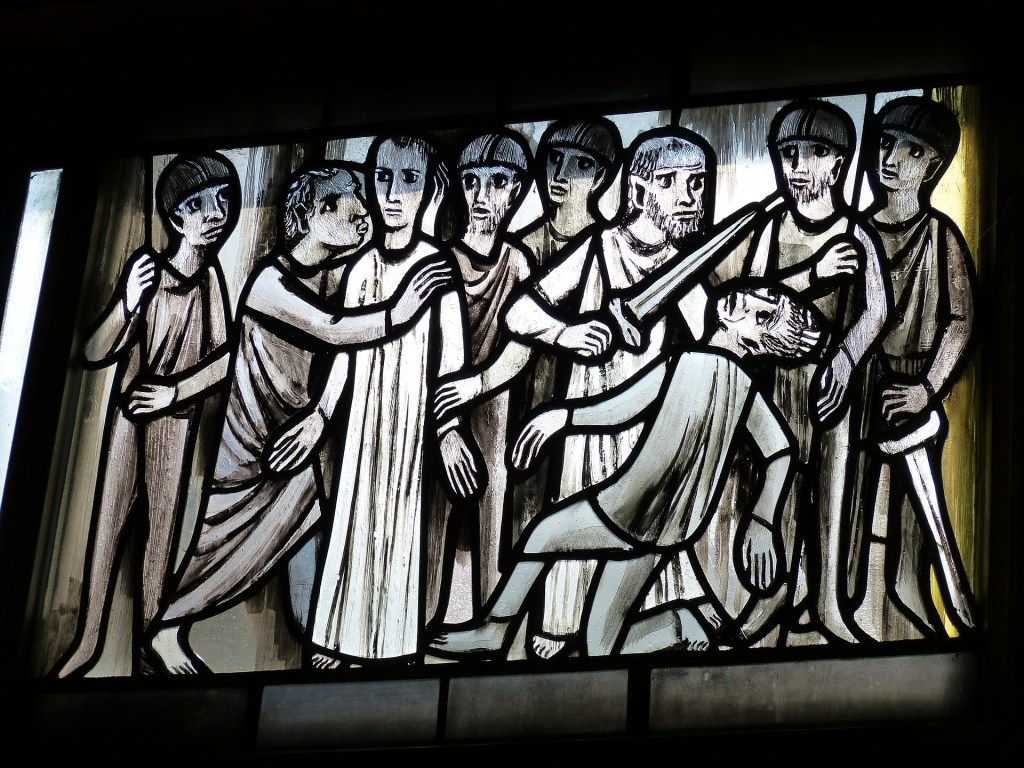
While he was still speaking a crowd came up, and the man who was called Judas, one of the Twelve, was leading them. He approached Jesus to kiss him, but Jesus asked him, ‘Judas, are you betraying the Son of Man with a kiss?’

When Jesus’ followers saw what was going to happen, they said, ‘Lord, should we strike with our swords?’ And one of them struck the servant of the high priest, cutting off his right ear.

But Jesus answered, ‘No more of this!’ And he touched the man’s ear and healed him.

Then Jesus said to the chief priests, the officers of the temple guard, and the elders, who had come for him, ‘Am I leading a rebellion, that you have come with swords and clubs? Every day I was with you in the temple courts, and you did not lay a hand on me. But this is your hour – when darkness reigns.’

*       *       *

I want to start by comparing the opening of St Luke’s account of the arrest with that of St Matthew.

While he was still speaking, Judas, one of the Twelve, arrived. With him was a large crowd armed with swords and clubs, sent from the chief priests and elders of the people. Now the betrayer had arranged a signal with them: ‘The one I kiss is the man; arrest him.’ Going at once to Jesus, Judas said, ‘Greetings, Rabbi!’ and kissed him. Jesus replied, ‘Do what you came for, friend.’ (Matthew 26:53)

Luke’s account is ambiguous as to whether Judas actually kissed Jesus. Matthew’s is not. Judas greeted Jesus and kissed him. What I find surprising about the account is that Judas was needed to identify Jesus. Jesus had been teaching in the temple courts every day; surely he would have been immediately identifiable by any of the chief priests or elders? But perhaps the leaders insisted upon this positive identification so they could claim that even Jesus’ disciples thought he had gone too far in his ministry.

While I find the need for Jesus to be identified surprising, I find Jesus’ words to Judas astonishing.

Jesus replied, ‘Do what you came for, friend.’

To address his betrayer as “friend” shows the ultimate love of God. Even at this stage, Judas is forgiven by Jesus, and still has time to accept his forgiveness. If he had re-joined the other disciples he could have been one of the apostles of the early church.

We should never, ever imagine that we cannot be forgiven. Judas, who consciously betrayed Jesus to his death, was forgiven. All he had to do was to accept that forgiveness.

One of Jesus disciple’s – St John tells us it was Simon Peter (John 18:10) – struck with his sword, severing the ear of a servant of the high priest. Jesus stops him – and heals the injured man.

Jesus’ ministry of forgiveness and healing continues even at this time of extraordinary pressure.

Then Jesus said to the chief priests, the officers of the temple guard, and the elders, who had come for him, ‘Am I leading a rebellion, that you have come with swords and clubs?

Jesus wants to make it clear that he is not leading a rebellion; far from it. He has been teaching every day in the temple courts. He contrasts his non-violent actions with the violence of the chief priests and the elders in coming with an armed mob to arrest him.

But this is your hour – when darkness reigns.’

It is literally dark on the Mount of Olives, but it is also spiritually dark. God’s Son, Jesus, is going willingly into the spiritual darkness of betrayal, torture and public execution.

It was, indeed, the hour when darkness reigned.

Prayer

Heavenly Father

Thank you for Jesus’ willingness to walk steadfastly into the darkness on our behalf.

In Jesus name, Amen
Luke 22: 39 – 46 Jesus prays on the Mount of Olives

Luke 22: 39 – 46 Jesus prays on the Mount of Olives

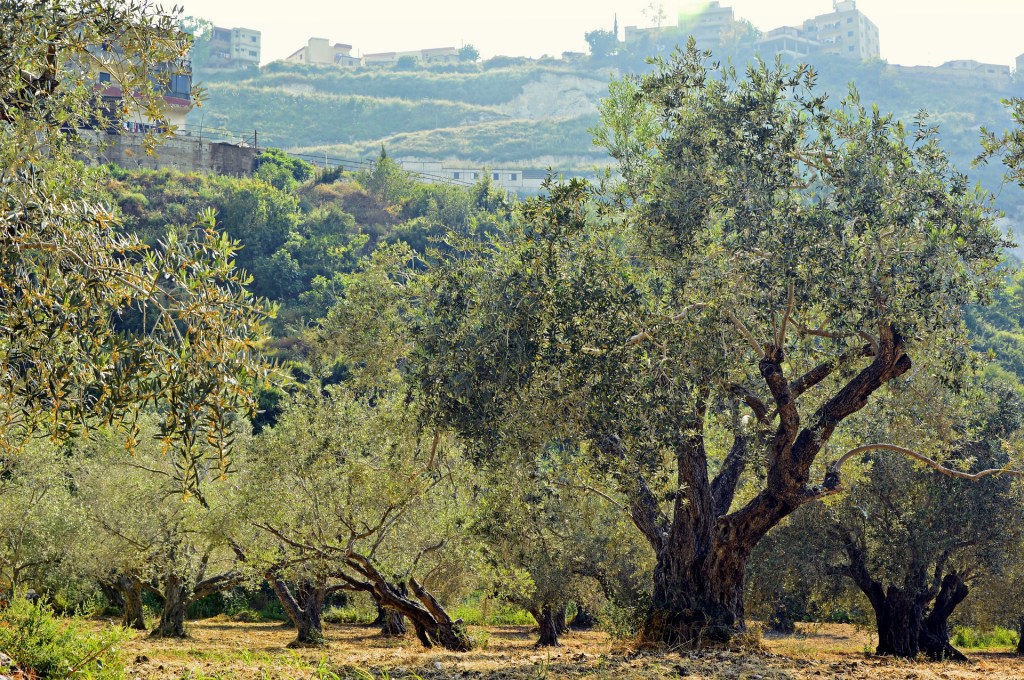
Jesus went out as usual to the Mount of Olives, and his disciples followed him. On reaching the place, he said to them, ‘Pray that you will not fall into temptation.’ He withdrew about a stone’s throw beyond them, knelt down and prayed, ‘Father, if you are willing, take this cup from me; yet not my will, but yours be done.’ An angel from heaven appeared to him and strengthened him. And being in anguish, he prayed more earnestly, and his sweat was like drops of blood falling to the ground.

When he rose from prayer and went back to the disciples, he found them asleep, exhausted from sorrow. ‘Why are you sleeping?’ he asked them. ‘Get up and pray so that you will not fall into temptation.’

*       *       *

Here we are, on the Mount of Olives.

Jesus warns his disciples with the words ‘Pray that you will not fall into temptation,’ then withdraws a stone’s throw from them and prays to his Father:

‘Father, if you are willing, take this cup from me.’

He petitions God with urgent human need. He asks, while all along he knows the answer. And he is fully obedient to his Father. “Yet not my will, but yours be done,’ he says.

If Jesus can pray out of his human need, so can we. However, we must copy his obedience as well. We must accept that God’s will is sovereign.

St Luke tells us, “And being in anguish, he prayed more earnestly, and his sweat was like drops of blood falling to the ground.”

When we read these verses, how can we have any doubt that Jesus was fully human? He was terrified. He was truly the Son of Man.

When Jesus rises from prayer and went to his disciples, what does he find?

They were asleep. They had disobeyed his instructions to pray, because they were exhausted from sorrow.

I wonder whether they felt helpless in the face of events? This wasn’t how they’d imagined it would be. Only hours ago, they had been eating and debating which of them was considered to be the greatest. Now they are on the Mount of Olives, and their Teacher, their Lord, the man they had thought was the Messiah, is praying earnestly that his Father will allow him to escape his coming ordeal. How could their faith not be shaken to its core?

Sometimes I envy the disciples. How wonderful it must have been to sit at his feet, like Mary, and listen to the teaching exactly as it was given! But here on the Mount of Olives, they are bereft, tested in a way we can never be. We have read the Passion story, over and over again. We know that after Jesus’ death comes his resurrection, and all our faith rests on that event. We can never experience the desolation of the disciples during the Passion.

When he rose from prayer and went back to the disciples, he found them asleep, exhausted from sorrow. ‘Why are you sleeping?’ he asked them. ‘Get up and pray so that you will not fall into temptation.’

But now there is the noise of a crowd approaching, and the shadow of a cross.

Prayer

Heavenly Father,

Thank you that you love us so much that you sent Jesus to die for us. Thank you that you raised him from the dead and proved that love will always ultimately win.

In Jesus’ name, Amen

Luke 22: 24 – 38 The Last Supper – Part 2

Luke 22: 24 – 38 The Last Supper – Part 2

A dispute also arose among them as to which of them was considered to be greatest. Jesus said to them, ‘The kings of the Gentiles lord it over them; and those who exercise authority over them call themselves Benefactors. But you are not to be like that. Instead, the greatest among you should be like the youngest, and the one who rules like the one who serves. For who is greater, the one who is at the table or the one who serves? Is it not the one who is at the table? But I am among you as one who serves. You are those who have stood by me in my trials. And I confer on you a kingdom, just as my Father conferred one on me, so that you may eat and drink at my table in my kingdom and sit on thrones, judging the twelve tribes of Israel.

‘Simon, Simon, Satan has asked to sift all of you as wheat. But I have prayed for you, Simon, that your faith may not fail. And when you have turned back, strengthen your brothers.’

But he replied, ‘Lord, I am ready to go with you to prison and to death.’

Jesus answered, ‘I tell you, Peter, before the cock crows today, you will deny three times that you know me.’

Then Jesus asked them, ‘When I sent you without purse, bag or sandals, did you lack anything?’

‘Nothing,’ they answered. He said to them, ‘But now if you have a purse, take it, and also a bag; and if you don’t have a sword, sell your cloak and buy one. It is written: “And he was numbered with the transgressors”; and I tell you that this must be fulfilled in me. Yes, what is written about me is reaching its fulfilment.’

The disciples said, ‘See, Lord, here are two swords.’

‘That’s enough!’ he replied.

*       *       *

Simon Peter is starting to realise what is to happen.

‘Lord, I am ready to go with you to prison and to death.’

He has realised that Jesus hasn’t come as a king in majesty but to suffer at the hands of the authorities. He thinks he’s worked it out and prepared himself, but Jesus knows otherwise.

Jesus answered, ‘I tell you, Peter, before the cock crows today, you will deny three times that you know me.’

There are parallels between this and Peter’s earlier declaration that Jesus is the Messiah. Once again Peter has realised a truth about Jesus before the other disciples, but he hasn’t realised the full implications of God’s plan.

All three of the synoptic gospels describe how Peter confesses Jesus as Messiah. St Matthew, though, couples Peter’s confession of faith with a stern rebuke from Jesus.

St Matthew describes how, immediately after Peter’s declaration that Jesus is the Messiah, Jesus tells the disciples that he is to go to Jerusalem and suffer and die. Peter says to Jesus, ‘Never, Lord! This shall never happen to you!’ Jesus turned and said to Peter, ‘Get behind me, Satan” You are a stumbling block to me…” (Matthew 16: 13 – 23)

Jesus response to Peter’s mistake during the Last Supper is different. In the first place, Jesus takes the initiative. Before Peter has made the mistake, Jesus says this to him: ‘Simon, Simon, Satan has asked to sift all of you as wheat. But I have prayed for you, Simon, that your faith may not fail. And when you have turned back, strengthen your brothers.’

It is such a gentle reprimand. It shows Peter that the door of redemption will remain open to him. Jesus wants him to strengthen his brothers; he can’t do that unless he receives forgiveness for his betrayal – and Jesus, by implication, promises that to him.

Indeed, Jesus is treating all his disciples gently on this night. For even as they were eating the Passover together, the disciples were arguing about which of them was considered to be greatest.

Jesus must have wondered whether they had understood anything! In a matter of hours he will be arrested and his ordeal will begin – and his disciples are arguing about status. Jesus reminds them that  ‘Instead, the greatest among you should be like the youngest, and the one who rules like the one who serves.’

And he reassures them that, yes, he understands that they have stood by him in his trials, and a reward awaits them. In the kingdom of heaven, they will eat and drink at his table, and sit on thrones, judging the twelve tribes of Israel.

The meal ends.

The company gather their belongings and leave together for the Mount of Olives.

The ordeal has begun.

Prayer

Heavenly Father

Jesus showed such love to those around him, even under the extreme stress of his Passion. Please help us to reflect that love to those around us.

In Jesus name, Amen

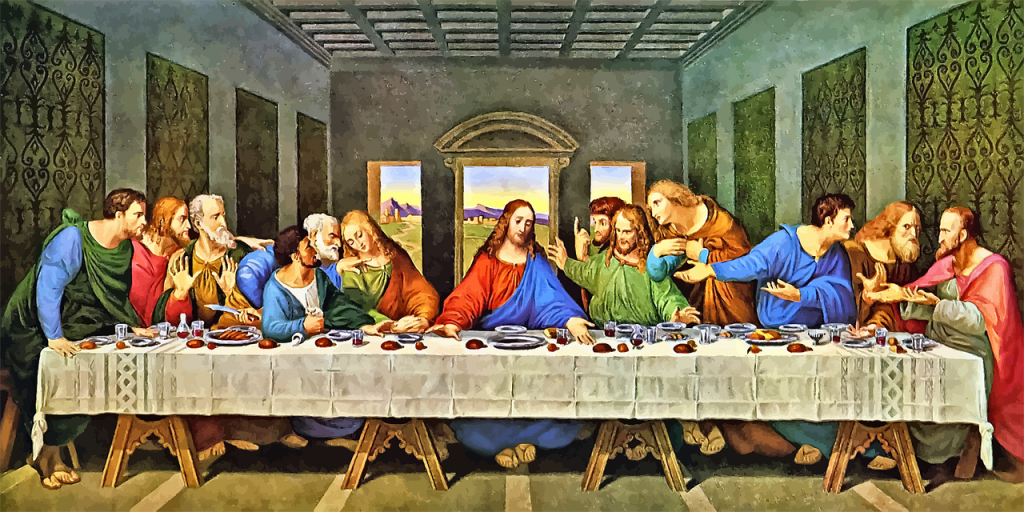
Luke 22: 7 – 23 The Last Supper – Part 1

Luke 22: 7 – 23 The Last Supper – Part 1

Then came the day of Unleavened Bread on which the Passover lamb had to be sacrificed. Jesus sent Peter and John, saying, ‘Go and make preparations for us to eat the Passover.’

‘Where do you want us to prepare for it?’ they asked.

He replied, ‘As you enter the city, a man carrying a jar of water will meet you. Follow him to the house that he enters, and say to the owner of the house, “The Teacher asks asks: where is the guest room, where I may eat the Passover with my disciples? He will show you a large room upstairs, all furnished. Make preparations there.’

They left and found things just as Jesus had told them. So they prepared the Passover.

When the hour came, Jesus and his apostles reclined at the table. And he said to them, ‘I have eagerly desired to eat this Passover with you before I suffer. For I tell you, I will not eat it again until it finds fulfilment in the kingdom of God.’

After taking the cup, he gave thanks and said, ‘Take this and divide it among you. For I tell you I will not drink again from the fruit of the vine until the kingdom of God comes.’

And he took bread, gave thanks and broke it, and gave it to them, saying, ‘This is my body given for you; do this in remembrance of me.’

In the same way, after the supper he took the cup, saying, ‘This cup is the new covenant in my blood, which is poured out for you. But the hand of him who is going to betray me is with mine on the table. The Son of Man will go as it has been decreed. But woe to that man who betrays him!’ They began to question among themselves which of them it might be who would do this.

*       *       *

How would we feel, I wonder, if we knew we were very soon to be crucified? Terrified, I should imagine. And yet look at these words of Jesus, just hours before his suffering begins.

When the hour came, Jesus and his apostles reclined at the table. And he said to them, ‘I have eagerly desired to eat this Passover with you before I suffer.’

He ‘eagerly desired’ to eat this Passover despite knowing what was inevitably following.

His words tell us that this is a very important occasion. He knows that soon he will be put to death, and his twelve chosen disciples will have to continue his ministry without him. In accordance with his Father’s will, Jesus gives his disciples a ritual to remind them of what he has done, and the high price he has paid. He gives them bread and wine, telling them that these represent his body and his blood; the disciples must eat and drink them in remembrance of him.

We follow their example in the service of Mass, or the Eucharist, or Holy Communion. For many of us it is the act of worship in which we feel closest to God, as we remember Jesus’ sacrifice.

Jesus also says, ‘This cup is the new covenant in my blood, which is poured out for you,’ and by doing so he establishes a new covenant to replace the old covenant made between God and Abraham. No longer do we need to be Jewish to worship God; Jesus has given everybody, Jew and Gentile, a way to approach and worship God.

Thank you, Jesus, for what you did for me.

Prayer

Heavenly Father

Thank you that Jesus blessed us with the Eucharist in remembrance of him. Please help us always to remember the high price he paid for each one of us.

In Jesus’ name, Amen

Luke 22: 1 – 6 Judas agrees to betray Jesus

Luke 22: 1 – 6 Judas agrees to betray Jesus

Now the Festival of Unleavened Bread, called the Passover, was approaching, and the chief priests and the teachers of the law were looking for some way to get rid of Jesus, for they were afraid of the people. Then Satan entered Judas, called Iscariot, one of the twelve. And Judas went to the chief priests and the officers of the temple guard and discussed with them how he might betray Jesus. They were delighted and agreed to give him money. He consented, and watched for an opportunity to hand Jesus over to them when no crowd was present.

*       *       *

Why?

Why would he do this?

He’s been with Jesus for many months. He’s one of the inner circle of disciples. He’s seen miracles. He’s endured hardships. He must surely have felt the attraction of Jesus and his teaching, or why would he have signed up?

We aren’t told. All St Luke tells us is that he betrayed Jesus.

St Matthew tells us a little more.

When Judas, who had betrayed him, saw that Jesus was condemned, he was seized with remorse and returned the thirty pieces of silver to the chief priests and the elders. 1I have sinned,’ he said, ‘for I have betrayed innocent blood.’

‘What is that to us,’ they replied. ‘That’s your responsibility.’

So Judas threw the money into the temple and left. Then he went away and hanged himself. (Matthew 27: 3 – 5)

Judas feels remorse for his action. Could it be that he never expected Jesus to be condemned to death? Did the chief priests and teachers of the law tell him they just intended a short period of imprisonment while things calmed down? Maybe just until the Passover crowds had dispersed?

Might they have told Judas that the Romans were becoming interested in Jesus, and were thinking of trying him for treason? Jesus would be much safer if he were in Jewish custody…

It’s certainly possible that Judas was deceived.

Is there a lesson for us in Judas’ story?

I think there are three.

  • We must pray, so we stay in touch with Jesus. If Judas had been duped by the authorities, Jesus could have set him right.
  • We must never despair. Jesus would, I’m pretty certain, have forgiven Judas, but Judas doesn’t give him the chance. He kills himself.
  • We should treat human arguments with great care whenever they appear to contradict the teaching of Jesus. We should weigh them in the light of the bible and the prompting of the Holy Spirit, and by prayer.

Prayer

Heavenly Father,

Please help us to ground our lives and our actions in you. Help us not to be led astray.

In Jesus name, Amen

Luke 21: 20 – 38 The destruction of the temple and signs of the end times – Part 2

Luke 21: 20 – 38 The destruction of the temple and signs of the end times – Part 2

‘When you see Jerusalem surrounded by armies, you will know that its desolation is near. Then let those who are in Judea flee to the mountains, and let those in the country not enter the city. For this is the time of punishment in fulfilment of all that has been written. How dreadful it will be in those days for pregnant women and nursing mothers! There will be great distress in the land and wrath against this people. They will fall by the sword and will be taken as prisoners to all the nations. Jerusalem will be trampled upon by the Gentiles until the times of the Gentiles are fulfilled.

‘There will be signs in the sun, moon and stars. On the earth, nations will be in anguish and perplexity at the roaring and tossing of the sea. People will faint from terror, apprehensive of what is coming on the world, for the heavenly bodies will be shaken. At that time they will see the Son of Man coming in a crowd with power and great glory. When these things begin to take place, stand up and lift up your heads, because your redemption is drawing near.’

He told them this parable: ‘Look at the fig-tree and all the trees. When they sprout leaves, you can see for yourselves and know that summer is near. Even so, when you see these things happening, you know that the kingdom of God is near.

‘Truly I tell you, this generation will certainly not pass away until all these things have happened. Heaven and earth will pass away, but my words will never pass away.

‘Be careful, or your hearts will be weighed down with carousing, drunkenness and the anxieties of life, and that day will close on you suddenly like a trap. For it will come on all those who live on the face of the whole earth. Be always on the watch, and pray that you may be able to escape all that is about to happen, and that you may be able to stand before the Son of Man.’

Each day Jesus was teaching at the temple, and each evening he went out to spend the night on the hill called the Mount of Olives, and all the people came early in the morning to hear him at the temple.

*       *       *

There are several different ways of understanding this passage. These include:

  • Reading these as the literal words of Jesus;
  • Accepting that Jesus taught like this, but that the words have been filtered both through an oral tradition and through the evangelist, St Luke;
  • Reading as though the words reflect more the teaching of the early church than the teaching of Jesus;

I am going to adopt the second view point. If after reading this you feel strongly that I’m mistaken, do please write in the comment box below and let me know.

*       *      *

Oh dear – that first paragraph (verses 20 – 24) is hard going. It fits as a prophecy of the destruction of Jerusalem and the temple by the Romans in 70 A.D. If Jesus actually spoke the words written, then his prophecy of the event was accurate. However, the gospel was probably written about 80 – 90 A.D. so the writer would have known about the fate of Jerusalem. I should say here that there is considerable debate about the date of St Luke’s gospel. Those scholars who subscribe to the view that every word of the bible is literally true would date it as earlier, precisely because this passage is presented as prophesy.

I can keep an open mind on the dating of the gospel. What really sticks in my throat is the description of this event as punishment. The words attributed to Jesus identify pregnant women and nursing mothers as suffering particularly harshly. That’s always the way with war; the weak suffer, while the strong rarely do. Why does a God of love use violence against the vulnerable as a punishment?

The only way I can rationalise this to myself is to make two suppositions. The first is that God doesn’t will these events (although he permits them to happen through having given us free will). With this supposition, prophecies about ‘God’s punishment’ can be understood as the inevitable consequences of the sinfulness of mankind as a whole.

The second supposition is that those who suffer when they are innocent, either through man’s inhumanity or through natural events like earthquakes, are somehow compensated after death. I can’t think of anything in the bible that explicitly supports this point of view; but I’ll keep looking.

Verses 25 – 26 read as though they came out of a lucky dip bottle labelled “Prophecies – Various”. The prophecies are completely unspecific.

Then we have verse 32: ‘Truly I tell you, this generation will certainly not pass away until all these things have happened.’

It’s 2020 A.D. and this prophecy is still unfulfilled.

I think, overall, that this passage is St Luke’s attempt to represent for us something of the flavour of the way Jesus taught. It doesn’t seem at all unlikely that he would have spoken of the consequences of human sin in terms of punishment by God. That was the way his listeners thought.

The passage conveys essential teaching about the transitory nature of human life. The time available for each of us to turn to God is limited. Yesterday’s passage included teaching on how we are to witness for Jesus, using the words that he gives us rather than our own thought-out arguments.

Jesus is also very likely to have used prophecy in his ministry. St Luke may have included the prophecies of this passage as an illustration of how Jesus used the gift, rather than as a literal record of specific prophecies.

I could, of course, be completely wrong…

Prayer

Heavenly Father

I believe in you as a God of love; I find it hard to believe that you could desire human punishment. Please help me to deepen my understanding of your nature, that I may grow closer to Jesus.

In Jesus’ name, Amen

Luke 21: 5 – 19 The destruction of the temple and signs of the end times – Part 1

Luke 21: 5 – 19 The destruction of the temple and signs of the end times – Part 1

Some of his disciples were remarking about how the temple was adorned with beautiful stones and with gifts dedicated to God. But Jesus said, ‘As for what you see here, the time will come when not one stone will be left on another; every one of them will be thrown down.’

‘Teacher,’ they asked, ‘when will these things happen? And what will be the sign that they are about to take place?’

He replied: ‘Watch out that you are not deceived. For many will come in my name, claiming, “I am he,” and “The time is near.” Do not follow them. When you hear of wars and uprisings, do not be frightened. These things must happen first, but the end will not come right away.’

Then he said to them: ‘Nation will rise against nation, and kingdom against kingdom. There will be great earthquakes, famines and pestilences in various places, and fearful events and great signs from heaven.

‘But before all this, they will seize you and persecute you. They will hand you over to synagogues and put you in prison, and you will be brought before kings and governors, and all on account of my name. And so you will bear testimony to me. But make up your mind not to worry beforehand how you will defend yourselves. For I will give you words and wisdom that none of your adversaries will be able to resist or contradict. You will be betrayed even by parents, brothers and sisters, relatives and friends, and they will put some of you to death. Everyone will hate you because of me. But not a hair of your head will perish. Stand firm, and you will win life.

*        *        *

There are several different ways of understanding this passage. These include:

  • Reading these as the literal words of Jesus;
  • Accepting that Jesus taught like this, but that the words have been filtered both through an oral tradition and through the evangelist, Luke;
  • Reading as though the words reflect more the teaching of the early church than the teaching of Jesus;

I am going to adopt the second view point. If after reading this you feel strongly that I’m mistaken, do please write in the comment box below and let me know.

Jesus takes a casual discussion by some of his disciples about the beauty of the temple as an opportunity to teach them something of what is in store for them. He tells them that, lovely though the temple is, it will be totally destroyed. Not surprisingly they’re alarmed, wanting to know when this will happen, and what sign they should look out for. They presumably want to make sure they’re nowhere near when it happens. It’s worth noting that they obviously trust Jesus’ prophecy.

Jesus starts his teaching by warning the disciples against false prophets. Times of turmoil are fertile ground for unscrupulous would-be leaders. Just like today, in Jesus’ day there were many who would present a simplistic answer to national or international problems. Indeed, when the Jews revolted against the Romans there were several factions with different leaders and agendas. One could make a case for this being the cause of their defeat, the destruction of Jerusalem and the scattering of the nation. “Do not follow them,” Jesus warns the disciples.

Is this warning an instruction for all time? To me, it certainly suggests that I should be cautious as to how passionately I should follow any political leader. At all times I must have my eyes fixed on God and his will, rather than on human strength and political agendas.

I think the heart of this teaching, though, is in verses 12 – 19. Jesus tells the disciples that they will be seized and persecuted. No ifs or buts; it’s going to happen. The reason? To bear testimony to Jesus. And as they are to bear testimony to Jesus, he will give them the words to say.

“But make up your mind not to worry beforehand how you will defend yourselves,” said Jesus. “For I will give you words and wisdom that none of your adversaries will be able to resist or contradict.”

Jesus is reassuring his disciples that when they are going to speak for him, he will give them the words to say. They shouldn’t spend time preparing a defence. In practice, what we see in Acts is that the disciples often spent times of imprisonment in praising God, rather than worrying. When you think about it, what better preparation could they make?

That applies to us, too. When we speak to someone about Jesus, we don’t need to prepare elaborate speeches – if we do, we’ll get it wrong. We just need to speak simply about him. He will give us the right words to say.

Jesus warns his disciples that they will be persecuted by many, including those who are closest to them. Some of them will even be put to death. However, he reassures them.

Stand firm, and you will win life.

Prayer

Heavenly Father,

Thank you for the teaching of this passage. Please give us the right words to speak to others about Jesus.

In Jesus name, Amen

Luke 21: 1 – 4 The widow’s offering

Luke 21: 1 – 4 The widow’s offering

As Jesus looked up, he saw the rich putting their gifts into the temple treasury. He also saw a poor widow put in two very small copper coins. ‘Truly I tell you,’ he said, ‘this poor widow has put in more than all the others. All these people gave their gifts out of their wealth; but she out of her poverty put in all she had to live on.

*       *       *

The aspect of this story that strikes me most forcefully is the relationship that must exist between the widow and God. As Jesus says, ‘she out of her poverty put in all she had to live on.

An offering to the temple wasn’t charity given to the poor; it was an offering made to God.

There could have been all sorts of motivations, good and bad, for the rich to give to the temple. Gratitude, perhaps; or maybe out of a feeling of guilt; perhaps out of love for God, and a desire to beautify his house; or maybe as a way of gaining status by giving publicly and lavishly.

Jesus doesn’t disparage the gifts of the wealthy – he just says the widow has given more than they have.

But what reasons could the widow have for giving?

In the first place, her faith must be deep. She put in ‘all she had to live on’ trusting that God would meet her physical needs.

Could it have been gratitude? Why would a desperately poor widow feel so grateful that she gave all she had to live on to God? She must have had joy in her life, and that joy can only have come from God.

Sacrificial giving like this is a complete surrender to God. It is worship. It is saying, “Lord, all I have is yours”.

The widow gives to the limit; she places herself entirely in God’s hands. As a result, despite being poor and having no status at all, she is filled with joy. She experiences God’s love very strongly and very directly.

Faith, gratitude, love and worship are closely intermingled in this passage. God loves the widow, and she consciously experiences his love. She responds with faith, gratitude and worship, and that increases her closeness to God. She rejoices.

Blessed are you who are poor, for yours is the kingdom of God (Luke 6: 20)

The widow’s example shows us how this teaching of Jesus can be literally true even in this earthly life.

Prayer

Heavenly Father,

Thank you for your love for me. Please help me respond like the widow – with faith, gratitude and worship. Please help me to be more ready to share my material blessings.

In Jesus name, Amen  

Luke 20: 41 – 47 Whose son is the Messiah & Warning against the teachers of the law

Luke 20: 41 – 47 Whose son is the Messiah & Warning against the teachers of the law

Then Jesus said to them, ‘Why is it said that the Messiah is the son of David? David himself declares in the Book of Psalms:

‘ “The Lord said to my Lord: ‘Sit at my right hand until I make your enemies a footstool for your feet.’ “

David calls him, “Lord” How then can he be his son?’

While all the people were listening, Jesus said to his disciples, ‘Beware of the teachers of the law. They like to walk around in flowing robes and love to be greeted with respect in the market-places and have the most important seats in the synagogues and the places of honour at banquets. They devour widows’ houses and for a show make lengthy prayers. These men will be punished most severely.’

*       *       *

The first three verses are slightly enigmatic to a modern reader. What does this passage mean?

We must remember to put this in the context in which it was spoken. Jesus is speaking to the Sadducees, who believe there is no resurrection. Jesus has just told them that God tells Moses that he is the God of Abraham, the God of Isaac and he God of Jacob, and that he is not the God of the dead but of the living.

The Jews believed that seniority was very important. The first-born child had special privileges; for example, they would receive a double share of the inheritance. It would have been contrary to this belief if King David were to refer to one of his descendants as ‘Lord’; he just wouldn’t have done it.

In discussing this point, Jesus is saying that Psalm 110 is a prophetic psalm which tells of the coming of the Messiah. King David, the writer of the psalm, is describing a vision in which the Lord God says to the Messiah that he will be a mighty leader, a high priest for ever, and that he will sit in judgment over kings.

Jesus says that it is plainly wrong to say that the Messiah can be a descendant of King David, because David would not have referred to him as Lord. The inference is that the Messiah is altogether greater than David. Perhaps even more importantly, he is pointing out how limited is our human understanding of the Kingdom of heaven

Having posed that conundrum to the Sadducees, Jesus now warns against teachers of the law. He draws us a picture of them in their daily life.

They liked to wear flowing robes. This showed that they didn’t do manual labour. They were above that. They showed disdain for the ordinary person.

They liked respect in the market-places – not the respect that we should show to everybody, but the respect that establishes and reinforces status; division; exploitation.

They prized the most important seats in the synagogue and places of honour at banquets; showing they wanted status and influence.

What are the spiritual consequences of this behaviour?

It establishes ‘in’ groups and ‘out’ groups, and makes it easier to treat others as objects to gratify our desires. Jesus makes it plain that looking down on those we perceive as weaker or less worthy than ourselves has practical consequences. He points out that “They devour widows’ houses and for a show make lengthy prayers.” This was a particularly pointed accusation, because widows had special status under Mosaic law: ‘Do not take advantage of the widow or the fatherless. If you do and they cry out to me, I will certainly hear their cry. My anger will be aroused, and I will kill you with the sword; your wives will become widows and your children fatherless.’ (Exodus 22: 22 – 24)

Another consequence is that their life is governed by appearances rather than love. This is an insidious consequence. Gradually these men will lose the capacity for human love, and their ability to respond to God’s love will be reduced.

Jesus gives a frightening warning. ‘These men will be punished most severely’.

To be loveless causes people to cut themselves off from God, and that is a terrible punishment.

Now, there are some people who find it difficult to experience the emotion of love. In case anyone reading this has that difficulty (and I confess that I was like that for a long time), don’t worry. God’s love is for all. Trust God for it. Love in our lives is at least as much a matter of will as it is of emotion. Keep on loving people; doing kindly actions; putting others first. Pray for your love to be deepened, and trust God to do exactly that. The simple fact that you are seeking to love shows that you love God and trust him.

And for the rest of us who are able to feel love, if we know anyone who struggles with feeling love, let’s pray for them and show them as much love as we can.

Prayer

Heavenly Father

By the standards of Jesus, my motives are mixed. I don’t always act out of love. Sometimes I place appearance ahead of love. Create in me a pure heart, O Lord, and renew a right spirit within me.

In Jesus name, Amen

Luke 20: 27 – 39 The resurrection and marriage

Luke 20: 27 – 39 The resurrection and marriage

Some of the Sadducees, who say there is no resurrection, came to Jesus with a question. ‘Teacher,’ they said, ‘Moses wrote for us that if a man’s brother dies and leaves a wife but no children, the man must marry the widow and raise up offspring for his brother. Now there were seven brothers. The first one married a woman and died childless. The second and then the third married her, and in the same way the seven died, leaving no children. Finally, the woman died too. Now then, at the resurrection whose wife will she be, since the seven were married to her?’

Jesus replied, ‘The people of this age marry and are given in marriage. But those who are considered worthy of taking part in the age to come and in the resurrection from the dead will neither marry nor be given in marriage, and they can no longer die; for they are like the angels. They are God’s children, since they are children of the resurrection. But in the account of the burning bush, even Moses showed that the dead rise, for he calls the Lord “the God of Abraham, and the God of Isaac, and the God of Jacob”. He is not the God of the dead, but of the living, for to him all are alive.’

Some of the teachers of the law responded, ‘Well said, teacher!’ And no one dared ask him any more questions.

*       *       *

As a child of the mid-20th century, born into western culture, I tend to think of marriage as the fulfilment of romantic love. The prince marries Cinderella, and lives happily ever after. However, if I had been born into an Asian family, for example, my marriage might have been arranged by my family and, while my happiness would have been considered, other factors would have played a part.

I mention this because my view of marriage is different from that of a 1st century Jew, and will colour my understanding of this passage.

Marriage in 1st century Israel was largely to do with maintaining the extended family, and, in particular, the property rights of the family. The question posed by the Sadducees arises from a situation described in the Torah (the Hebrew scriptures, which form the first five books of the Old Testament). Exactly as the Sadducees describe, the brother of a man who dies without children is obliged to marry the widow. This is to try to ensure that the man’s property can pass to an heir within the extended family. (Deuteronomy 25: 5 – 10)

As the Sadducees pose the problem, during her earthly life the woman has been married to all seven brothers. To whom is she married at the resurrection? The motive for asking the question is to ridicule the idea of there being a resurrection.

Jesus’ answer is one of the rare occasions he speaks of the world to come. He says that it’s different. Those who are worthy are raised in bodies like angels. There is no need for inheritance laws, because nobody dies. There is no need for extended family because everyone is a child of God.

In other words, life after the resurrection will be very different, and centred on God. It is a spiritual realm, not a material one.

Jesus goes on to deal with the Sadducees’ motive in asking the question. He reminds his listeners that when God appeared to Moses in the burning bush, he described himself as “the God of Abraham, and the God of Isaac, and the God of Jacob”. Jesus adds, He is not the God of the dead, but of the living, for to him all are alive.’

Although Jesus has spoken of the world to come, it’s hard to imagine it – perhaps one reason why he doesn’t speak of it very often. The key insights he gives us are that it’s different; it’s spiritual, not material; we will all be God’s children; and we will not die.

Prayer

Heavenly Father

Thank you for your love for us. Thank you for human love, which can point us to you.

In Jesus name, Amen