Mark 12: 41 – 44 The widow’s offering

Mark 12: 41 – 44 The widow’s offering

Jesus sat down opposite the place where the offerings were put and watched the crowd putting their money into the temple treasury. Many rich people threw in large amounts. But a poor widow came and put in two very small copper coins, worth only a few pence.

Calling his disciples to him, Jesus said, ‘Truly I tell you, this poor widow has put more into the treasury than all the others. They all gave out of their wealth; but she, out of her poverty, put in everything – all she had to live on.’

*       *       *

The widow gave two very small copper coins. They weren’t valueless, like a cent or a penny today; you could definitely buy something with them; but you couldn’t buy very much. The best ‘guesstimate’ I’ve seen of their value is that they could have bought the woman a cheap meal. As Jesus said, she put in all she had to live on. She would go to bed hungry that night.

A part of me says, ‘Surely God didn’t want her to make herself destitute?’ Jesus is perfectly clear, though. He thinks her example is so important that he calls his disciples together to emphasise its importance.

This is part of Jesus’ teaching about money, and it should certainly prompt me to assess my own giving to God. I can see only too clearly that I am giving out of my wealth. I’m not sure that’s its primary message for me today.

The thing that made the widow’s gift particularly valuable was that she put God first. Who would you go hungry for? Your children? Your spouse? Your best friend? The widow gave so generously to God because she loved him. She had a relationship with him. She put him first because she knew him.

As I meditate and pray today, that is where I must start; by earnestly seeking to let the love of God grow in my life. I need to learn how to experience his presence so that I want to put him first in every part of my life.

Prayer

Heavenly Father

Thank you that the death and resurrection of Jesus have given me the opportunity to have a loving relationship with you. Please help me to be open to your love, and to be ready to do your will.

In Jesus’ name, Amen

Mark 12: 38 – 40 Warning against the teachers of the law

Mark 12: 38 – 40 Warning against the teachers of the law

As he taught, Jesus said, ‘Watch out for the teachers of the law. They like to walk around in flowing robes and be greeted with respect in the market-places, and have the most important seats in the synagogues and the places of honour at banquets. They devour widows’ houses and for a show make lengthy prayers. These men will be punished most severely.’

*       *       *

What did Jesus say about the teachers of the law?

  • They like to walk around in flowing robes (the flowing robes showed that they didn’t need to toil with their hands to earn a living)
  • They like to be greeted with respect in the market-places
  • They like to have the most important seats in the synagogues
  • They like to have the places of honour at banquets
  • They devour widows’ houses
  • Their lengthy prayers are just for show  

Imagine that you’re a mother in 1st century Judaea. Your twelve-year-old son has just come home and told you that his teacher has said that he’s an excellent student. In fact, he could become a teacher of the law himself!

How would you feel?

I think I’d feel pretty pleased. My imagination would dash ahead. I would see my little Reuben a grown man, striding confidently through the town, having people greet him respectfully. He would earn a good living from his knowledge of the law. He would be invited to banquets and sit in one of the seats of honour! My friends would be green with envy at Reuben’s success…

And, if we’re honest, I think that’s how most of us would feel.

But Jesus describes two attributes of the teachers of the law that should cause us to stop and think.

  • They devour widows’ houses
  • Their lengthy prayers are just for show  

When Jesus accuses them of ‘devouring widows’ houses’, I imagine he means charging exorbitant fees for dealing with a widow’s inheritance. It would seem that the fees could eat up the entire estate, leaving the widow destitute. This is not merely cheating someone, it is cheating one of the weakest and most vulnerable members of society; a widow. The law of Moses gave specific and frequent encouragement for widows and orphans to be treated generously and with compassion.

Coming to the second point, we may, perhaps, wonder how Jesus can make such a general statement. Surely there must be some teachers of the law who pray sincerely? But actually, maybe not. If you are making your living by doing things that are directly contrary to the spirit of the law, maybe it’s simply not possible to pray sincerely.

In Luke 18; 9 – 14, Jesus tells a parable about sincere prayer. A Pharisee stands up in the temple and ‘thanks God’ that he’s not like other men – and then lists all the good things he’s done. A tax-collector also goes to the temple, but he stands at a distance, keeps his gaze lowered, beats his breast, and implores God to have mercy on him. Jesus tells us that it’s the tax-collector who goes home justified before God. Effective prayer depends 100% on having the right attitude.

And what is the right attitude? It’s coming before God knowing your need for him. It is being prepared – indeed, expecting, hoping, longing – for God to change you and make you more as he wants you to be.

Lengthy prayers done just for show, like those of the teachers of the law, are worse than useless.

Having looked at the two obviously bad attributes of the teachers of the law, what about their other characteristics that Jesus describes? I seem to remember feeling rather pleased that my Reuben could become such a respected person…

And that’s a thing, isn’t it? We all want to be honoured and respected members of our community, don’t we? Is that really wrong?

The answer, I’m afraid, is yes, it is wrong. If some members of our community have special respect, special honour, then there will be some who don’t. We will have tax-collectors as well as Pharisees. We will discriminate between them in a way that God does not, for we like Pharisees who behave nicely, and we don’t like tax-collectors who need to repent.

To live in accordance with Jesus’ teaching, we need to focus on love. Our aspiration should be to live in a community of love, in which we can both give and receive love. We should aspire to listen to God, and, in the power of the Holy Spirit, do his will.

Prayer

Heavenly Father

Have mercy on me, a sinner. I’m sorry I’m so disobedient. Please help me to do better.

In Jesus’ name, Amen

Mark 12: 35 – 37 Whose son is the Messiah?

Mark 12: 35 – 37 Whose son is the Messiah?

While Jesus was teaching in the temple courts, he asked, ‘Why do the teachers of the law say that the Messiah is the son of David? David himself, speaking by the Holy Spirit, declared:

‘ “The Lord said to my Lord: ‘Sit at my right hand until I put your enemies under your feet.’”

David himself calls him “Lord”. How then can he be his son?’

The large crowd listened to him with delight.

*       *       *

What is Jesus saying here?

He quotes the first verse of Psalm 110, and tells his listeners that King David (the writer of the psalm) was speaking prophetically when he wrote it. Many of Jesus’ listeners would have been familiar with the psalm; they would have learned it by rote during childhood. However, it’s not so familiar to us, so I’ll quote the whole of it.

“The Lord says to my Lord, ‘Sit at my right hand until I make your enemies a footstool for your feet.

The Lord will extend your mighty sceptre from Zion, saying, ‘Rule in the midst of your enemies!’

Your troops will be willing on your day of battle. Arrayed in holy splendour, your young men will come to you like dew from the morning’s womb.

The Lord has sworn and will not change his mind: ‘You are a priest for ever, in the order of Melchizedek.’

The Lord is at your right hand; he will crush kings on the day of his wrath.

He will judge nations, heaping up the dead and crushing the rulers of the whole earth.

He will drink from a brook along the way; and so he will lift his head high.” (Psalm 110)

“The Lord” refers to God; “my Lord” refers to the Messiah. In this psalm, David is writing about God’s promises to the Messiah. God says that he will do the following

  • the Messiah’s enemies shall be a footstool for his feet;
  • the Messiah’s rule will extend out from Zion despite opposition; 
  • the Messiah will command troops arrayed in holy splendour who have miraculously appeared overnight;
  • the Messiah will be a priest for ever;
  • the Messiah will have God’s full backing;
  • the Messiah will judge nations;
  • the Messiah will be constantly refreshed by the Holy Spirit (the living water of the Holy Spirit is symbolised by the brook).

In this psalm, David refers to the Messiah as “my Lord”. He acknowledges him as his superior. But in Judaism, ancestors took precedence over descendants. If the Messiah is a son (= descendant) of David, he could never outrank David himself.

How can this be? It is a paradox.

Jesus wants his followers thinking about who he is, and what that means.

He’s prompting people – including us – to understand as best we can who he really is, and by quoting Psalm 110 to us, he’s giving us some idea of that. He is a ruler; a commander; a priest for ever; the representative to humanity of God the Father; a judge; and he will be constantly refreshed by the Holy Spirit.

Thought-provoking questions

One of my favourite web-sites is Sacred Space. In their reflection on the verses we’ve been studying today, they pose the questions “Who is Jesus for me? How would I introduce him to someone else?”

Those are good questions to consider.

Prayer

Heavenly Father

Thank you for sending us Jesus to show us what your love looks like when it’s lived out in this world. Please help me to follow him as best I can. I place my life in your hands, Lord.

In Jesus’ name, Amen

Mark 12: 28 – 34 The greatest commandment

Mark 12: 28 – 34 The greatest commandment

One of the teachers of the law came and heard them debating. Noticing that Jesus had given them a good answer, he asked him, ‘Of all the commandments, which is the most important?’

‘The most important one,’ answered Jesus, ‘is this: “Hear, O Israel: the Lord our God, the Lord is one. Love the Lord your God with all your heart and with all your soul and with all your mind and with all your strength.” The second is this: “Love your neighbour as yourself.” There is no commandment greater than these.’

‘Well said, teacher,’ the man replied. ‘You are right in saying that God is one and there is no other but him. To love him with all your heart, with all your understanding and with all your strength, and to love your neighbour as yourself is more important than all burnt offerings and sacrifices.’

When Jesus saw that he had answered wisely, he said to him, ‘You are not far from the kingdom of God.’ And from then on no one dared ask him any more questions.

*       *       *

Jesus’ reply to the teacher of the law who had asked which was the most important of the commandments, is this: “Hear, O Israel: the Lord our God, the Lord is one. Love the Lord your God with all your heart and with all your soul and with all your mind and with all your strength.”

This is a paraphrase of Deuteronomy 10: 12 – 13

And now, Israel, what does the Lord your God ask of you but to fear the Lord your God, to walk in obedience to him, to love him, to serve the Lord your God with all your heart and with all your soul, and to observe the Lord’s commands and decrees that I am giving you today for your own good? (Deuteronomy 10: 12 – 13)

There is a subtle change of emphasis between the original in Deuteronomy and Jesus’ paraphrase. In Deuteronomy, the first thing the Israelites are told to do is to “fear the Lord your God”. The second is to “walk in obedience to him”. It’s not until you get to the third instruction that you see anything about love – and it’s just a brief mention, “to love him,” – and then we’re back to service with, “to serve the Lord your God with all your heart and with all your soul,” and obedience with, “and to observe the Lord’s commands and decrees that I am giving you today for your own good.”

But how different are they really? Let’s look at the detail.

“Fear the Lord your God.”

Is fear compatible with love? St John says: “There is no fear in love. But perfect love drives out fear, because fear has to do with punishment. The one who fears is not made perfect in love.” (1 John 4: 18)

“Walk in obedience to him”. God is all-powerful, but he’s given humanity free will. We can choose to obey or not. He wants the best for each one of us. That will happen if we listen for what he has to tell us, and obey him. Obedience to God is not something he imposes on us, it is something he wants for us so he can perfect us.

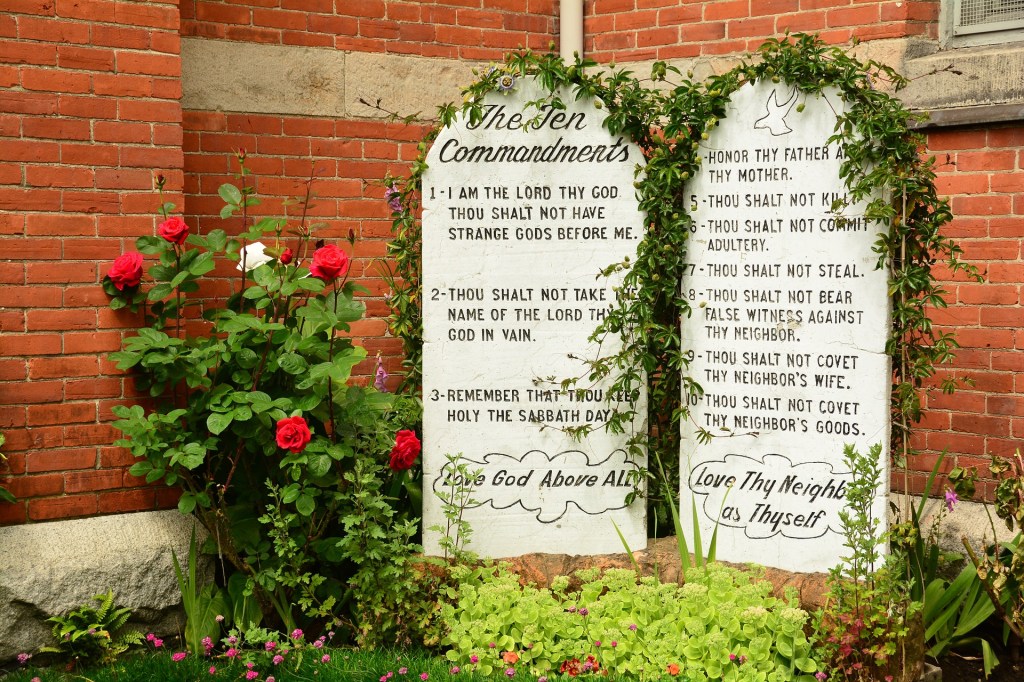
“And to observe the Lord’s commands and decrees that I am giving you today for your own good.” God has given us some strong pointers about how we can best live our lives. The ten commandments are a good start, and the example of the life of Jesus says pretty much everything else that we need to know.

After reviewing the two statements of the greatest commandment, it seems to me that there is a real difference between them. The version in Deuteronomy puts an emphasis on the fear of God. The version given by Jesus puts the entire emphasis on love. God the Father is love, and our appropriate response to him is to love him with all our heart and with all our soul and with all our mind and with all our strength.

Jesus adds more to his reply to the teacher of the law, by giving him a summary of the rest of the Mosaic law in a single sentence: “Love your neighbour as yourself.”

It is tremendously important to realise that these two commandments are so closely linked that they can’t be separated. If you lack the insight that God the Father is love, then how are you going to properly love your neighbour as yourself? If you aren’t trying to love your neighbour as yourself, you aren’t living your life in the way that God wants – and he wants only the best for you.

‘Well said, teacher,’ the man replied. ‘You are right in saying that God is one and there is no other but him. To love him with all your heart, with all your understanding and with all your strength, and to love your neighbour as yourself is more important than all burnt offerings and sacrifices.’

Jesus must have looked at this man and loved him. It was so rare that any of the religious establishment were able to accept his teaching.

When Jesus saw that he had answered wisely, he said to him, ‘You are not far from the kingdom of God.’

I think there were two things of which Jesus approved; the man’s knowledge that the kingdom of God was built on love; and his willingness to listen and learn.

I pray that I and any readers of this blog post will grow in our experience of God’s love, and show it every day in our love for our neighbours.

Prayer

Heavenly Father

Thank you for the teaching and example of Jesus. Please help me to love and obey him more each day.

In Jesus’ name, Amen

Mark 12: 18 – 27 Marriage at the resurrection

Mark 12: 18 – 27 Marriage at the resurrection

Then the Sadducees, who say there is no resurrection, came to him with a question. ‘Teacher,’ they said, ‘Moses wrote for us that if a man’s brother dies and leaves a wife but no children, the man must marry the widow and raise up offspring for his brother. Now there were seven brothers. The first one married and died without leaving any children. The second one married the widow, but he also died, leaving no child. It was the same with the third. In fact, none of the seven left any children. Last of all, the woman died too. At the resurrection, whose wife will she be, since the seven were married to her?’

Jesus replied, ‘Are you not in error because you do not know the scriptures or the power of God? When the dead rise, they will neither marry nor be given in marriage; they will be like the angels in heaven. Now about the dead rising – have you not read in the Book of Moses, in the account of the burning bush, how God said to him, “I am the God of Abraham, the God of Isaac, and the God of Jacob”? He is not the God of the dead, but of the living. You are badly mistaken!’

*       *       *

Jesus has been challenged by the chief priests, the teachers of the law and the elders, and by the Pharisees and Herodians. Now it is time for another powerful group, the Sadducees, to question him.

As Mark says, the Sadducees didn’t believe in a resurrection of the dead; apparently they didn’t believe in angels either. They were an upper-class group who largely controlled temple worship. They confined religion strictly to the five books of Moses, and didn’t take account of the oral tradition of such as the Pharisees.

You may think their question is strange. Why are a group who don’t believe in the resurrection asking a detailed question regarding a situation whose outcome only shows up in the resurrection? In fact, what they are doing is using a well-established logical/rhetorical argument known as ‘Reductio ad Absurdum’.

Wikipedia defines this as a ‘form of argument that attempts to establish a claim by showing that the opposite scenario would lead to absurdity or contradiction.’

Here, the questioners have constructed a situation that seems to show that it is absurd to think there is a resurrection. The woman has been married to all seven men; whose wife is she after the resurrection?

Jesus has no patience with their question (and we’ll return to this point in a moment).

Jesus replied, ‘Are you not in error because you do not know the scriptures or the power of God?’

These are harsh words to the men who were responsible for temple worship. Jesus plainly thinks that the question is nonsensical. Nevertheless, he gives them a clear and straight-forward answer. The premise of their question is wrong.

Jesus said, ‘When the dead rise, they will neither marry nor be given in marriage; they will be like the angels in heaven.’

There is no marriage after resurrection, says Jesus, therefore the situation cannot arise. As the situation cannot arise, there is no absurdity, and their argument fails.

Jesus then goes on to give a positive, scriptural reference to resurrection.

‘Now about the dead rising – have you not read in the Book of Moses, in the account of the burning bush, how God said to him, “I am the God of Abraham, the God of Isaac, and the God of Jacob”? He is not the God of the dead, but of the living.’

The only authority the Sadducees respect is the written word of the Books of Moses, which are also the first five books of our Christian Old Testament. So Jesus quotes from one of them to demonstrate that Moses himself gave them the argument for the reality of resurrection. (The quotation is from Exodus 3: 6)

It is interesting to look more closely at the story told by the Sadducees.

‘Moses wrote for us that if a man’s brother dies and leaves a wife but no children, the man must marry the widow and raise up offspring for his brother. Now there were seven brothers. The first one married and died without leaving any children. The second one married the widow, but he also died, leaving no child. It was the same with the third. In fact, none of the seven left any children. Last of all, the woman died too. At the resurrection, whose wife will she be, since the seven were married to her?’

This was indeed what Moses had said (Deuteronomy 25: 5 – 10). It was called levirate marriage. It had nothing to do with love and was principally intended to ensure the continuation of the family blood-line, and the orderly inheritance of land and property.

The whole motivation behind the Sadducees question had nothing to do with a sincere interest in God’s will. It was all to do with property!

Which brings us back to the harshness of Jesus’ reply. He has no patience with the question because the bad faith of the Sadducees has left very little room for him to open their eyes to the truth.

And now I come to the bit of this teaching that I find difficult.

‘When the dead rise, they will neither marry nor be given in marriage; they will be like the angels in heaven.’

I’ve been married for 46 years. My wife and I love each other dearly. Her human love for me has taught me how to love others. The words ‘When the dead rise, they will neither marry nor be given in marriage’ send a shiver through me. Daphne and I have been a partnership in the best sense of the word, loving, supporting, discovering new things, challenging old ways of behaving, growing as people. I don’t want that to stop.

But just as marriage is about trust, so is faith. I must trust God. He has my best interests at heart. He has Daphne’s best interests at heart. If it is best for us to stay together after death, that is what will happen. The only way he will part us is if he wishes both of us to have something even better.

Prayer

Heavenly Father

You are the God of Abraham, Isaac and Jacob; and you are my God, too. I’m sorry for when my faith falls short; I’m sorry for when I let worldly things have priority over the spiritual. Please help me to be open to your teaching, and obedient to your will.

In Jesus’ name, Amen

Mark 12: 13 – 17 Paying the poll-tax to Caesar

Mark 12: 13 – 17 Paying the poll-tax to Caesar

Later they sent some of the Pharisees and Herodians to Jesus to catch him in his words. They came to him and said, ‘Teacher, we know that you are a man of integrity. You aren’t swayed by others, because you pay no attention to who they are; but you preach the way of God in accordance with the truth. Is it right to pay the poll-tax to Caesar or not? Should we pay or shouldn’t we?’

But Jesus knew their hypocrisy. ‘Why are you trying to trap me?’ he asked. ‘Bring me a denarius and let me look at it.’ They brought the coin, and he asked them, ‘Whose image is this? And whose inscription?’

‘Caesar’s,’ they replied.

Then Jesus said to them, ‘Give back to Caesar what is Caesar’s and to God what is God’s.’

And they were amazed at him.

*       *       *

“Later they sent some of the Pharisees and Herodians to Jesus to catch him in his words.”

Mark has referred to previous opponents of Jesus as “chief priests, teachers of the law and elders.” Now he tells us of an encounter of Jesus with the Pharisees and Herodians.

They came to him and said, ‘Teacher, we know that you are a man of integrity.

This looks respectful – but that’s just for the benefit of the crowd. The Pharisees and Herodians hate Jesus.

You aren’t swayed by others, because you pay no attention to who they are;

The words seem to be flattering, making Jesus sound like a person of robust integrity; but they conceal a trap. The speakers are trying to lure Jesus into saying that it is unlawful to pay taxes to Caesar, in other words, to the occupying power, Rome.

Look at the different levels of truth in this sentence. At a surface level the words are true. Jesus was indeed a man of integrity who wasn’t swayed by others. However, the way the words are intended and the way they are spoken makes them a falsehood. The Pharisees and Herodians used them just as flattery to avoid antagonising the crowd. But underneath the falsehood lies a deeper truth; a truth about the Pharisees and Herodians themselves. In terms of their motivation, the words mean ‘You aren’t swayed by us. You pay no attention to who we are.’ This is what they really hate about Jesus.

but you preach the way of God in accordance with the truth.

Jesus does indeed preach the way of God in accordance with the truth. Even as the Pharisees and Herodians seek to trap Jesus, they bear unintentional witness to his goodness.

Is it right to pay the poll-tax to Caesar or not? Should we pay or shouldn’t we?’

The trap is sprung. If Jesus says that the poll-tax should be paid to Rome he will lose credibility with his followers, who are all looking to him as their deliverer from Roman rule. If he says that it’s unlawful to pay the poll-tax, he will be denounced to the Roman authorities for sedition.

But Jesus knew their hypocrisy.

Jesus was used to the hypocrisy of the Pharisees. He would have seen through their trap even as they were flattering him

‘Why are you trying to trap me?’ he asked.

This is a very important question for each of the Pharisees and Herodians. They could have been listening to the words of life that Jesus brings. Instead, they’re trying to trap him.  

‘Bring me a denarius and let me look at it.’ They brought the coin, and he asked them, ‘Whose image is this? And whose inscription?’

As always, Jesus cuts to the heart of the matter. Coinage is issued by the authorities, in this case the Roman emperor. It carries both the emperor’s image, and an inscription. It is his guarantee of stability and good governance.

‘Caesar’s,’ they replied.

I imagine them as being puzzled by Jesus’ question. They possibly hesitated before answering.

Then Jesus said to them, ‘Give back to Caesar what is Caesar’s and to God what is God’s.’

In effect, Jesus is saying that the Pharisees and Herodians are confusing the spiritual with the temporal. Money bears the image and inscription of the issuing authority. It is used for buying and selling, for raising taxation and for carrying out work for the common good. God, by contrast, is interested in the spiritual, that people should act justly, show mercy, and walk humbly with him.

And they were amazed at him.

*       *       *

This passage is relevant to how we read the bible. Do we read it to find inconsistencies, or to learn more about God’s will?

I think it’s necessary to read it carefully, but with faith. I struggle with much of it, especially in the Old Testament.

The passage from Mark’s gospel that I’ve been studying today prompts me to wonder if there is a different way of looking at the more bloodthirsty parts. Jesus can show me the true meaning of the passages, but I need to listen humbly to him. I love his message of love, and I want to put it into practice more perfectly. But I can only do this with his help.

Prayer

Heavenly Father

Your Holy Spirit teaches us your way in accordance with the truth. Please help me to listen, understand and obey all you have to tell me, so that I can draw ever closer to Jesus, in whose name I pray.

Amen

Mark 12: 1 – 12 The parable of the tenants

Mark 12: 1 – 12 The parable of the tenants

Jesus then began to speak to them in parables: ‘A man planted a vineyard. He put a wall round it, dug a pit for the winepress and built a watchtower. Then he rented the vineyard to some farmers and moved to another place. At harvest time he sent a servant to the tenants to collect from them some of the fruit of the vineyard. But they seized him, beat him and sent him away empty-handed. Then he sent another servant to them; they struck this man on the head and treated him shamefully. He sent still another, and that one they killed. He sent many others; some of them they beat, others they killed.

‘He had one left to send, a son, whom he loved. He sent him last of all, saying, “They will respect my son.”

‘But the tenants said to one another, “This is the heir. Come, let’s kill him, and the inheritance will be ours.” So they took him and killed him, and threw him out of the vineyard.

‘What then will the owner of the vineyard do? He will come and kill those tenants and give the vineyard to others. Haven’t you read this passage of Scripture:

‘ “The stone the builders rejected

 has become the cornerstone;

the Lord has done this,

and it is marvellous in our eyes” ?’

Then the chief priests, the teachers of the law and the elders looked for a way to arrest him because they knew he had spoken the parable against them. But they were afraid of the crowd; so they left him and went away.

*       *       *

We need to read this carefully, to avoid making mistakes. This isn’t a parable about the owner of the vineyard; it is a parable about the tenants.

The vineyard had a winepress, it was surrounded by a wall to protect it from robbers, and it had a watchtower to provide early warning of any attempt by robbers to break in. This self-contained facility for the production of a luxury consumer product (namely, wine) was comprehensively equipped. It had everything necessary to prosper.

The owner who built the vineyard stands for God. The vineyard stands for Israel, who had been provided by God with everything they needed to prosper.

The owner rented the vineyard to some farmers, the rent to be a portion of the fruit gathered during harvest. The farmers in the story stand for the religious authorities, the chief priests, the teachers of the law and the elders. So far, so good. You’d expect such men to be trustworthy, wouldn’t you?

But they’re not, far from it. When the owner sends for his share of the produce, the tenants beat, humiliate and even kill the servants that the owner sends to them. In the story, these servants represent the prophets God sent to Israel, who were beaten and killed by the predecessors of the authorities to whom Jesus was speaking.

So the owner decides to send his son. As he says, “They will respect my son.”

No. They don’t. Look at this.

‘But the tenants said to one another, “This is the heir. Come, let’s kill him, and the inheritance will be ours.”

Their wickedness is completely premeditated. They kill the son, and throw his body out of the vineyard.

Then Jesus speaks directly and plainly to the chief priests, the teachers of the law and the elders.

‘What then will the owner of the vineyard do? He will come and kill those tenants and give the vineyard to others. Haven’t you read this passage of Scripture:

‘ “The stone the builders rejected

 has become the cornerstone;

the Lord has done this,

and it is marvellous in our eyes” ?’

Jesus leaves no doubt that God is the owner, and that he himself is the son. He leaves it to the chief priests, the teachers of the law and the elders to work out for themselves that they are the wicked tenants.

“Then the chief priests, the teachers of the law and the elders looked for a way to arrest him because they knew he had spoken the parable against them. But they were afraid of the crowd; so they left him and went away.”

Jesus has accused the religious authorities of hypocrisy over and over again. All that stands between him and arrest is the authorities fear of the crowd.

This is a strong attack on the hypocritical authorities of Jesus’ generation. We could easily sit back and say, “Gosh, those chief priests were really asking for it – and they surely got it!”

But hang on a minute. How do we fare as God’s tenants on earth? Are we good stewards? Are we doing all we can to protect the environment? Are we working to achieve social justice? Do we seek peace among nations? Do we love our neighbour as ourselves?

What is God telling us to do – and are we doing it?

Prayer

Heavenly Father,

Thank you for creating a good world that can support all of us in comfort. We recognise that despite this, many of our fellow humans live in poverty. I confess that my sin makes me slow and ungenerous in helping. Please open my heart and help me to be a better tenant.

In Jesus’ name, Amen

Mark 11: 27 – 33 The authority of Jesus questioned

Mark 11: 27 – 33 The authority of Jesus questioned

They arrived again in Jerusalem, and while Jesus was walking in the temple courts, the chief priests, the teachers of the law and the elders came to him. ‘By what authority are you doing these things,’ they asked. ‘And who gave you authority to do this?’

Jesus replied, ‘I will ask you one question. Answer me, and I will tell you by what authority I am doing these things. John’s baptism – was it from heaven, or of human origin? Tell me!’

They discussed among themselves and said, ‘If we say, “From heaven,” he will ask, “Then why didn’t you believe him?” But if we say “Of human origin…” ’ (They feared the people, for everyone held that John really was a prophet.)

So they answered Jesus ‘We don’t know.’

Jesus said, ‘Neither will I tell you by what authority I am doing these things.’

*       *       *

When I first read this passage at school, it was explained as Jesus being particularly adroit in debate with the religious authorities of his day. Of course, that’s true – but there’s so much more!

The chief priests, teachers of the law and the elders asked Jesus two questions:

“ ‘By what authority are you doing these things,’ they asked. ‘And who gave you authority to do this?’ ”

Rabbis were trained by a process of discipleship. A promising student would seek to study with, and live with, a mature rabbi, and would model their life on their mentor’s. When they themselves reached maturity they would become a rabbi, and they would cite their mentor as their authority for teaching. (This is what Paul did when he addressed a hostile crowd in Jerusalem – see Acts 22: 1 – 3).

That is what the chief priests, teachers of the law and the elders meant by the first question.

The other question meant ‘Who gave you authority to drive traders from the temple courts?’

How could Jesus have answered? What was his authority? It was nothing less than the direct commission of God the Father. Suppose he had said that to the chief priests, teachers of the law and the elders? They would have considered the claim to be blasphemous. (Read what happens to Stephen in Acts 7: 55 – 58). They probably wouldn’t have been able to do anything about it straightaway because of the crowd, but they would certainly have seized him as soon as they could.

Instead of falling into their trap, Jesus turns the questions back on them:

Jesus replied, ‘I will ask you one question. Answer me, and I will tell you by what authority I am doing these things. John’s baptism – was it from heaven, or of human origin? Tell me!’

Confronted by this question, the chief priests, teachers of the law and the elders find no answer. They are afraid of Jesus’ criticism if they say John’s baptism was from heaven; they are afraid of a hostile crowd if they say it was of human origin.

So they answered Jesus ‘We don’t know.’

Which was a lie, because every man there would have held an opinion as to John’s ministry. Matthew tells us in his gospel:

“But when he [i.e. John the Baptist] saw many of the Pharisees and Sadducees coming to where he was baptising…” (Matthew 3: 7)

John’s ministry was significant. The Pharisees and Sadducees had gone and checked it out. Probably most would have seen it as being of human origin, although some may have seen it as heavenly. John’s theology was probably very similar to that of the Pharisees with one big exception; he saw the systemic nature of human sin and pointed it out to those he baptised. “ ‘What should we do then?’ the crowd asked. John answered, ‘Anyone who has two shirts should share with the one who has none.’ ” And to tax collectors, he said, “ ‘Don’t collect any more than you are required to.’ ” And to soldiers, “ ‘Don’t extort money and don’t accuse people falsely – be content with your pay.’ ” (Luke 3: 10 – 14, abbreviated)

The chief priests, teachers of the law and the elders could have answered honestly. If they had done so, whichever way they had answered would have given Jesus the opportunity to teach them about the truth. It’s not impossible that one or two of the chief priests subsequently repented as a result of Jesus’ question.

Jesus’ question was not so much a clever debating trick as another opportunity for his opponents to repent and follow him. He never stopped trying to win people for God’s kingdom. He never stops today.

What was the absolute barrier to repentance? Why, it was hypocrisy. The religious authorities had no wish to follow Jesus – it was too costly. They would lose wealth, status, and influence. And they hid their reluctance behind a lie.  

So they answered Jesus ‘We don’t know.’

May God grant we never do the same.

Prayer

Heavenly Father

I am often tempted to take the easy way out of serving Jesus. I am sorry that often I fail to resist. Please give me strength to serve at all times and under all circumstances.

In Jesus’ name, Amen

Mark 11: 12 – 26 Jesus curses a fig-tree and clears the temple courts

Mark 11: 12 – 26 Jesus curses a fig-tree and clears the temple courts

The next day as they were leaving Bethany, Jesus was hungry. Seeing in the distance a fig-tree in leaf, he went to find out if it had any fruit. When he reached it, he found nothing but leaves, because it was not the season for figs. Then he said to the tree, ‘May no one ever eat fruit from you again.’ And his disciples heard him say it.

On reaching Jerusalem, Jesus entered the temple courts and began driving out those who were buying and selling there. He overturned the tables of the money-changers and the benches of those selling doves, and would not allow anyone to carry merchandise through the temple courts. And as he taught them, he said, ‘Is it not written: “My house will be called a house of prayer for all nations”? But you have made it “a den of robbers”.

The chief priests and the teachers of the law heard this and began looking for a way to kill him, for they feared him, because the whole crowd was amazed at his teaching.

When evening came, Jesus and his disciples went out of the city.

In the morning, as they went along, they saw the fig-tree withered from the roots. Peter remembered and said to Jesus, ‘Rabbi, look! The fig-tree you cursed has withered!’

‘Have faith in God,’ Jesus answered. ‘Truly I tell you, if anyone says to this mountain, “Go, throw yourself into the sea,” and does not doubt in their heart but believes that what they say will happen, it will be done for them. Therefore I tell you, whatever you ask for in prayer, believe that you have received it, and it will be yours. And when you stand praying, if you hold anything against anyone, forgive them, so that your Father in heaven may forgive you your sins.’

*       *       *

I have always found the story of Jesus cursing the fig-tree rather disturbing. It seemed arbitrary and harsh. After all, figs weren’t in season, so of course it would have no fruit. I sat down to grapple with it this morning, and asked why Jesus had done this. The answer that came to me was this. The death of the fig-tree enables Jesus to teach his disciples about faith.

Jesus starts his teaching on faith with the words, ‘Have faith in God.’ That’s what he’s talking about. Not faith in the abstract, where you just have to wish hard enough for something to receive it, but faith in God.

What is faith in God?

It’s not hoping for something, or wishing for it, or even feelings of inspiration after particularly moving worship music. No, faith in God is a resolution that says, “I choose to follow Jesus Christ. By God’s free grace, I shall serve Jesus as my king.” It is a resolution renewed daily, hourly sometimes, even minute by minute if circumstances are very difficult.

To serve Jesus as king, we have to know what he wants us to do. This means bible study, prayer and humility. Bible study teaches us about Jesus. Prayer gives us a way of listening to God’s will. Humility allows us to gradually release our own desires and conceits and focus on the tasks that Jesus needs us to carry out.

Jesus said, ‘Truly I tell you, if anyone says to this mountain, “Go, throw yourself into the sea,” and does not doubt in their heart but believes that what they say will happen, it will be done for them.’

Jesus never did such a miracle, but I’m sure that if it had been part of God’s plan he would have done. Miracles happen, but only when God wills them to happen.

So why does Jesus use this example?

I think it’s to teach us not to limit our expectations of God. After all, Jesus miraculously fed multitudes; he miraculously calmed the Sea of Galilee in a storm. The teaching here encourages us that we are permitted to ask for such things, provided we are sure they are God’s will.

Jesus concluded the teaching with the words, ‘And when you stand praying, if you hold anything against anyone, forgive them, so that your Father in heaven may forgive you your sins.’

What a reminder! Jesus has just taught us about the faith that moves mountains. That involves constant prayer to be in tune with the will of God. And when we stand praying, if we hold anything against any one, we are to forgive them so that our Father in heaven may forgive us our sins. If we carry sin, we can’t serve Jesus effectively. If we don’t forgive others, we carry sin and we can’t serve Jesus effectively. And this promise about effective prayer hinges totally on our faith in God, which is to say, our obedience in following Jesus.

There is, of course, another strand to the passage we’ve read today – it is the clearing of the temple.

The clearing of the temple antagonises the religious authorities. They “began looking for a way to kill him, for they feared him, because the whole crowd was amazed at his teaching.”

Jesus’ actions are deliberately designed to stir up the authorities. Through intense prayer, he knows what the Father wills for him. His faith is perfect. He knows his role. He is walking on the way of the cross in perfect obedience. He knows, now, that he is soon to die.

That is the faith he was teaching his disciples to strive for, the faith that enables obedience to the will of God.

May all those of us who follow Jesus grow in faith every day.

Prayer

Heavenly Father

Thank you for sending Jesus to be our king. Please help me, and all the followers of Jesus, to grow in faith every day.

In Jesus name, Amen

Mark 11: 1 – 11 Jesus comes to Jerusalem as king

Mark 11: 1 – 11 Jesus comes to Jerusalem as king

As they approached Jerusalem and came to Bethphage and Bethany at the Mount of Olives, Jesus sent two of his disciples, saying to them, ‘Go to the village ahead of you, and just as you enter it, you will find a colt tied there, which no one has ever ridden. Untie it and bring it here. If anyone asks you, “Why are you doing this?” say, “the Lord needs it and will send it back here shortly.” ’

They went and found a colt outside in the street, tied at a doorway. As they untied it, some people standing there asked, ‘What are you doing, untying that colt?’ They answered as Jesus had told them to, and the people let them go. When they brought the colt to Jesus and threw their cloaks over it, he sat on it. Many people spread their cloaks on the road, while the others spread branches they had cut in the fields. Those who went ahead and those who followed shouted,

‘Hosanna!’

‘Blessed is he who comes in the name of the Lord!’

‘Blessed is the coming kingdom of our father David!’

‘Hosanna in the highest heaven!’

Jesus entered Jerusalem and went into the temple courts, but since it was already late, he went out to Bethany with the Twelve.

*       *       *

There are two stories in this passage.

The first is the procuring of a colt for Jesus to ride into Jerusalem. It’s a curious story. Two of the disciples are sent ahead to borrow a colt. Jesus gives them words to say if they are challenged. They are indeed challenged; they say the words and they’re allowed to take the colt.

Some people interpret this event as a demonstration of Jesus’ omniscience, but I don’t think that’s right. During his earthly ministry, Jesus was fully human, which surely means he wasn’t omniscient. He would have relied, like us, on the progressive revelation of God’s plan by the Holy Spirit.

Could the borrowing of the colt be explained as part of that revelation by the Holy Spirit?

Yes, of course it could. But Jesus had dealings with people outside his inner circle – Nicodemus, for example – and it seems possible that he made prior arrangements to borrow the colt. The words given to the two disciples were a way they could authenticate themselves to the owner.

The second story is of Jesus’ entry into Jerusalem.

It was Passover. Jerusalem was always crowded during Passover, because thousands of Jews made pilgrimage there for the festival. Some of that crowd of pilgrims had probably travelled from Jericho with Jesus and his disciples. Others would have heard news that Jesus was coming and gone to greet him.

What did they see?

They saw Jesus on a borrowed colt, with cloaks for a saddle. They saw crowds of people spreading their cloaks, spreading palm branches on the ground in front of Jesus to protect him from the dusty road – and to honour him.

The crowd were cheering, shouting “Hosanna” (which has the literal meaning “Save, now!”).

They were shouting, ‘Blessed is the coming kingdom of our father David!’. This amounted to a claim that Jesus was the Messiah.

It was noisy, joyful, and triumphant. It was the coronation of a king!

The crowds, even the Twelve, were expecting Jesus to somehow overthrow Roman rule and restore the kingdom of Israel. People had seen him heal the sick, make the blind see, miraculously feed a crowd of thousands – even raise the dead. What a king he would be! What thrilling days in which to live!

Were the crowds right? We shall see over the next few weeks. They were right about one thing, though. Jesus is a king, and it was fitting that he should enter Jerusalem in triumph.

You are the King of Glory, Lord. Amen.

Prayer

Heavenly Father

Thank you for sending Jesus as my king. Please help me to be obedient and follow him faithfully.

In Jesus’ name, Amen