Acts 22: 22 – 29 Paul the Roman citizen

Acts 22: 22 – 29 Paul the Roman citizen

[‘Then the Lord said to me, “Go; I will send you far away to the Gentiles.” ’]

The crowd listened to Paul until he said this. Then they raised their voices and shouted, ‘Rid the earth of him! He’s not fit to live!’

As they were shouting and throwing off their cloaks and flinging dust into the air, the commander ordered that Paul be taken into the barracks. He directed that he be flogged and interrogated in order to find out why the people were shouting at him like this. As they stretched him out to flog him, Paul said to the centurion standing there, ‘Is it legal for you to flog a Roman citizen who hasn’t even been found guilty?’

When the centurion heard this, he went to the commander and reported it. ‘What are you going to do?’ he asked. ‘This man is a Roman citizen.’

The commander went to Paul and asked, ‘Tell me, are you a Roman citizen?’

‘Yes, I am,’ he answered.

Then the commander said, ‘I had to pay a lot of money for my citizenship.’

‘But I was born a citizen,’ Paul replied.

Those who were about to interrogate him withdrew immediately. The commander himself was alarmed when he realised that he had put Paul, a Roman citizen, in chains.

*       *       *

Roman citizenship brought many benefits, but perhaps the greatest was freedom. Most people in the Roman Empire were not Roman citizens. They could be detained, interrogated and tortured without any justification if an official of the empire thought it necessary or desirable.

The commander initially thought that Paul was not a Roman citizen. Although he’d heard Paul speak Greek, and therefore knew he was educated, he would have expected a Roman citizen to wear a toga (a privilege that only a citizen was permitted) and to move in Roman social circles. Paul did neither. The commander’s mistake was understandable.

Faced with someone who had been at the centre of a riot, not once but twice, the commander lost patience and left his soldiers to flog the truth out of Paul. Paul waited until the last moment, and then disclosed he was a Roman citizen.

The commander was brought back, and when Paul confirmed that he was indeed a Roman citizen, the commander had to release him from restraints. He knew it was most unlikely Paul would have falsely claimed Roman citizenship. There would be documentary evidence of his citizenship; as he was born a citizen, it would take the form of a birth certificate. It would have been a wooden diptych inscribed with his name, and the names of seven witnesses. He might even have been carrying the proof with him. The penalty for falsely claiming to be a Roman citizen was death.

I’m really not sure what lesson to take from this passage. Paul, once a devout and zealous Jew and still an observer of the Jewish Law, has made use of the secular power of Rome to protect him from devout and zealous Jews.

Paul is a highly privileged Roman citizen, a part of the power structure of the world of his time, and he uses his privilege to combat another power structure, the Jewish theocracy. This doesn’t seem altogether in line with the life of Jesus, who, as far as possible took himself outside power structures altogether.

What am I missing here, I wonder?

Prayer

Heavenly Father,

I don’t understand what you’re trying to teach me here. Please help me to be open to your word.

In Jesus’ name, Amen

Acts 21: 39 – 40 and Acts 22: 11 – 21 Paul speaks to the crowd – part 2

Acts 21: 39 – 40 and Acts 22: 11 – 21 Paul speaks to the crowd – part 2

Paul answered, ‘I am a Jew, from Tarsus in Cilicia, a citizen of no ordinary city. Please let me speak to the people.’

After receiving the commander’s permission, Paul stood on the steps and motioned to the crowd. When they were all silent, he said to them in Aramaic, ‘Brothers and fathers, listen now to my defence.’

When they heard him speak to them in Aramaic, they became very quiet.

Then Paul said: ‘I am a Jew, born in Tarsus of Cilicia, but brought up in this city. I studied under Gamaliel and was thoroughly trained in the law of our ancestors. I was just as zealous for God as any of you are today. I persecuted the followers of this Way to their death, arresting both men and women and throwing them into prison, as the high priest and all the Council can testify. I even obtained letters from them to their associates in Damascus, and went there to bring these people as prisoners to Jerusalem to be punished.

‘About noon as I came near Damascus, suddenly a bright light from heaven flashed around me. I fell to the ground and heard a voice say to me, ‘Saul! Saul! Why do you persecute me?’

‘ “Who are you, Lord?” I asked.

‘ “I am Jesus of Nazareth, whom you are persecuting,” he replied. My companions saw the light, but they did not understand the voice of him who was speaking to me.

‘ “What shall I do, Lord?”

‘ “Get up,” the Lord said, “and go into Damascus. There you will be told all that you have been assigned to do.” My companions led me by the hand into Damascus, because the brilliance of the light had blinded me.

‘A man named Ananias came to see me. He was a devout observer of the law and highly respected by all the Jews living there. He stood beside me and said, “Brother Saul, receive your sight!” And at that very moment I was able to see him.

‘Then he said: “The God of our ancestors has chosen you to know his will and to see the Righteous One and to hear words from his mouth. You will be his witness to all people of what you have seen and heard. And now what are you waiting for? Get up, be baptised and wash your sins away, calling on his name.”

‘When I returned to Jerusalem and was praying at the temple, I fell into a trance and saw the Lord speaking to me. “Quick!” he said. “Leave Jerusalem immediately, because people here will not accept your testimony about me.”

‘ “Lord,” I replied, “these people know that I went from one synagogue to another to imprison and beat those who believe in you. And when the blood of your martyr Stephen was shed, I stood there giving my approval and guarding the clothes of those who were killing him.”

‘Then the Lord said to me, “Go; I will send you far away to the Gentiles.” ’

*       *       *

“You will be his witness to all people of what you have seen and heard.”

This was St Paul’s calling, as reported by St Luke in Acts. The words are spoken by Ananias in Damascus.

Paul saw Jesus in the form of a blinding light, and heard a voice that spoke directly to him about the path he was to follow. He subsequently had a vision of Jesus talking to him, with a specific instruction as to what he was to do. He bears witness to this experience in this passage.

We, too, are called to witness to other people of what we have seen and heard.

For me, it is important that I remind myself periodically of what I have seen and heard. I can see Jesus in other Christians; I can hear him speak both as a still, small voice and also in the words of other Christians.

What can we do to witness more powerfully to Jesus?

The answer prompted by today’s study is to know Jesus better; to spend time with him; to listen to his voice; to expect miracles to happen. We are allowed to ask God to open our hearts so that we can love Jesus. We are given the Holy Spirit to lead us into all truth, and to give us the power to witness.

Prayer

Heavenly Father

I am sorry that my love for you and for Jesus is so poor and cold. Please help me to accept your free gift of salvation in all its fulness. Please help me to know Jesus in my life.

In Jesus’ name, Amen

Acts 21: 27 – 39 Paul arrested & Paul speaks to the crowd

Acts 21: 27 – 39 Paul arrested & Paul speaks to the crowd

When the seven days were nearly over, some Jews from the province of Asia saw Paul at the temple. They stirred up the whole crowd and seized him, shouting, ‘Fellow Israelites, help us! This is the man who teaches everyone everywhere against our people and our law and this place. And besides, he has brought Greeks into the temple and defiled this holy place.’ (They had previously seen Trophimus the Ephesian in the city with Paul and assumed that Paul had brought him into the temple.)

The whole city was aroused, and the people came running from all directions. Seizing Paul, they dragged him from the temple, and immediately the gates were shut. While they were trying to kill him, news reached the commander of the Roman troops that the whole city of Jerusalem was in an uproar. He at once took some officers and soldiers and ran down to the crowd. When the rioters saw the commander and his soldiers, they stopped beating Paul.

The commander came up and arrested him and ordered him to be bound with two chains. Then he asked who he was and what he had done. Some in the crowd shouted one thing and some another, and since the commander could not get at the truth because of the uproar, he ordered that Paul be taken into the barracks. When Paul reached the steps, the violence of the mob was so great he had to be carried by the soldiers. The crowd that followed kept shouting, ‘Get rid of him!’

Paul speaks to the crowd

As the soldiers were about to take Paul into the barracks, he asked the commander, ‘May I say something to you?’

‘Do you speak Greek?’ he replied. ‘Aren’t you the Egyptian who started a revolt and led four thousand terrorists out into the wilderness some time ago?’

Paul answered, ‘I am a Jew, from Tarsus in Cilicia, a citizen of no ordinary city. Please let me speak to the people.’

*       *       *

What had happened in Jerusalem? Shortly after the resurrection of Jesus and the coming of the Holy Spirit, the followers of Jesus had been persecuted by the Jews. Stephen had been martyred, and many followers had fled. And yet now, a scant two decades at most after Stephen’s death, the church seems quite comfortable in Jerusalem.

St Luke tells us, in Acts, that some Jews had accepted Jesus – indeed it was a substantial number; ‘many thousands’ we are told. Many of them wanted Gentile converts to be subject to the law of Moses; we know this from the council at Jerusalem described in Acts 15. The judgment of the council recorded in James’ letter (Acts 15: 23 – 29) shows that although these advocates of the law of Moses were censured (‘We have heard that some went out from us without our authorisation and disturbed you, troubling your minds by what they said’…), James had found it diplomatic to include some requirements for ritual purity on the Gentiles.

And now Paul was visiting Jerusalem, this group got to work again. As we saw in yesterday’s post, they pressed James to coerce Paul into actions that would have given the impression that he agreed that ritual purity was necessary for Jewish followers of Jesus, while staying silent as to whether Gentiles should follow his example. They were a powerful lobby.

Was there a tacit agreement between the Jews and those who followed the Way? If not, how had the atmosphere changed so much since the martyrdom of Stephen? Was Paul’s testimony needed to return the focus of the church to salvation for all by the free grace of God?

This passage shows the clear division between those who want to retain the requirement for ritual purity, and those who believe in salvation through Jesus, by the free grace of God.

The opponents of Jesus wanted to kill Paul – they wanted to stamp out this ‘heresy’ that threatened their distinctive and privileged status. They would have murdered him, if they could. They rioted and almost overcame a squad of Roman soldiers in their attempts to kill him.

We must beware of our own potential to let self-interest reject the command of God. The more certain we are about specific doctrines, the more carefully we should pray for guidance about them. Our salvation is through the person of Jesus, and through him alone.

Prayer

Heavenly Father

I am a sinner. I know there is much in my life of which I should repent. I am sorry for my rebellion in thought and deed and omission. Please help me to change and become a better follower of Jesus. I want to see your kingdom come.

In Jesus’ name, Amen

Acts 21: 17 – 26 Paul’s arrival at Jerusalem

Acts 21: 17 – 26 Paul’s arrival at Jerusalem

When we arrived at Jerusalem, the brothers and sisters received us warmly. The next day Paul and the rest of us went to see James, and all the elders were present. Paul greeted them and reported in detail what God had done among the Gentiles through his ministry.

When they heard this, they praised God. Then they said to Paul: ‘You see, brother, how many thousands of Jews have believed, and all of them are zealous for the law. They have been informed that you teach all the Jews who live among the Gentiles to turn away from Moses, telling them not to circumcise their children or live according to our customs. What shall we do? They will certainly hear that you have come, so do what we tell you. There are four men with us who have made a vow. Take these men, join in their purification rites and pay their expenses, so that they can have their heads shaved. Then everyone will know there is no truth in these reports about you, but that you yourself are living in obedience to the law. As for the Gentile believers, we have written to them our decision that they should abstain from food sacrificed to idols, from blood, from the meat of strangled animals and from sexual immorality.’

The next day Paul took the men and purified himself along with them. Then he went to the temple to give notice of the date when the days of purification would end and the offering would be made for each of them.

*       *       *

There is no doubt that James and the elders in Jerusalem accepted that Gentiles could be saved, and rejoiced in that fact.

“Paul greeted them and reported in detail what God had done among the Gentiles through his ministry. When they heard this, they praised God.”

However, they had a problem. The first followers of the Way had been practising Jews, many thousands of them, and they were “zealous for the law”. In other words, the earliest church was essentially a Jewish sect, who continued to observe the law of Moses. While they wanted to include those Gentiles who believed, they also wanted to retain the beliefs and practices that made them distinctively Jewish. They believed that Paul was attacking a very important element of their identity.

As the elders told Paul, “They have been informed that you teach all the Jews who live among the Gentiles to turn away from Moses, telling them not to circumcise their children or live according to our customs.”

To solve this problem, the elders suggest that Paul should demonstrate publicly that he himself was still living in accordance with Jewish laws and customs. They suggested this: “There are four men with us who have made a vow. Take these men, join in their purification rites and pay their expenses, so that they can have their heads shaved. Then everyone will know there is no truth in these reports about you, but that you yourself are living in obedience to the law.”

Furthermore, James says: “As for the Gentile believers, we have written to them our decision that they should abstain from food sacrificed to idols, from blood, from the meat of strangled animals and from sexual immorality.”

The purpose of this plan was to force Paul to publicly demonstrate his support for the following doctrines:

  • The importance of ritual purity.
  • The centrality of the temple to worship and salvation.
  • Different standards of behaviour for Jews and Gentiles.

Are these things consistent with the teaching of Jesus?

Personally, I don’t think so.

Prayer

Heavenly Father,

You love us, and you call us to follow Jesus and love each other. Please help me to do that with all my heart and with all my soul and with all my mind and with all my strength.

In Jesus’ name, Amen

Acts 21: 1 – 16 On to Jerusalem

Acts 21: 1 – 16 On to Jerusalem

After we had torn ourselves away from them, we put out to sea and sailed straight to Kos. The next day we went to Rhodes and from there to Patara. We found a ship crossing over to Phoenicia, went on board and set sail. After sighting Cyprus and passing to the south of it, we sailed on to Syria. We landed at Tyre, where our ship was to unload its cargo. We sought out the disciples there and stayed with them seven days. Through the Spirit they urged Paul not to go to Jerusalem. When it was time to leave, we left and continued on our way. All of them, including wives and children, accompanied us out of the city, and there on the beach we knelt to pray. After saying goodbye to each other, we went aboard the ship, and they returned home.

We continued our voyage from Tyre and landed at Ptolemais, where we greeted the brothers and sisters and stayed with them for a day. Leaving the next day, we reached Caesarea and stayed at the house of Philip the evangelist, one of the Seven. He had four unmarried daughters who prophesied.

After we had been there a number of days, a prophet named Agabus came down from Judea. Coming over to us, he took Paul’s belt, tied his own hands and feet with it and said, ‘The Holy Spirit says, “In this way the Jewish leaders in Jerusalem will bind the owner of this belt and will hand him over to the Gentiles”’

When we heard this, we and the people there pleaded with Paul not to go up to Jerusalem. Then Paul answered, ‘Why are you weeping and breaking my heart? I am ready not only to be bound, but also to die in Jerusalem for the name of the Lord Jesus.’ When he would not be dissuaded, we gave up and said, ‘The Lord’s will be done.’

After this, we started on our way up to Jerusalem. Some of the disciples from Caesarea accompanied us and brought us to the house of Mnason, where we were to stay. He was a man from Cyprus and one of the early disciples.

*       *       *

Paul was hastening to Jerusalem, hoping to be there in time for Pentecost. Winds were fair, and they reached Tyre swiftly. In Tyre they met the local church, and Luke writes, “Through the Spirit they urged Paul not to go to Jerusalem.”

It was safe to be a follower of the Way in Tyre. When Paul decided he was going to ignore the warnings and press on to Jerusalem, the whole congregation went with him to the ship and held an impromptu prayer meeting on the beach.

The company sailed south along the coast until they came to Caesarea, where Agabus prophesied ‘The Holy Spirit says, “In this way the Jewish leaders in Jerusalem will bind the owner of this belt and will hand him over to the Gentiles”’

Another warning prophecy. It was safe in Caesarea. Philip the Evangelist, with his four daughters, had made his home there when he had been forced to flee after Stephen’s martyrdom. He was a prominent figure in the early church, having been one of the seven deacons in Jerusalem, and he’d had a successful ministry in Samaria.

Jerusalem was obviously going to be very dangerous for Paul, so why did he go there? Was he disobedient to the Spirit in Tyre? It looks at first sight as though was. However, that’s not necessarily the case.  “Through the Spirit they urged Paul not to go to Jerusalem,” could have been something like, ‘If you go to Jerusalem, then you will be arrested and handed over to the Gentiles.”Luke hasn’t written it as such, but, if it were, then Paul would be making a brave choice, knowing what lay in store for him.

And maybe that would be why there was a prophecy at all. God’s plan could have been to let the disciples know in a very immediate way the sacrifice that Paul was prepared to make for them and for the gospel.

It makes sense like that, but I’m going to be cautious about drawing conclusions. You see, in tomorrow’s passage we see what happened when Paul reached Jerusalem – and it has a bearing on the teaching handed down by the church even to the present day.

Prayer

Heavenly Father

Thank you for the bible, and for all those who have taken your gospel to others. Please help me to understand better your great love for all mankind, and to draw closer to Jesus.

In Jesus’ name, Amen

Acts 20: 13 – 38 Paul’s farewell to the Ephesian elders

Acts 20: 13 – 38 Paul’s farewell to the Ephesian elders

We went on ahead to the ship and sailed for Assos, where we were going to take Paul aboard. He had made this arrangement because he was going there on foot. When he met us at Assos, we took him aboard and went on to Mitylene. The next day we set sail from there and arrived off Chios. The day after that we crossed over to Samos, and on the following day arrived at Miletus. Paul had decided to sail past Ephesus to avoid spending time in the province of Asia, for he was in a hurry to reach Jerusalem, if possible, by the day of Pentecost.

From Miletus, Paul sent to Ephesus for the elders of the church. When they arrived, he said to them: ‘You know how I lived the whole time I was with you, from the first day I came into the province of Asia. I served the Lord with great humility and tears and in the midst of severe testing by the plots of my Jewish opponents. You know that I have not hesitated to preach anything that would be helpful to you but have taught you publicly and from house to house. I have declared to both Jews and Greeks that they must turn to God in repentance and have faith in our Lord Jesus.

And now, compelled by the Spirit, I am going to Jerusalem, not knowing what will happen to me there. I only know that in every city the Holy Spirit warns me that prison and hardships await me. However, I consider my life worth nothing to me; my only aim is to finish the race and complete the task the Lord Jesus has given me – the task of testifying to the good news of God’s grace.

‘Now I know that none of you among whom I have gone about preaching the kingdom will ever see me again. Therefore, I declare to you today that I am innocent of the blood of any of you. For I have not hesitated to proclaim to you the whole will of God. Keep watch over yourselves and all the flock of which the Holy Spirit has made you overseers. Be shepherds of the church of God, which he bought with his own blood. I know that after I leave, savage wolves will come in among you and will not spare the flock. Even from your own number men will arise and distort the truth in order to draw away disciples after them. So be on your guard! Remember that for three years I never stopped warning each of you with tears.

‘Now I commit you to God and to the word of his grace, which can build you up and give you an inheritance among all those who are sanctified. I have not coveted anyone’s silver or gold or clothing. You yourselves know that these hands of mine have supplied my own needs and the needs of my companions. In everything I did, I showed you that by this kind of hard work we must help the weak, remembering the words the Lord Jesus himself said: “It is more blessed to give than to receive.”’

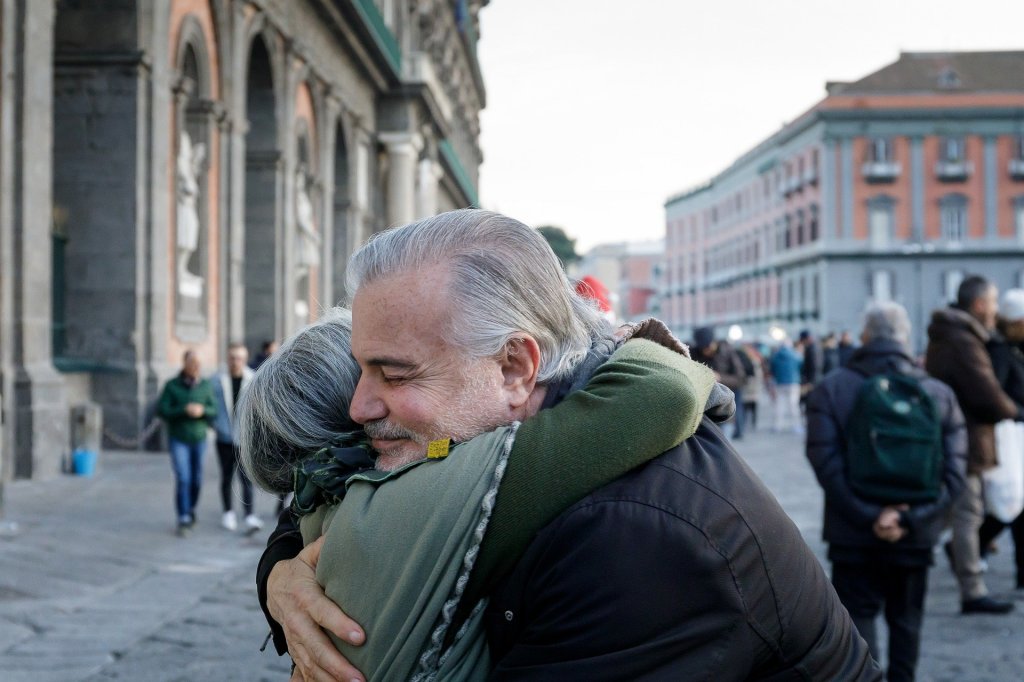
When Paul had finished speaking, he knelt down with all of them and prayed. They all wept as they embraced him and kissed him. What grieved them most was his statement that they would never see his face again. Then they accompanied him to the ship.

*       *       *

This is a different view of Paul. Mostly I’ve seen him as argumentative, arrogant even, insisting that he’s right and the others – whoever they are – are wrong. As someone who has occasionally had to present difficult truths to a reluctant public, I have sometimes frowned at Paul’s confrontational approach. It’s so much more effective to reframe the issue rather than simply argue against the others’ point of view.

At the same time, I’ve seen him as vastly dedicated, fearless, ready to dare anything, to suffer anything for the sake of the good news. Very admirable, but not very endearing. A man to respect rather than love, perhaps.

But look at verses 36 – 38.

“When Paul had finished speaking, he knelt down with all of them and prayed. They all wept as they embraced him and kissed him. What grieved them most was his statement that they would never see his face again. Then they accompanied him to the ship.”

The elders of the church at Ephesus embrace Paul, they kiss him. Most telling of all, they weep because he had told them he would never see his face again. Clearly, they loved Paul.

Paul himself explains a little.

“I served the Lord with great humility and tears”. Paul passionately desired the salvation of everyone with whom he came in contact.

“You know that I have not hesitated to preach anything that would be helpful to you but have taught you publicly and from house to house.” Paul has preached the word everywhere, in public and in private. If you met Paul, he would talk to you about Jesus; he would want to assure himself that you were as close to Jesus as you could be.

Paul cared for people – and people loved Paul.

Prayer

Heavenly Father

Thank you for the witness of your servant Paul. Thank you that the love he showed towards those round him expressed the love you feel for each one of us. Help us, in turn, to show your love to everybody we know.

In Jesus’ name, Amen.

Acts 20: 1 – 12 Through Macedonia and Greece & Eutychus raised from the dead at Troas

Acts 20: 1 – 12 Through Macedonia and Greece & Eutychus raised from the dead at Troas

When the uproar had ended, Paul sent for the disciples and, after encouraging them, said goodbye and set out for Macedonia. He travelled through that area, speaking many words of encouragement to the people, and finally arrived in Greece, where he stayed three months. Because some Jews had plotted against him just as he was about to sail for Syria, he decided to go back through Macedonia. He was accompanied by Sopater son of Pyrrhus from Berea, Aristarchus and Secundus from Thessalonika, Gaius from Derbe, Timothy also, and Tychicus and Trophimus from the province of Asia. These men went on ahead and waited for us at Troas. But we sailed from Philippi after the Festival of Unleavened Bread, and five days later joined the others at Troas, where we stayed seven days.

On the first day of the week we came together to break bread. Paul spoke to the people and, because he intended to leave the next day, kept on talking until midnight. There were many lamps in the upstairs room where we were meeting. Seated in a window was a young man named Eutychus, who was sinking into a deep sleep as Paul talked on and on. When he was sound asleep, he fell to the ground from the third storey and was picked up dead. Paul went down, threw himself on the young man and put his arms around him. ‘Don’t be alarmed,’ he said. ‘He’s alive!’ Then he went upstairs again and broke bread and ate. After talking until daylight, he left. The people took the young man home alive and were greatly comforted.

*       *       *

The last chapter was in Ephesus, and finished with an account of a riot instigated by the silversmith Demetrius against Paul. Although the civil authorities quelled the riot, it was clear that Paul’s presence was dangerous, so he encouraged the disciples and went to Macedonia. He spent some time there, going from place to place and encouraging the churches he had started, finishing in Greece where he stayed for three months.

He was about to travel by sea to Syria, but a plot caused him to change his plans and return via Macedonia.

“He was accompanied by Sopater son of Pyrrhus from Berea, Aristarchus and Secundus from Thessalonika, Gaius from Derbe, Timothy also, and Tychicus and Trophimus from the province of Asia.”

Why does St Luke give us a list of Paul’s companions on the journey?

Both St Luke’s gospel and the Acts of the Apostles, are addressed to Theophilus. The name Theophilus means ‘Friend of God’, or ‘Beloved of God’, or ‘Loving God’, and it could be either a form of address for anyone seeking the truth about God, or the name of a specific individual.

If it is the former, then the list of names in verse 4 may be Luke’s way of naming witnesses who could vouch for the truth of what he has written about Paul’s ministry. If the latter, Luke may be telling Theophilus that these people can be trusted.

It is important to remember that St Luke wrote his gospel and Acts in the expectation that Jesus would soon come again. He wrote for his contemporaries, and the people in this list in verse 4 would have been known to the other believers. They would have been alive and able to answer questions.

Eventually Paul and his companions reached Troas. The companions included Luke – note the word “we” in “But we sailed from Philippi after the Festival of Unleavened Bread…”.

And in Troas, a significant miracle may have occurred. A young man named Eutychus started to doze during Paul’s preaching. He was sitting in a window on the third floor. Gradually he went sound asleep – and fell out of the window.

Being on the third floor, he must have fallen at least 6 metres. It’s hard to imagine that he wasn’t at the very least seriously injured. The first people to examine him pronounced him dead. Paul, though, went down, threw himself on the young man and put his arms around him. ‘Don’t be alarmed,’ he said. ‘He’s alive!’”

Was Eutychus raised from the dead? It’s certainly possible that he wasn’t dead, and the text doesn’t say he was made whole, only that, The people took the young man home alive and were greatly comforted.”

Paul makes no claims for the healing. Luke does not state that Paul healed him, or raised him to life. Other raisings to life – Lazarus, Jairus’s daughter, the son of the widow of Nain, Tabitha – were different. It was clear in each case that a miracle had happened.

I feel very doubtful whether this event was miraculous. I think Eutychus was just…fortunate.

Prayer

Heavenly Father

You hold and sustain all life. Every day for every one of us is a miracle of life that you have given us. Thank you for my life, for the love that I have been fortunate enough to have been given and especially for the love of Jesus.

In Jesus’ name, Amen

Acts 19: 23 – 41 The riot in Ephesus

Acts 19: 23 – 41 The riot in Ephesus

About that time there arose a great disturbance about the Way. A silversmith named Demetrius, who made silver shrines of Artemis, brought in a lot of business for the craftsmen there. He called them together, along with the workers in related trades, and said: ‘You know, my friends, that we receive a good income from this business. And you see and hear how this fellow Paul has convinced and led astray large numbers of people here in Ephesus and in practically the whole province of Asia. He says that gods made by human hands are no gods at all. There is danger that not only will our trade lose its good name, but also that the temple of the great goddess Artemis will be discredited; and the goddess herself, who is worshipped throughout the province of Asia and the world, will be robbed of her divine majesty.’

When they heard this, they were furious and began shouting: ‘Great is Artemis of the Ephesians!’ Soon the whole city was in an uproar. The people seized Gaius and Aristarchus, Paul’s travelling companions from Macedonia, and all of them rushed into the theatre together. Paul wanted to appear before the crowd, but the disciples would not let him. Even some of the officials of the province, friends of Paul, sent him a message begging him not to venture into the theatre.

The assembly was in confusion: some were shouting one thing, some another. Most of the people did not even know why they were there. The Jews in the crowd pushed Alexander to the front, and they shouted instructions to him. He motioned for silence in order to make a defence before the people. But when they realised he was a Jew, they all shouted in unison for about two hours: ‘Great is Artemis of the Ephesians!’

The city clerk quietened the crowd and said: ‘Fellow Ephesians, doesn’t all the world know that the city of Ephesus is the guardian of the temple of the great Artemis and of her image, which fell from heaven? Therefore, since these facts are undeniable, you ought to calm down and not do anything rash. You have brought these men here, though they have neither robbed temples nor blasphemed our goddess. If, then, Demetrius and his fellow craftsmen have a grievance against anybody, the courts are open and there are proconsuls. They can press charges. If there is anything further you want to bring up, it must be settled in a legal assembly. As it is, we are in danger of being charged with rioting because of what happened today. In that case we would not be able to account for this commotion, since there is no reason for it.’ After he had said this, he dismissed the assembly.

*       *       *

Probably because I’m a writer, I like to read scriptural passages like today’s in the same way I would read a piece of fiction. And in this case, when I reached the end, I would ask, “Why did St Luke choose to include this in his account of the Acts of the Apostles?”

It’s a graphic piece of story-telling. We have conspirators plotting to silence Paul; the exploitation of religion and nationalism to enrage the citizens of Ephesus; a riot (I admire the way Luke puts us in the moment, with his description of the crowd chanting “Great is Artemis of the Ephesians,” over and over for hours!); and the heroism and diplomacy of the unnamed city clerk. And isn’t that striking? The city clerk faces down a large crowd of enraged and potentially violent people and sends them home – and we don’t even know his name!

Read in this way, this passage is a tribute to civic virtue, Roman-style. There is a system in place and easily available for citizens to get justice; “If, then, Demetrius and his fellow craftsmen have a grievance against anybody, the courts are open and there are proconsuls.” Just as important, there is a civic official whose concept of duty was to deal with the situation and ensure a peaceful resolution at whatever cost to himself.

So why did Luke include the story?

I think it was possibly to illustrate the nature of the threat faced by Paul and his co-workers. They are no longer facing spontaneous anger from individuals or small groups. It’s no longer only the Jews who reject his message. It’s organised opposition by people whose self-interest is threatened by Paul’s preaching of Jesus. They’ve taken care to ensure there is a solid coalition among those whose livelihood may be damaged. They deliberately appeal to the base motivations of nationalism and fanaticism. This is ruthless and dangerous.

In the case of the Ephesians, it was the worship of Artemis in the temple that brought prosperity, and which was undermined by Paul’s teaching. The worship of a false god wasn’t remotely compatible with Christianity. What false gods are there in my life that may compromise my faith in Jesus?

Prayer

Heavenly Father

Thank you for Jesus, whose life shows us what it means to love you, and to love each other. Please help me to follow him more obediently.

In Jesus’ name, Amen

Acts 19: 11 – 22 Paul in Ephesus – part 2

Acts 19: 11 – 22 Paul in Ephesus – part 2

God did extraordinary miracles through Paul, so that even handkerchiefs and aprons that had touched him were taken to those who were ill, and their illnesses were cured and the evil spirits left them.

Some Jews who went around driving out evil spirits tried to invoke the name of the Lord Jesus over those who were demon-possessed. They would say, ‘In the name of the Jesus whom Paul preaches, I command you to come out.’ Seven sons of Sceva, a Jewish chief priest, were doing this. One day the evil spirit answered them, ‘Jesus I know, and Paul I know about, but who are you?’ Then the man who had the evil spirit jumped on them and overpowered them all. He gave them such a beating that they ran out of the house naked and bleeding.

When this became known to the Jews and Greeks living in Ephesus, they were all seized with fear, and the name of the Lord Jesus was held in high honour. Many of those who believed now came and openly confessed what they had done. A number who had practised sorcery brought their scrolls together and burned them publicly. When they calculated the value of the scrolls, the total came to 50,000 drachmas. In this way the word of the Lord spread widely and grew in power.

After all this had happened, Paul decided to go to Jerusalem, passing through Macedonia and Achaia. ‘After I have been there,’ he said, ‘I must visit Rome also.’ He sent two of his helpers, Timothy and Erastus, to Macedonia, while he stayed in the province of Asia a little longer.

*       *       *

“Some Jews who went around driving out evil spirits tried to invoke the name of the Lord Jesus over those who were demon-possessed.”

The result was a disaster for them; they were beaten up by the possessed man, and fled his house naked and bleeding. Let’s compare this with another story in Luke’s gospel.

“’Master,’ said John, ‘we saw someone driving out demons in your name and we tried to stop him, because he is not one of us.’

‘Do not stop him,’ Jesus said, ‘for whoever is not against you is for you.’” (Luke 9: 49 – 50)

At first sight this seems contradictory, but is it? There are several different ways of comparing the two events.

What is going on in the story of the sons of Sceva? They try to cast out a demon by invoking the name of Jesus. This was Ephesus, and sorcery – as we see later in the chapter – was rife. When a sorcerer tried to invoke a spirit to do something – for example, to heal somebody – he thought of it in terms of having power over the spirit he invoked. So in this case, the sons of Sceva were trying to cast out demons by ‘controlling’ or ‘using’ the spirit of Jesus. In the case of the gospel story, however, Jesus endorsed the healer’s actions; although the man wasn’t one of the group of disciples closest to Jesus, he was witnessing to Jesus and that was what mattered.

Then, there is the motivation of those who were trying to cast out demons in Jesus’ name. The sons of Sceva may well have been expecting payment for the healing. We can assume, I think, from Jesus’ endorsement of the man mentioned in the gospel that he was doing it purely as a witness to Jesus. It is important for our hearts to be right before we even think of attempting prayer for healing.

Finally, another way of looking at the events is through the lens of what God wants to happen. Anyone who has had contact with a Christian healing ministry knows that prayer doesn’t always lead to physical healing. Before praying for healing, it is better to pray for guidance. Consider the raising of Tabitha from the dead.

“Peter sent them all out of the room; then he got down on his knees and prayed. Turning towards the dead woman, he said, ‘Tabitha, get up.’ She opened her eyes, and seeing Peter she sat up.” (Acts 9: 40)

Why did Peter pray? I believe it was so that he was completely sure that God wanted him to raise Tabitha.

What was God’s will in the attempt by the sons of Sceva and their failure to heal the demoniac? Look at the consequences. The populace of Ephesus had a stark sign against sorcery – and they heeded the warning.

“Many of those who believed now came and openly confessed what they had done. A number who had practised sorcery brought their scrolls together and burned them publicly. When they calculated the value of the scrolls, the total came to 50,000 drachmas. In this way the word of the Lord spread widely and grew in power.”

The big lesson that I take away from today’s reading is that it is God’s will, and God’s power expressed through Jesus. My role is to witness to that truth.

Prayer

Heavenly Father

Thank you for the life, death and resurrection of Jesus. Please help me to witness about Jesus, in whose name I pray.

Amen

Acts 19: 1 – 10 Paul in Ephesus – part 1

Acts 19: 1 – 10 Paul in Ephesus – part 1

While Apollos was at Corinth, Paul took the road through the interior and arrived at Ephesus. There he found some disciples and asked them, ‘Did you receive the Holy Spirit when you believed?’

They answered, ‘No, we have not even heard that there is a Holy Spirit.’

So Paul asked, ‘Then what baptism did you receive?’

‘John’s baptism,’ they replied.

Paul said, ‘John’s baptism was a baptism of repentance. He told the people to believe in the one coming after him, that is, in Jesus.’ On hearing this they were baptised in the name of the Lord Jesus. When Paul placed his hands on them, the Holy Spirit came on them, and they spoke in tongues and prophesied. There were about twelve men in all.

Paul entered the synagogue and spoke boldly there for three months, arguing persuasively about the kingdom of God. But some of them became obstinate; they refused to believe and publicly maligned the Way. So Paul left them. He took the disciples with him and had discussions daily in the lecture hall of Tyrranus. This went on for two years, so that all the Jews and Greeks who lived in the province of Asia heard the word of the Lord.

*        *        *

Greeks.

What does Luke mean when he refers to people as Greeks?

The territories through which Paul travelled were ruled by the Roman empire. Sometimes the Romans ruled directly but more often they used local leaders. Provided the taxes rolled into Rome’s treasury, and the province was kept stable, they weren’t too concerned who held day-to-day power.

Luke only refers specifically to Romans a few times, but he refers frequently to Greeks. He almost seems to use the description as a synonym for Gentile.

I think this is probably because Greek was the common language of countries surrounding the Mediterranean. Educated men and women would have spoken Greek as their first or second language in the same way that most people today speak English/American. Greek culture was also all-pervasive. The Romans had adopted Greek gods – the names were changed, but the characters and myths persisted. Greek philosophy underpinned intellectual life.

It’s interesting how many Greeks found Paul’s teaching attractive. Possibly that is to do with the Jewish ethical principles. Greek ethics were based more on philosophy than religion, but there is a good deal of common ground between Stoicism and Judaeo-Christian ethics.

There were Greek converts to Judaism in all the synagogues; it’s clear that Judaism was attractive to the Greek mind. Paul’s teaching of the Way (or Christianity as we now call it) differed from Judaism mainly through proclaiming Jesus as Messiah. However, it was also based on Jewish ethics – only without the emphasis on ritual purity.

Whenever Paul taught in the synagogue, eventually a core of Jews would take such exception to his message that he would be forced to leave. Possibly it was the removal of the need for ritual purity that caused the split? And at the same time this change to Judaism made it even more attractive to the Greeks, hence Paul’s success when he left the synagogue and taught elsewhere.

At all events, we have no requirements for ritual purity today. We have a much tougher challenge – to love our neighbour as ourself. May the knowledge of God’s love for us give us the strength to accept the challenge!

Prayer

Heavenly Father, thank you for the message preached by Paul. Thank you for the love you have for each one of us. Please help me to love my neighbour as myself.

In Jesus’ name, Amen