2 Thessalonians 1: 1 – 12 Thanksgiving and prayer

2 Thessalonians 1: 1 – 12 Thanksgiving and prayer

Paul, Silas and Timothy,

To the church of the Thessalonians in God our Father and the Lord Jesus Christ:

Grace and peace to you from God the Father and the Lord Jesus Christ.

We ought always to thank God for you, brothers and sisters, and rightly so, because your faith is growing more and more, and the love all of you have for one another is increasing. Therefore, among God’s churches we boast about your perseverance and faith in all the persecutions and trials you are enduring.

All this is evidence that God’s judgment is right, and as a result you will be counted worthy of the kingdom of God, for which you are suffering. God is just: he will pay back trouble to those who trouble you and give relief to you who are troubled, and to us as well. This will happen when the Lord Jesus is revealed from heaven in blazing fire with his powerful angels. He will punish those who do not know God and do not obey the gospel of our Lord Jesus. They will be punished with everlasting destruction and shut out from the presence of the Lord and from the glory of his might on the day he comes to be glorified in his holy people and to be marvelled at among all those who have believed. This includes you, because you believed our testimony to you.

With this in mind, we constantly pray for you, that our God may make you worthy of his calling, and that by his power he may bring to fruition your every desire for goodness and your every deed prompted by faith. We pray this so that the name of our Lord Jesus may be glorified in you, and you in him, according to the grace of our God and the Lord Jesus Christ.

*       *       *

First, an apology to those who read my blog regularly. I’m sorry not to post yesterday. I spent hours grappling with the passage, but I struggle with eschatological theology and found nothing encouraging I could write. That’s my fault, of course, as there’s plenty of encouragement to be found in the passage. I pray that God will help me to understand things better today, so that I may draw closer to Jesus.

And while I’m specifically addressing my readers, may I ask for feedback in the comments section, please? Positive, negative or just friendly, they would all be encouraging. I am sure that other people have insights that would be helpful to the understanding of us all.

*       *       *

“God is just: he will pay back trouble to those who trouble you and give relief to you who are troubled, and to us as well.”

Is this actually correct? Suppose one of those troubling the Thessalonians repents of doing so; will he be paid back with trouble? I don’t think he will, because his repentance will be met with forgiveness. God forgives the sins of everyone who repents and follows Jesus; that’s a key insight of our faith, isn’t it?

But perhaps this only applies to those who have failed to repent before the second coming of Jesus?

“This will happen when the Lord Jesus is revealed from heaven in blazing fire with his powerful angels.”

While that interpretation fits the words, it still means that recompense to the Thessalonians in terms of punishment of their persecutors will be incomplete.

“He will punish those who do not know God and do not obey the gospel of our Lord Jesus. They will be punished with everlasting destruction and shut out from the presence of the Lord and from the glory of his might on the day he comes to be glorified in his holy people and to be marvelled at among all those who have believed.”

Punishment is a difficult topic.

It doesn’t seem to deter, or be effective in changing people’s behaviour.

You might take the view that certain acts justify punishment by their nature, and for that you could look, perhaps, at Mosaic law.

But how would you decide guilt? What level of mental competence is required for someone to be guilty of murder, for example? Or, turning the question around, what level of mental competence is required to accept Jesus and be saved?

Punishment can have a function in society by placing the right to vengeance for a crime in the hands of society, thereby minimising personal revenge and vendetta. This seems to be how Paul is considering it in this passage. But how does this align with “Love your neighbour as yourself” (Matthew 22:39)? And with “If anyone slaps you on the right cheek, turn to them the other cheek also.” (Matthew 5: 39)? And with “Bless those who persecute you; bless and do not curse.” (Romans 12: 14)?

It seems to me there are difficulties in the concept of a wrathful God.

Am I suggesting that God doesn’t care about sin?

Certainly not!

Sin always has consequences, and they are often drastic. All human beings are prone to sin, and it takes the grace of God for us to improve.

I suggest that we need to start from the premise that God is love. Imagine a parent’s love, but perfect. Imagine the passion with which God experiences that love, wanting above anything else to save every one of his created children from the consequences of their mistakes and rebellion. In the ten commandments, he has given us laws that teach us how to avoid the worst of the damage to each other. However, he knows that laws can only reduce bad actions, not nurture good ones.

To nurture good actions requires love to be active in the world. To do this, God gave us Jesus, the example of supreme love, and he calls each one of us to follow Jesus in loving our fellow human beings. Is it not the case that the great insight of Christianity is that our motivation matters?

St Paul, in a different letter, wrote:

“If I speak in the tongues of men or of angels, but do not have love, I am only a resounding gong or a clanging cymbal. If I have the gift of prophecy and can fathom all mysteries and all knowledge, and if I have a faith that can move mountains, but do not have love, I am nothing. If I give all I possess to the poor and give over my body to hardship that I may boast, but do not have love, I gain nothing.” (1 Corinthians 13: 1 – 3)

I believe this is a far more accurate picture of God than the picture of a wrathful God painted by Paul in 2 Thessalonians.

Prayer

Heavenly Father

Thank you that you love us so very much. Thank you that we are your sons and daughters. Thank you for being close to me and guiding my thoughts today.

In Jesus’ name, Amen
1 Thessalonians 5: 12 – 28 Final instructions

1 Thessalonians 5: 12 – 28 Final instructions

Now we ask you, brothers and sisters, to acknowledge those who work hard among you, who care for you in the Lord and who admonish you. Hold them in the highest regard in love because of their work. Live in peace with each other. And we urge you, brothers and sisters, warn those who are idle and disruptive, encourage the disheartened, help the weak, be patient with everyone. Make sure that nobody pays back wrong for wrong, but always strive to do what is good for each other and for everyone else.

Rejoice always, pray continually, give thanks in all circumstances; for this is God’s will for you in Christ Jesus.

Do not quench the Spirit. Do not treat prophecies with contempt but test them all: hold on to what is good, reject every kind of evil.

May God himself, the God of peace, sanctify you through and through. May your whole spirit, soul and body be kept blameless at the coming of our Lord Jesus Christ. The one who calls you is faithful, and he will do it.

Brothers and sisters, pray for us. Greet all God’s people with a holy kiss. I charge you before the Lord to have this letter read to all the brothers and sisters.

The grace of our Lord Jesus Christ be with you.

*       *       *

This is Paul’s ‘wish list’ for the Thessalonians. It is the earliest teaching we have as to how the early church should live, dating from about 50 AD.

What an encouraging list it is!

Let me pick out a particularly helpful sentence: “Rejoice always, pray continually, give thanks in all circumstances; for this is God’s will for you in Christ Jesus.”

How often should we rejoice? Always!

How often should we pray? Continually!

Under what circumstances should we give thanks? Under all circumstances!

Look at the end of the sentence: “for this is God’s will for you in Christ Jesus.” These aren’t demands, they are promises.

We will rejoice as we accept our new life from God.

We will pray because we want to listen to our heavenly Father who loves us.

We will give thanks because God is moulding us into the people he wants us to become.

“Rejoice always, pray continually, give thanks in all circumstances; for this is God’s will for you in Christ Jesus.”

Prayer

Heavenly Father

Thank you that you wish to sanctify each of us through and through.

Thank you that you will keep us blameless at the coming of our Lord Jesus Christ.

Amen

1 Thessalonians 5: 1 – 11 The day of the Lord

1 Thessalonians 5: 1 – 11 The day of the Lord

Now, brothers and sisters, about times and dates we do not need to write to you, for you know very well that the day of the Lord will come like a thief in the night. While people are saying, ‘Peace and safety’, destruction will come on them suddenly, as labour pains on a pregnant woman, and they will not escape.

But you, brothers and sisters, are not in darkness so that this day should surprise you like a thief. You are all children of the light and children of the day. We do not belong to the night or to the darkness. So then, let us not be like others, who are asleep, but let us be awake and sober. For those who sleep, sleep at night, and those who get drunk, get drunk at night. But since we belong to the day, let us be sober, putting on faith and love as a breastplate, and the hope of salvation as a helmet. For God did not appoint us to suffer wrath but to receive salvation through our Lord Jesus Christ. He died for us so that, whether we are awake or asleep, we may live together with him. Therefore encourage one another and build each other up, just as in fact you are doing.

*       *       *

Once again we have an expectation of the second coming of Jesus, bringing destruction and wrath.

“…the day of the Lord will come like a thief in the night. While people are saying, ‘Peace and safety’, destruction will come on them suddenly … and they will not escape.”

“For God did not appoint us to suffer wrath but to receive salvation through our Lord Jesus Christ.”

This brings me up against a hard question.

Do I believe that God will come in wrath and punish multitudes of human beings?

I don’t like this question. I wriggle and look for a way out. However, I have to say – and I could be completely wrong – that I don’t believe in a wrathful God.

Will there be an accounting? Yes, I guess so. I think I shall be required to examine and accept the consequences of how I have lived my life. When I see the effects of some of my sins, I imagine I shall be filled with deep contrition. When my errors of understanding are made plain to me – and everyone else – I expect I shall feel extremely foolish.

I shall be profoundly grateful for God’s grace to rescue me from being overwhelmed by guilt, shame and regret.

How do I account for the scriptural emphasis on the wrath of God?

I don’t believe in the literal truth of the bible. I think it shows the development of the human understanding of God, culminating in the life, death and resurrection of Jesus. It is a compilation from many sources and was agreed by the church in the late 4th century AD.

The human understanding of the nature of God depends on the understanding of those who recorded the workings of God in the world – those who wrote the scriptures that make up the bible.

At the time Paul was writing, the world was governed by autocrats with pretty much absolute power. This applied not just to the Roman emperor, but to local rulers like Herod, who had John the Baptist executed without charge or trial.

It was a society where punishment was extreme. For example, when God miraculously released Peter from prison, Herod had his guards executed. (Acts 12: 19) The Acts of the Apostles makes no comment on this, except to record that it happened.

Paul and the gospel writers would have expected an autocrat to use his power; they knew draconian punishments could be handed out arbitrarily. Slave owning was widespread, and a master could punish his slaves pretty much as he chose.

God is, of course, the ultimate autocrat. It is not surprising that Paul and the gospel writers should imagine him responding to wrongdoing, or shortcomings, with violence.

Not surprising – but not necessarily accurate.

Prayer

Heavenly Father

If I have misunderstood your will in this matter, please do not let it lead others into error, and please correct me.

In Jesus’ name, Amen.

1 Thessalonians 4: 13 – 18 Believers who have died

1 Thessalonians 4: 13 – 18 Believers who have died

Brothers and sisters, we do not want you to be uninformed about those who sleep in death, so that you do not grieve like the rest of mankind, who have no hope. For we believe that Jesus died and rose again, and so we believe that God will bring with Jesus those who have fallen asleep in him. According to the Lord’s word, we tell you that we who are still alive, who are left until the coming of the Lord, will certainly not precede those who have fallen asleep. For the Lord himself will come down from heaven, with a loud command, with the voice of the archangel and with the trumpet call of God, and the dead in Christ will rise first. After that, we who are still alive and are left will be caught up together with them in the clouds to meet the Lord in the air. And so we will be with the Lord for ever. Therefore encourage one another with these words.

*       *       *

This passage shows clearly that the early church believed that the second coming of Jesus was imminent. Paul says, “…we tell you that we who are still alive, who are left until the coming of the Lord…”; I’m quite sure he didn’t expect to live for the almost 2000 years that have elapsed since he wrote this letter!

Many generations have lived since then; many people have died.

Do we grieve?

I think many of us do, when we lose someone dear to us.

Yet Paul’s teaching here is as valid today as it was then: “For we believe that Jesus died and rose again, and so we believe that God will bring with Jesus those who have fallen asleep in him.”

If we take this seriously, what need have we for grief? There will be separation for a period and then a joyful reuniting in the presence of our Lord.

Despite this faith, we feel sadness when we are bereaved. Partly it’s the loss of the person’s physical presence. Partly we regret the lost opportunities that they can no longer have – this is particularly the case when the person we have lost is young. Also, there may be personal issues that we wish we had settled before our friend or family member died.

Certainly bereavement is a big test of our faith.

We can only offer our little faith to God in the belief that he will make it sufficient, and remember the words that St Paul wrote at the end of this passage.

“And so we will be with the Lord for ever. Therefore encourage one another with these words.”

AMEN!

Prayer

Heavenly Father,

Thank you for the life, death and resurrection of Jesus. Please help my faith to grow until all my trust is in you.

In Jesus’ name, Amen

1 Thessalonians 4: 1 – 12 Living to please God

1 Thessalonians 4: 1 – 12 Living to please God

As for other matters, brothers and sisters, we instructed you how to live in order to please God, as in fact you are living. Now we ask you and urge you in the Lord Jesus to do this more and more. For you know what instructions we gave you by the authority of the Lord Jesus.

It is God’s will that you should be sanctified: that each of you should learn to control your own body in a way that is holy and honourable, not in passionate lust like the pagans, who do not know God; and that in this matter no one should wrong or take advantage of a brother or sister. The Lord will punish all those who commit such sins, as we told you and warned you before. For God did not call us to be impure, but to live a holy life. Therefore, anyone who rejects this instruction does not reject a human being but God, the very God who gives you his Holy Spirit.

Now about your love for one another we do not need to write to you, for you yourselves have been taught by God to love each other. And in fact, you do love all of God’s family throughout Macedonia. Yet we urge you, brothers and sisters, to do so more and more, and to make it your ambition to lead a quiet life: you should mind your own business and work with your hands, just as we told you, so that your daily life may win the respect of outsiders and so that you will not be dependent on anybody.

*       *       *

Once again, Paul commends the Thessalonians: “As for other matters, brothers and sisters, we instructed you how to live in order to please God, as in fact you are living.”

However, there is scope for them to do even better: “Now we ask you and urge you in the Lord Jesus to do this more and more.”

It would seem that the community has been disrupted by sexual sin, which seems to have involved the exploitation of one or more of the church members: “It is God’s will that you should be sanctified: that each of you should learn to control your own body in a way that is holy and honourable, not in passionate lust like the pagans, who do not know God; and that in this matter no one should wrong or take advantage of a brother or sister.”

Paul deals with this very discreetly. He doesn’t address those involved by name. Instead, he expresses his teaching in terms of the Jewish law, as a matter of purity or holiness. There is a nuance, though, that the NIV translation doesn’t catch.

Verse 6 in the NIV is translated as “and that in this matter no one should wrong or take advantage of a brother or sister.”

The King James translation is “That no man go beyond and defraud his brother in any matter: because that the Lord is the avenger of all such, as we also have forewarned you and testified.” The Greek uses words that are appropriate to business; the KJV recognises this, while the NIV translation doesn’t.

Verse 6 is right in the middle of the teaching on sexual ethics. What would it mean to “defraud a brother” under such circumstances? The obvious answer is sexual activity with his marriage partner. Paul is equating cheating in marriage with cheating in business – or theft.

Perhaps for the 21st century we need to acknowledge the particular emphases of both translations; the “cheating” element of the KJV and the reciprocal nature of the NIV where it says “brothers and sisters”. It’s wrong to cheat with someone else’s spouse.

I think, too, that it’s worth noting that the gospels record Jesus saying very little about sexual sin. He was far more concerned with hypocrisy and lack of love.

Perhaps, also, we should acknowledge here that the relationship between husband and wife is a very delicate matter. To take one’s marriage vows lightly would obviously be wrong – but matters such as domestic abuse don’t necessarily surface before marriage. Every case is different, and needs sensitive intervention rather than immediate condemnation. After all, even if sin is involved, God’s desire is to save the sinner not condemn them!

Paul, having dealt with that pastoral issue, returns to encouragement. He wants the Thessalonian church to win the respect of outsiders, by minding their own business and leading a quiet life. Good advice! A community who show unity, love for each other, and who work hard, are a good advertisement for their faith.

May we show such virtues in our life together as a church.

Prayer

Heavenly Father

Thank you for calling us to follow you. Please help us to witness to your love through the example of our lives.

In Jesus’ name, Amen

1 Thessalonians 3: 6 – 13 Timothy’s encouraging report

1 Thessalonians 3: 6 – 13 Timothy’s encouraging report

But Timothy has just now come to us from you and has brought good news about your faith and love. He has told us that you always have pleasant memories of us and that you long to see us, just as we also long to see you. Therefore, brothers and sisters, in all our distress and persecution we were encouraged about you because of your faith. For now we really live, since you are standing firm in the Lord. How can we thank God enough for you in return for all the joy we have in the presence of our God because of you? Night and day we pray most earnestly that we may see you again and supply what is lacking in your faith.

Now may our God and Father himself and our Lord Jesus clear the way for us to come to you. May the Lord make your love increase and overflow for each other and for everyone else, just as ours does for you. May he strengthen your hearts so that you will be blameless and holy in the presence of our God and Father when our Lord Jesus comes with all his holy ones.

*       *       *

“How can we thank God enough for you in return for all the joy we have in the presence of our God because of you?”

Joy.

That’s a very strong word. It’s stronger than pleasure, stronger than happiness, stronger than delight. There is a sense that things are exactly as they should be.

And yet Paul, who is writing this letter, is being persecuted. Furthermore, the people to whom he is writing are being persecuted; the Thessalonian church is facing temptation and attack.

We can expect opposition. We shouldn’t be surprised if opposition becomes persecution. When that happens, we can take the words of Paul as applying to us: “May the Lord make your love increase and overflow for each other and for everyone else.”

It really is the case that the only answer to hostility, attack and persecution is love – for each other – and for everyone else (including those carrying out the persecution).

Prayer

Heavenly Father

Thank you for all you are teaching me. Please help me to put what I learn into practice, to do your will.

In Jesus’ name, Amen

1 Thessalonians 2: 17 – 20, 3: 1 – 5 Paul’s longing to see the Thessalonians

1 Thessalonians 2: 17 – 20, 3: 1 – 5 Paul’s longing to see the Thessalonians

But, brothers and sisters, when we were orphaned by being separated from you for a short time (in person, not in thought), out of our intense longing we made every effort to see you. For we wanted to come to you – certainly I, Paul, did, again and again – but Satan blocked our way. For what is our hope, our joy, or the crown in which we will glory in the presence of our Lord Jesus when he comes? Is it not you? Indeed you are our glory and joy.

So when we could stand it no longer, we thought it best to be left by ourselves in Athens. We sent Timothy, who is our brother and co-worker in God’s service in spreading the gospel of Christ, to strengthen and encourage you in your faith, so that no one would be unsettled by these trials. For you know quite well that we are destined for them. In fact, when we were with you, we kept telling you that we would be persecuted. And it turned out that way, as you well know. For this reason, when I could stand it no longer, I sent to find out about your faith. I was afraid that in some way the tempter had tempted you and that our labours might have been in vain.

*       *       *

“For we wanted to come to you – certainly I, Paul, did, again and again – but Satan blocked our way.”

Paul writes this with great conviction, but how does he know it was Satan blocking his way?

Let’s assume that Satan exists and plays an active role in the world. How might he be stopping Paul from visiting the Thessalonians?

Perhaps Satan is stirring up hostility against Paul among the Jewish community in Thessalonica making a visit hazardous? But if that’s the case, why would he want to prevent Paul’s visit? Paul would be vulnerable there. The Jewish community have shown that they would like Paul dead. Wouldn’t that be easier to achieve in Thessalonica than in Athens?

Perhaps he is repeatedly thwarting Paul’s travel plans? If Paul isn’t there, it would be easier for Satan to tempt the Thessalonians into sin. If that were the case, wouldn’t that make Paul’s visit essential? Would God not be able to defeat Satan about this?

I find it very difficult to believe in Satan’s existence. That’s not to say I don’t believe evil exists, because it quite plainly does. However, human selfishness, greed, lust and cruelty seem quite sufficient to account for deliberate evil.

What about suffering that seems to come about at random? Is that evidence of an evil force? Personally I don’t think so. We increasingly understand the mechanisms by which disasters happen, whether they are hurricanes, earthquakes, volcanic eruptions – or, indeed, Covid pandemics. For some of them we can even do things to reduce their impact. They are natural phenomena.

What is surely much more significant is the love between Paul and the Thessalonians. On a human level, Paul misses his friends, referring to the experience as “when we were orphaned by being separated from you for a short time.” Even more importantly, Paul seeks to be a channel of God’s love for the Thessalonians as they come under persecution: “We sent Timothy, who is our brother and co-worker in God’s service in spreading the gospel of Christ, to strengthen and encourage you in your faith, so that no one would be unsettled by these trials.”

We live in a natural world, a world of beauty as well as suffering. We are creatures who can appreciate the beauty; we are creatures who can praise our Creator; we are creatures through whom our Creator can work. We are flawed – we need his help every step of the way – and he graciously gives it.

Thanks be to God!

Prayer

Heavenly Father

Thank you for your love for us. Thank you for giving us the capacity to experience your love, and to share it with others.

In Jesus’ name, Amen

1 Thessalonians 2: 1 – 16 Paul’s ministry in Thessalonica

1 Thessalonians 2: 1 – 16 Paul’s ministry in Thessalonica

You know, brothers and sisters, that our visit to you was not without results. We had previously suffered and been treated outrageously in Philippi, as you know, but with the help of our God we dared to tell you his gospel in the face of strong opposition. For the appeal we make does not spring from error or impure motives, nor are we trying to trick you. On the contrary, we speak as those approved by God to be entrusted with the gospel. We are not trying to please people but God, who tests our hearts. You know we never used flattery, nor did we put on a mask to cover up greed – God is our witness. We were not looking for praise from people, not from you or anyone else, even though as apostles of Christ we could have exerted our authority. Instead we were like young children among you.

Just as a nursing mother cares for her children, so we cared for you. Because we loved you so much, we were delighted to share with you not only the gospel of God but our lives as well. Surely you remember, brothers and sisters, our toil and hardship; we worked night and day in order not to be a burden to anyone while we preached the gospel of God to you. You are witnesses, and so is God, of how holy, righteous and blameless we were among you who believed. For you know that we dealt with each of you as a father deals with his own children, encouraging, comforting and urging you to live lives worthy of God, who calls you into his kingdom and glory.

And we also thank God continually because, when you received the word of God, which you heard from us, you accepted it not as a human word, but as it actually is, the word of God, which is indeed at work in you who believe. For you, brothers and sisters, became imitators of God’s churches in Judea, which are in Christ Jesus: you suffered from your own people the same things those churches suffered from the Jews who killed the Lord Jesus and the prophets and also drove us out. They displease God and are hostile to everyone in their efforts to keep us from speaking to the Gentiles so that they may be saved. In this way they always heap up their sins to the limit. The wrath of God has come upon them at last.

*       *       *

What is going on in this chapter? Paul appears to be defending himself against attacks on his integrity and his motives. He denies five separate charges:

  • For the appeal we make does not spring from error or impure motives;
  • nor are we trying to trick you;
  • We are not trying to please people but God, who tests our hearts;
  • You know we never used flattery;
  • nor did we put on a mask to cover up greed.

Who makes these accusations?

We’re not told explicitly. It surely can’t be the Thessalonian Christians themselves, because Paul has spent the whole of chapter 1 telling them how well they are doing.

The answer is given by implication:

  • We had previously suffered and been treated outrageously in Philippi;
  • you suffered from your own people the same things those churches suffered from the Jews who killed the Lord Jesus and the prophets and also drove us out;
  • They displease God and are hostile to everyone in their efforts to keep us from speaking to the Gentiles so that they may be saved.

Thessalonica wasn’t far from Philippi, where the Jews had publicly (and illegally) flogged Paul and Silas. The Jews in Thessalonica had started a riot against the presence of Paul in their city, and had caused their host to be arrested. I think it’s a safe guess that Paul was the subject of a whispering campaign by those Jews who hadn’t accepted his teaching about the Lord Jesus.

So Paul reminds the Thessalonian Christians:

  • Just as a nursing mother cares for her children, so we cared for you.
  • Because we loved you so much, we were delighted to share with you not only the gospel of God but our lives as well.
  • Surely you remember, brothers and sisters, our toil and hardship; we worked night and day in order not to be a burden to anyone while we preached the gospel of God to you.

He concludes his defence by once again encouraging them:

And we also thank God continually because, when you received the word of God, which you heard from us, you accepted it not as a human word, but as it actually is, the word of God, which is indeed at work in you who believe.

When we accept Jesus as the risen Messiah we accept the word of God, and it will work in our hearts to save us.

HALLELUJAH!

Prayer

Heavenly Father

Thank you for sending Jesus as our Saviour. Thank you for your Holy Spirit working within us to make us more like Jesus. Please help me to be alert to his words and obedient to your will.

In Jesus’ name, Amen

The Epistles. 1 Thessalonians – Chapter 1

The Epistles. 1 Thessalonians – Chapter 1

Paul, Silas and Timothy,

To the church of the Thessalonians in God the Father and the Lord Jesus Christ:

Grace and peace to you.

We always thank God for all of you and continually mention you in our prayers. We remember before our God and Father your work prompted by faith, your labour prompted by love, and your endurance inspired by hope in our Lord Jesus Christ.

For we know, brothers and sisters loved by God, that he has chosen you, because our gospel came to you not simply with words but also with power, with the Holy Spirit and deep conviction. You know how we lived among you for your sake. You became imitators of us and of the Lord, for you welcomed the message in the midst of severe suffering with the joy given by the Holy Spirit. And so you became a model to all believers in Macedonia and Achaia. The Lord’s message rang out from you not only in Macedonia and Achaia – your faith in God has become known everywhere. Therefore we do not need to say anything about it, for they themselves report what kind of reception you gave us. They tell how you turned to God from idols to serve the living and true God, and to wait for his Son from heaven, whom he raised from the dead – Jesus, who rescues us from the coming wrath.

*       *       *

The epistles (or letters) are the earliest writings we have about the Christian faith, and 1 Thessalonians is the earliest of the epistles. It probably dates from about 50 AD. It was written by St Paul, when he was living in Athens, to the church in Thessalonica that he had recently established.

It’s a very encouraging letter. Paul commends the Thessalonians, saying that he thanks God for “your work prompted by faith, your labour prompted by love, and your endurance inspired by hope in our Lord Jesus Christ.” He tells them that the churches in Macedonia and Achaia look up to them as a model.

Paul then tells them why he was confident that God had called them.

“For we know, brothers and sisters loved by God, that he has chosen you, because our gospel came to you not simply with words but also with power, with the Holy Spirit and deep conviction.”

There are a number of places in Acts where baptism with the Holy Spirit is described, and the experience is plainly completely distinctive.

The first occasion was Pentecost:

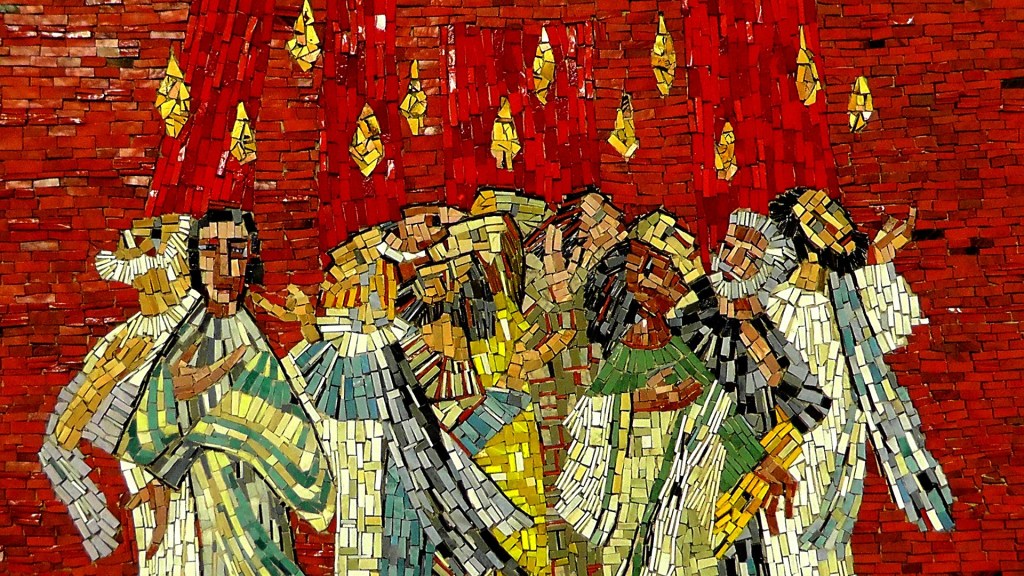
“When the day of Pentecost came, they were all together in one place. Suddenly a sound like the blowing of a violent wind came from heaven and filled the whole house where they were sitting. They saw what seemed to be tongues of fire that separated and came to rest on each of them. All of them were filled with the Holy Spirit and began to speak in other tongues as the Spirit enabled them.” (Acts 2: 1 – 4)

On another occasion, Philip (one of the deacons of the church, and not an apostle) had been preaching and baptising in Samaria:

“When the apostles in Jerusalem heard that Samaria had accepted the word of God, they sent Peter and John to Samaria. When they arrived, they prayed for the new believers there that they might receive the Holy Spirit, because the Holy Spirit had not yet come on any of them; they had simply been baptised in the name of the Lord Jesus. Then Peter and John placed their hands on them, and they received the Holy Spirit.” (Acts 8: 14 – 17)

When Peter visited the house of Cornelius, a Gentile, he preached about Jesus and the forgiveness of sins:

“While Peter was still speaking these words, the Holy Spirit came on all who heard the message. The circumcised believers who had come with Peter were astonished that the gift of the Holy Spirit had been poured out even on Gentiles. For they heard them speaking in tongues and praising God.” (Acts 10: 44 – 46)

Paul tells us about one outcome of the new life brought by the Holy Spirit “…you welcomed the message in the midst of severe suffering with the joy given by the Holy Spirit.”

Some of the Jews in Thessalonica believed what Paul was telling them, but most did not. They had started a riot, and had Paul’s host, Jason, arrested. Doubtless they took other actions against those who believed and accepted Jesus as Lord. They would almost certainly have barred them from the synagogue, which would have made earning a living more difficult. They could have imprisoned them, possibly had them flogged.

And yet the new converts welcomed the message with joy!

Prayer

Heavenly Father

Thank you for the gift of the Holy Spirit. Help us to always be obedient to his promptings.   

In Jesus name, Amen

Reflections on Acts – Part 3

Reflections on Acts – part 3

The passages covered in these reflections describe the way in which the Holy Spirit worked within the early church. They suggest how the church today could be renewed by God. Note, though – and it’s important – St Luke, when he wrote the words in the Acts of the Apostles, was not prescriptive. He was not writing a “how to” guide. Neither should these reflections be read in that way.

Acts 11: 1 – 18

The apostles and the believers throughout Judea heard that the Gentiles also had received the word of God. So when Peter went up to Jerusalem, the circumcised believers criticised him and said, ‘You went into the house of uncircumcised men and ate with them.’

Starting from the beginning, Peter told them the whole story: I was in the city of Joppa praying, and in a trance I saw a vision. I saw something like a large sheet being let down from heaven by its four corners, and it came down to where I was. I looked into it and saw four-footed animals of the earth, wild beasts, reptiles and birds. Then I heard a voice telling me, “Get up, Peter. Kill and eat.”

‘I replied, “Surely not, Lord! Nothing impure of unclean has ever entered my mouth.”

‘The voice spoke from heaven a second time, “Do not call anything impure that God has made clean.” This happened three times, and then it was all pulled up to heaven again.

‘Right then three men who had been sent to me from Caesarea stopped at the house where I was staying. The Spirit told me to have no hesitation about going with them. These six brothers also went with me, and we entered the man’s house. He told us how he had seen an angel appear in his house and say, “Send to Joppa for Simon who is called Peter. He will bring you a message through which you and all your household will be saved.”

‘As I began to speak, the Holy Spirit came on them as he had come on us at the beginning. Then I remembered what the Lord had said: “John baptised with water, but you will be baptised with the Holy Spirit.” So if God gave them the same gift he gave us who believed in the Lord Jesus Christ, who was I to think that I could stand in God’s way?’

When they heard this, they had no further objections and praised God, saying, ‘So then, even to Gentiles God has granted repentance that leads to life.’

*       *       *

This passage, in which Peter accounts for his actions in the house of Cornelius, marks the point at which the early church ceases to be a sect within Judaism and becomes the Christian church.

It has some important lessons for us today.

The episode started with prayer. Peter was praying. What was he praying about? Well, we don’t know, but it wouldn’t be surprising if he was asking for guidance as to what God wanted him to do next.

As a church, are we praying regularly for guidance as to our future actions? How many of our people pray regularly that our church community should receive guidance from God? Are we listening for answers?

Peter had experienced the giving of the Holy Spirit at Pentecost. He knew what the experience was like, and Peter was receptive to what the Holy Spirit had to say to him and to show him. He paid attention even though at first he didn’t understand the message.

As a church, are we aware of the work of the Holy Spirit in our lives? Do we pay attention to what the Holy Spirit is telling us?

When the Holy Spirit prompted Peter to go with the visitors, Peter was obedient. Likewise, Cornelius was obedient when he sent people to Peter.

It is essential that we act when we recognise what the Holy Spirit is saying to us. If we are not obedient, we oppose God’s plan.

The Holy Spirit validated the whole experience, firstly by the way his guidance made sense of God’s plan – all the actions were appropriate and at the right time – and secondly by the miraculous confirmation that the gift of the Holy Spirit was given to the Gentiles.

If we, as a church, look for the work of the Holy Spirit in our midst, his validation will teach us how to recognise when he is speaking to us.

Peter testified to the apostles and believers about his experience. This broadened the outlook of the believers, and was a vital step in the growth of the Christian church.

How often do we as a church give testimonies about the work of God in our midst?

St Luke reported this event in the Acts of the Apostles, and we’re reading it today, and being encouraged.

Do we keep a written record in our church of the work of God in our midst?

Prayer

Heavenly Father

Thank you for the gift of your Holy Spirit. Please help me to listen more carefully, to act on what I hear, and to be ready to share my experience of your work in my life.

In Jesus’ name, Amen

*       *       *

Acts 11: 19 – 30

During this time some prophets came down from Jerusalem to Antioch. One of them, named Agabus, stood up and through the Spirit predicted that a severe famine would spread over the entire Roman world. (This happened during the reign of Claudius.) The disciples, as each one was able, decided to provide help for the brothers and sisters living in Judea. This they did, sending their gift to the elders by Barnabas and Saul.

There was a prophet named Agabus from the church in Jerusalem. Through the Holy Spirit he predicted a severe famine throughout the Roman world. There was in fact a severe famine in Syria in 46/47 AD, and it was sufficiently widespread to be recorded by contemporary historians. Josephus, Suetonius and Tacitus all refer to it.

This apparent confirmation doesn’t really tell us very much, because we don’t have sufficient evidence to date Acts reliably. Its importance lies in what it teaches us about prophecy.

We have been told about a Jewish sorcerer and false prophet named Simon Acts 8: 9 – 24. The story about Agabus is to show us how prophecy should really be done.

The thing is, biblical prophecy is quite different from clairvoyance or second sight or any other supernatural attempts to see the future. It’s always inspired by the Holy Spirit and it always prompts actions that implement God’s plan. In this case, hearing of the predicted famine, “the disciples, as each one was able, decided to provide help for the brothers and sisters living in Judea. This they did, sending their gift to the elders by Barnabas and Saul.”

God wanted the Antioch Christians to have the opportunity to help their brothers and sisters in Judea. It was a demonstration of how Christian churches should support each other in times of hardship. It was clearly part of God’s plan.

*       *       *

Acts 12: 1 – 19

It was about this time that King Herod arrested some who belonged to the church, intending to persecute them. He had James, the brother of John, put to death with the sword. When he saw that this met with approval among the Jews, he proceeded to seize Peter also.. This happened during the Festival of Unleavened Bread. After arresting him, he put him in prison, handing him over to be guarded by four squads of four soldiers each. Herod intended to bring him out for public trial after the Passover.

So Peter was kept in prison, but the church was earnestly praying to God for him. The night before Herod was to bring him to trial, Peter was sleeping between two soldiers, bound with two chains, and sentries stood guard at the entrance. Suddenly an angel of the Lord appeared and a light shone in the cell. He struck Peter on the side and woke him up. ‘Quick, get up!’ he said, and the chains fell off Peter’s wrists.

Then the angel said to him, ‘Put on your clothes and sandals.’ And Peter did so. ‘Wrap your cloak round you and follow me,’ the angel told him. Peter followed him out of the prison, but he had no idea that what the angel was doing was really happening; he thought he was seeing a vision. They passed the first and second guards and came to the iron gate leading to the city. It opened for them by itself, and they went through it. When they had walked the length of one street, suddenly the angel left him.

Then Peter came to himself and said, ‘Now I know without a doubt that the Lord has sent his angel and rescued me from Herod’s clutches and from everything the Jewish people were hoping would happen.’

When this had dawned on him, he went to the house of Mary the mother of John, also called Mark, where many people had gathered and were praying.. Peter knocked at the outer entrance, and a servant named Rhoda came to open the door. When she recognised Peter’s voice, she was so overjoyed she ran back without opening it and exclaimed, ‘Peter is at the door!’

‘You’re out of your mind,’ they told her. When she kept insisting that it was so, they said, ‘It must be his angel.’

But Peter kept on knocking, and when they opened the door and saw him, they were astonished. Peter motioned with his hand for them for them to be quiet and described how the Lord had brought him out of prison. ‘Tell James and the other brothers and sisters about this,’ he said, and then he left for another place.

In the morning, there was no small commotion among the soldiers as to what had become of Peter. After Herod had a thorough search made for him and did not find him, he cross-examined the guards and ordered that they be executed.

Peter had just been miraculously rescued by God from imprisonment and probable martyrdom. His confidence in God was so great that instead of going immediately to a place of safety, he went to the house of Mary, the mother of John Mark. He knew that the believers would have gathered there to pray for him, and he wanted to show them that their prayers had been answered.

How did the believers receive Peter? They had been praying earnestly for him. There was a knocking on the door. Rhoda went to the door and heard Peter’s voice. Leaving the door closed, she ran into the assembly and called out the joyful news. And the brothers and sisters didn’t believe it! They didn’t believe the answer to prayer, even when one of their own number shouted it out loud! How would they ever believe the promptings of the Holy Spirit?

In this instance they were constrained by the wisdom of this world, and as a result they were in chains.

Peter trusted in God, and was familiar with the Holy Spirit. When the Holy Spirit spoke to him, it was as real as daily life. Peter lived by the wisdom of God. Chains, iron doors and guards were no barrier to the power of God to set him free. God had much more work for Peter to do, and Peter was ready to do it!